
Let me tell you something most blogging guides won’t.
I made zero dollars in my first year of blogging.
Not $50. Not $200. Not the “modest but encouraging $847 in month 6” that income reports love to tease. Zero. And for a long time, I thought that meant I was failing.
I wasn’t. But what to expect first year of blogging was something nobody had prepared me for honestly – not the timelines, not the silence, not the specific kind of work that actually builds something real versus the kind that keeps you busy without building anything at all.
This post is part of the how to start a business blog: blueprint for building a real digital asset in 2026 the full strategic framework behind everything I’m covering here. If you’re in your first year right now and wondering whether any of this is working, read what follows before you make any decisions.
📌 Reality CheckIf you expect to quit your job or earn significant income during your first year of blogging, this guide will probably disappoint you.
Most successful blogs spend their first year building content, topical authority, search visibility, and publishing systems—not generating substantial revenue. If your goal is to build a long-term digital asset that compounds year after year, you’re reading the right guide.
Here is the honest, documented account of what my first year actually looked like – month by month, failure by failure, and what I built instead of an income.
The blogging timeline first year expected results – what actually happened in my 12 months
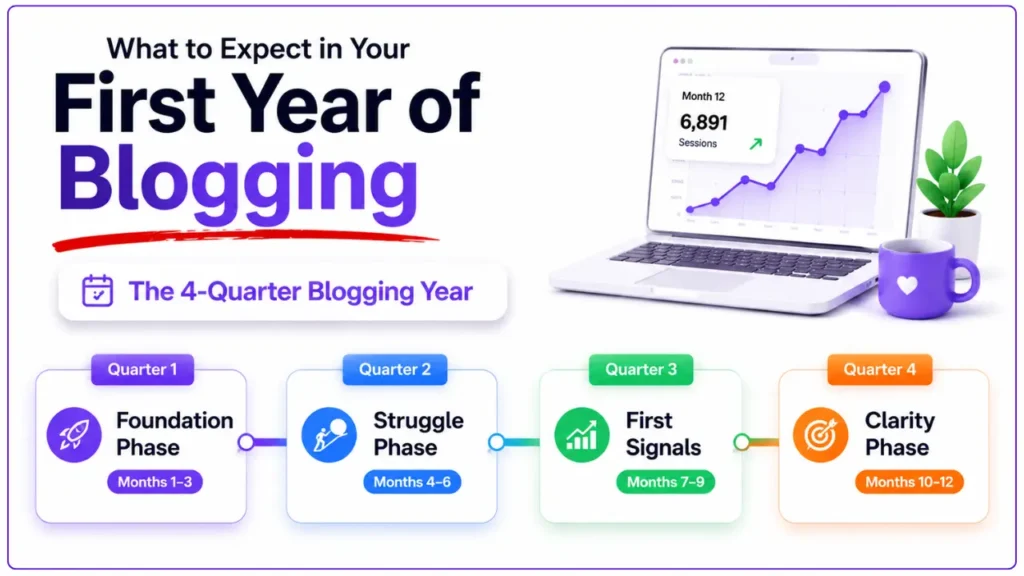
The blogging timeline first year expected results for most beginners follows four distinct phases – Foundation (months 1-3), Struggle (months 4-6), First Signals (months 7-9), and Clarity (months 10-12). Income in year one is typically zero to minimal. What compounds is infrastructure, systems, and authority — not revenue.
I call this the 4-Quarter Blogging Year and understanding which quarter you’re in changes everything about how you interpret what’s happening.
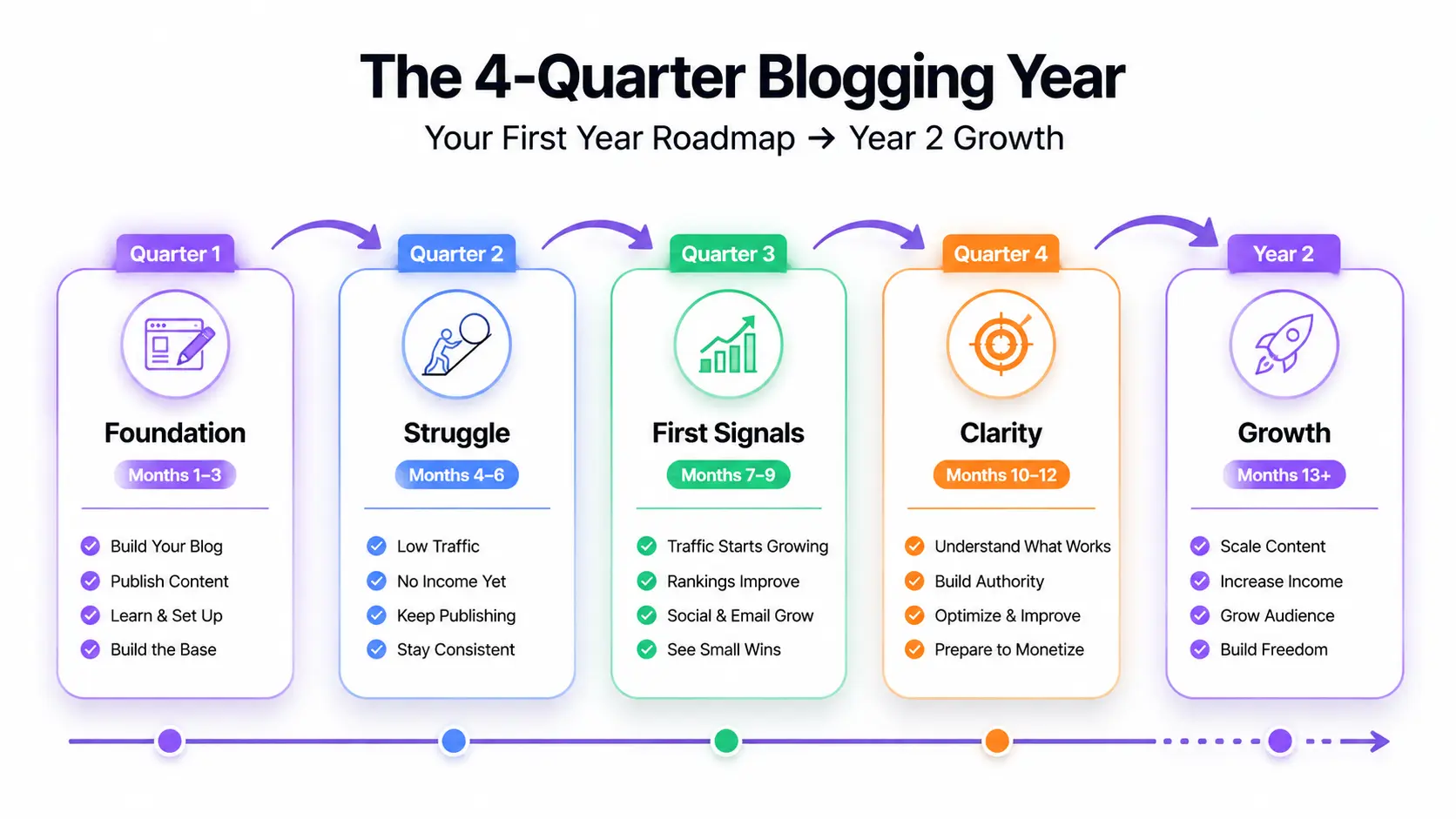
Quarter 01 – Months 1-3 : The foundation phase
This is where everything feels exciting and nothing works.
You’re choosing your niche, buying your domain, setting up WordPress, writing your first posts, and publishing into what feels like a void. No traffic. No comments. No validation that any of it is working.
Here’s what was actually happening in my Q1:
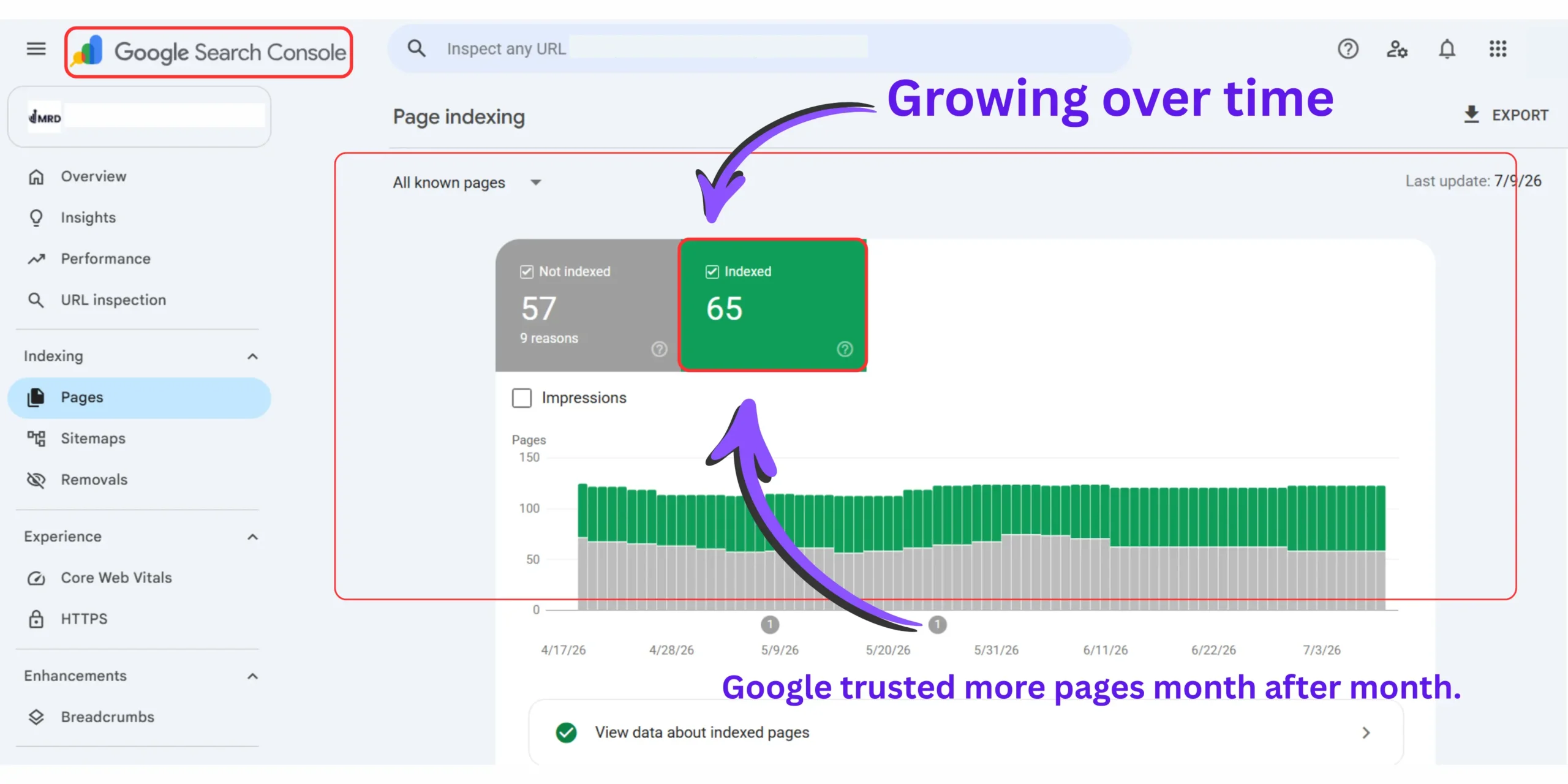
I spent weeks second-guessing my niche before I found the framework in how specific should a blog niche be? 5 warning signs your blog niche is too broad that finally gave me clarity. I rebuilt my homepage twice before learning how to design a blog homepage in WordPress without coding the right way. I published 11 posts in three months. My total traffic: 214 sessions.
The most important Q1 resource I wish I had from day one was a clear definition of what is quality content for a new blog – because I was publishing volume without understanding the depth standard that actually earns rankings.
The Q1 truth : Nothing is broken. This is exactly what the foundation phase looks like. Your only job is to build the structure, understand your reader, and stay consistent.
✅ Quarter 1 Progress ChecklistBy the end of Quarter 1 (Months 1–3), you should have completed these core foundation milestones before expecting meaningful traffic.
Quarter 02 – Months 4-6 : The struggle phase
This is where most bloggers quit.
Traffic is still minimal. The posts you published in Q1 are ranking somewhere between pages 3 and 11 of Google. Your enthusiasm from launch is wearing off, and the gap between the effort you’re investing and the results you’re seeing feels unsustainable.
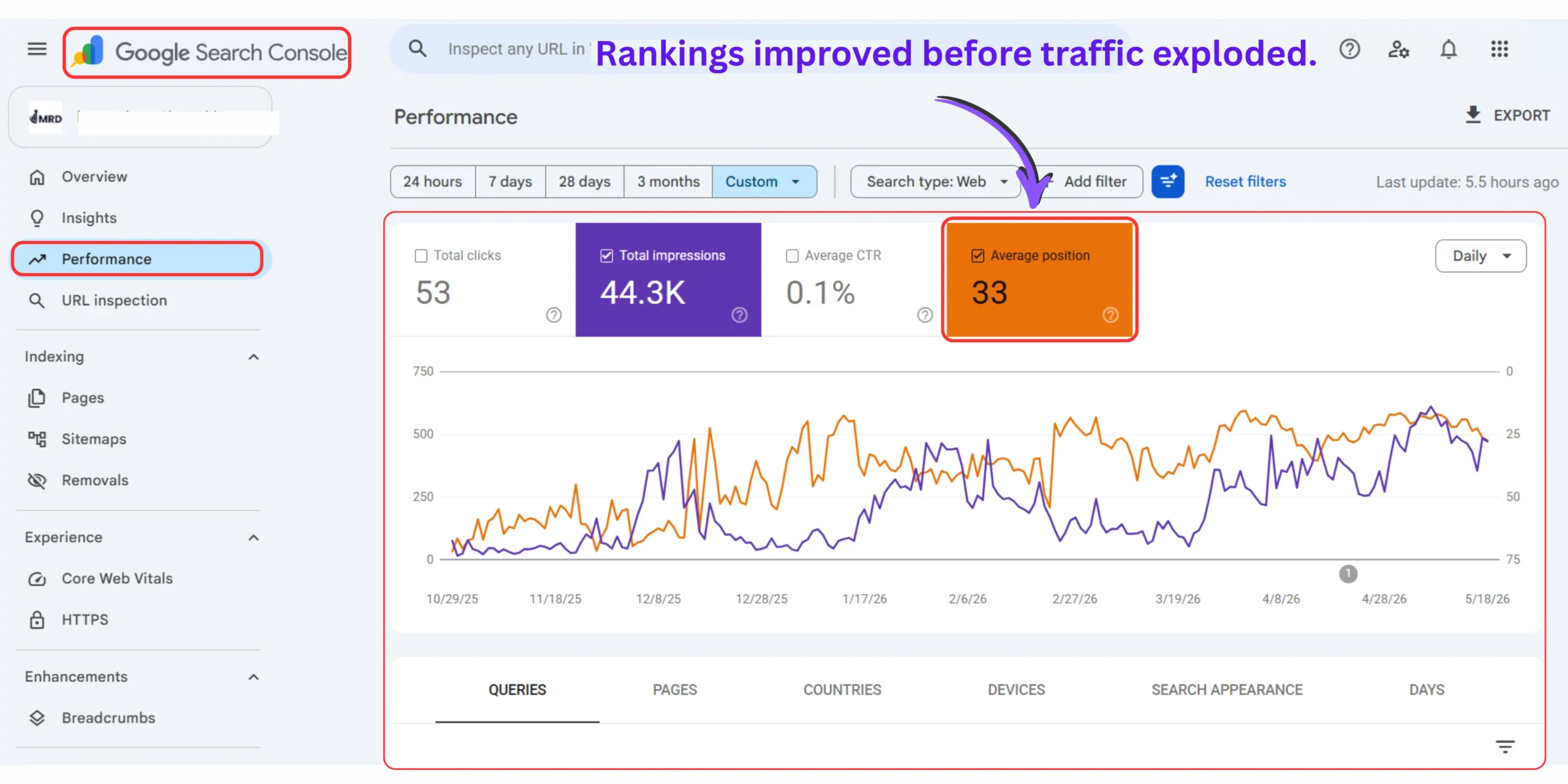
My month 4 traffic: 389 sessions. Month 5: 511 sessions. Month 6: 687 sessions.
Those numbers felt embarrassing when I looked at them. Now I understand they were entirely normal. New domains typically take 6-12 months to build enough authority for competitive keyword rankings.
The sessions I was accumulating weren’t failures – they were Google evaluating whether my content was worth investing ranking authority in.
The Q2 psychological trap is treating low traffic as evidence that blogging doesn’t work. It isn’t. It’s evidence that you’re in the phase where the work is underground – like roots forming before anything breaks the surface.
Why your blog is not getting traffic after 06 months is the exact question I was asking at month 6. Understanding that the answer was structural – not a content failure – was what kept me going. And why most blogs fail before making money documents the specific mindset error that causes most bloggers to abandon their blog precisely when it’s closest to breaking through.
The Q2 income psychology matters enormously here. Early income psychology for beginner bloggers covers the exact mental framework for staying motivated when the numbers don’t validate the effort – which is most of Q2 for almost every beginner.
✅ Quarter 2 Progress ChecklistBy the end of Quarter 2 (Months 4–6), your goal isn’t rapid growth—it’s proving consistency to both Google and yourself. Complete these milestones before worrying about significant traffic.
Quarter 03 – Months 7-9 : First signals
Something shifts in Q3.
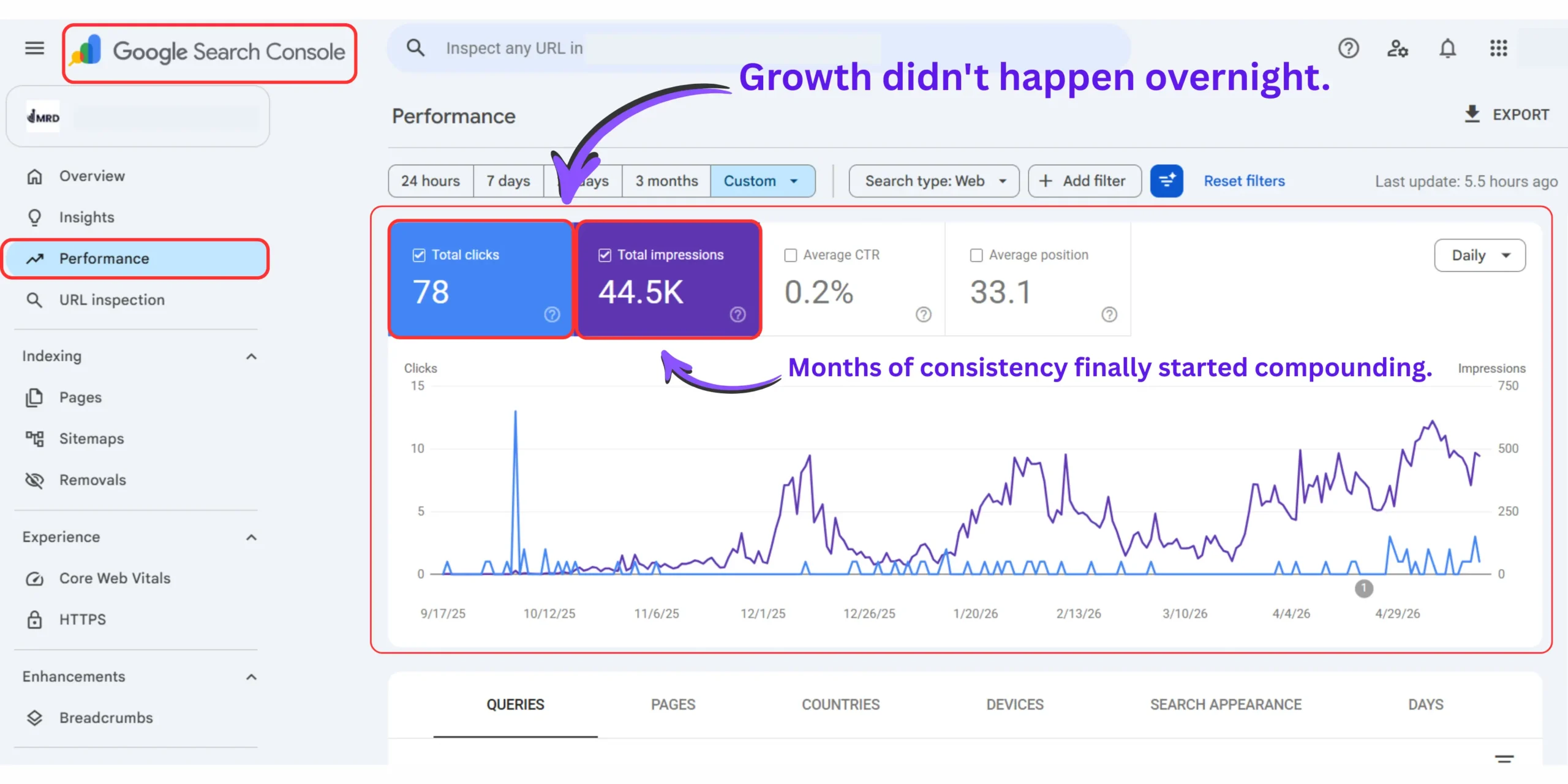
It’s not dramatic. It’s not a traffic explosion. But you start seeing evidence that the foundation work is compounding.
My month 7 traffic: 1,247 sessions. Month 8: 1,891 sessions. Month 9: 2,634 sessions.
Those numbers still weren’t generating income. But they were telling me something critical: the content I had published in Q1 and Q2 was beginning to rank. Posts I had written four months earlier were suddenly appearing on page 1 for long-tail queries I had almost forgotten I targeted.
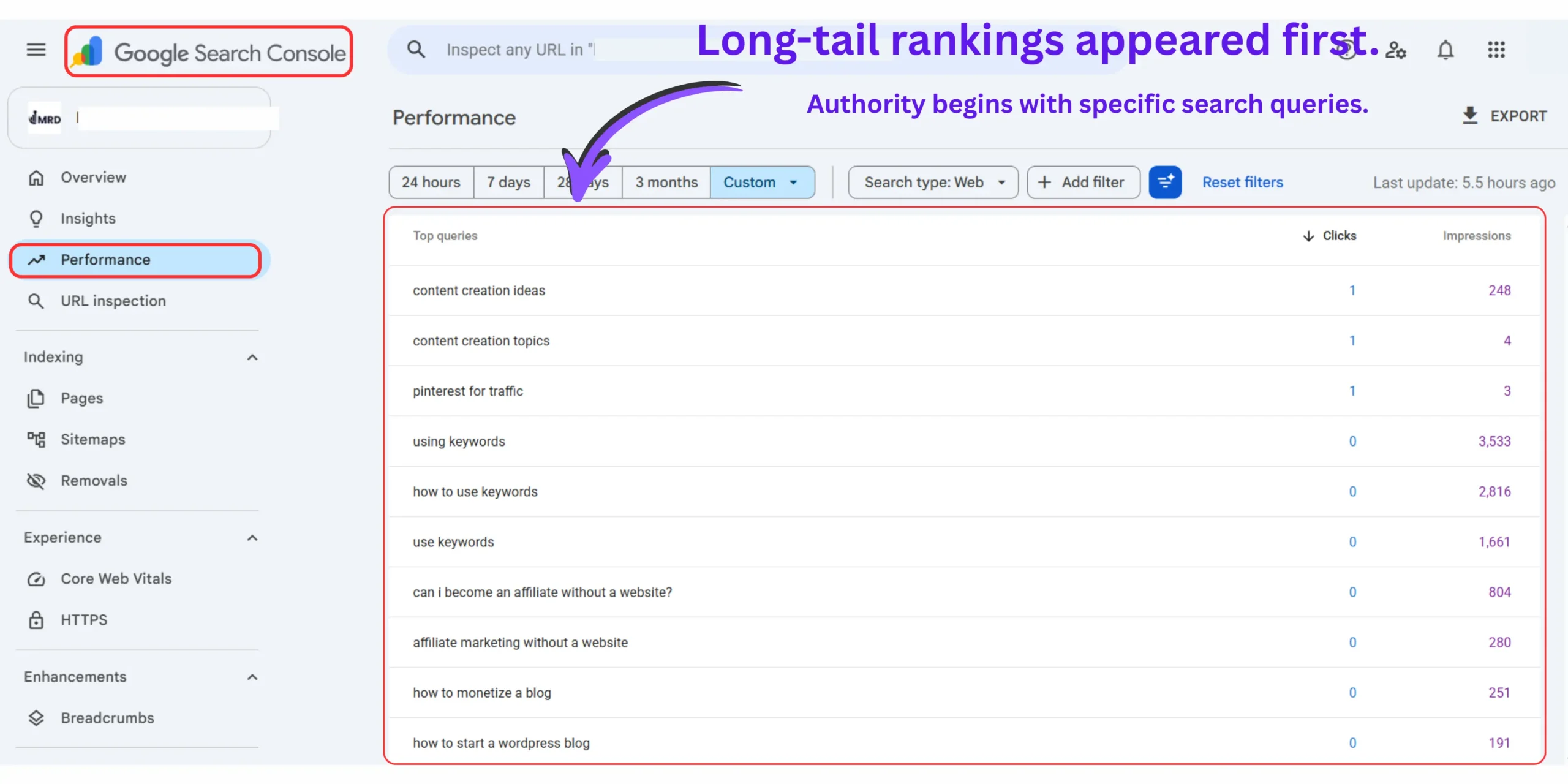
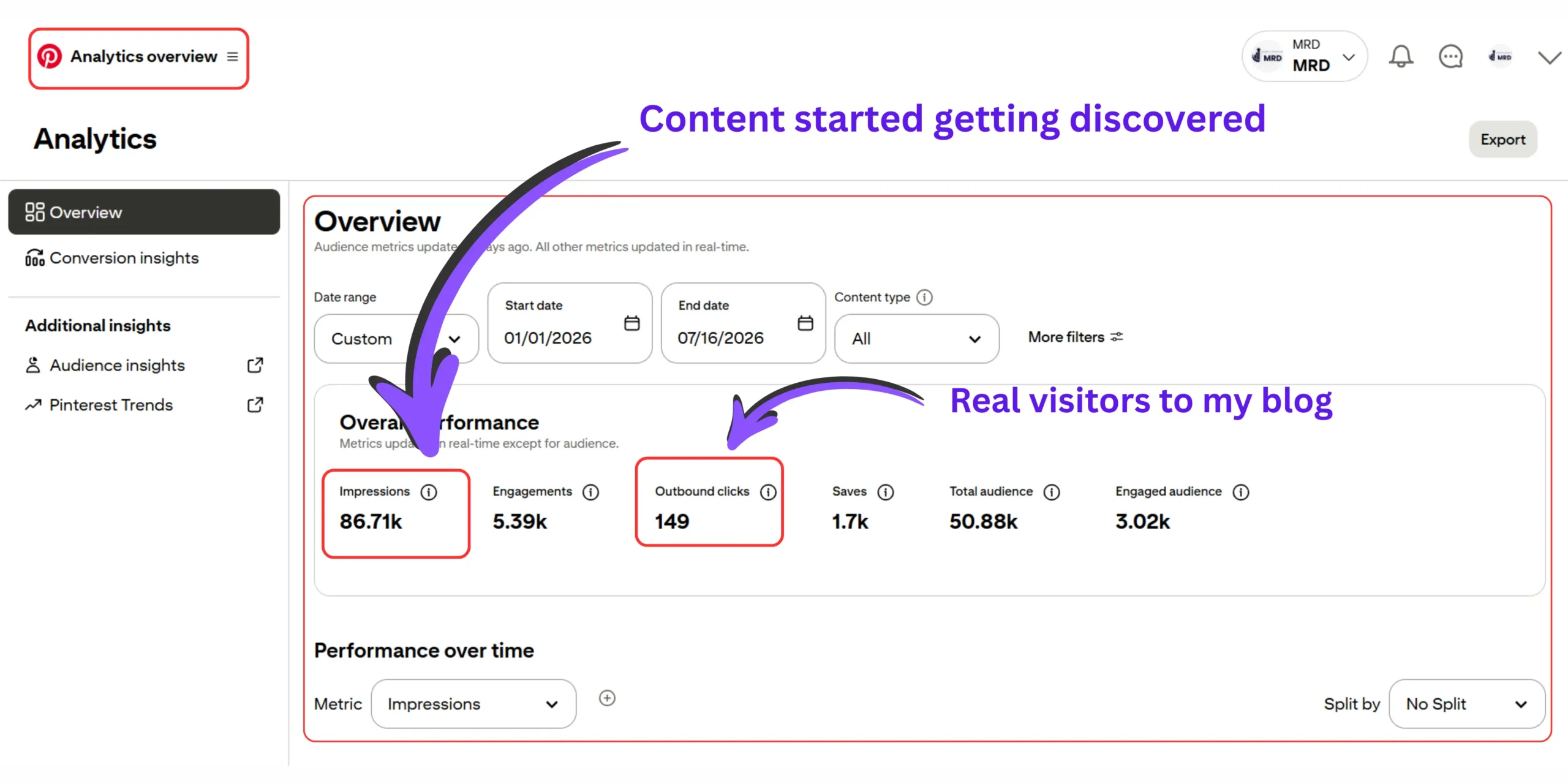
This is also the quarter where I started building traffic through social media instead of waiting exclusively for Google. Pinterest, LinkedIn, and Reddit became active distribution channels. How to get traffic to a new blog covers the specific multi-channel approach that made Q3 the turning point for my organic numbers.
✅ Quarter 3 Progress ChecklistBy the end of Quarter 3 (Months 7–9), you should begin seeing early signs that your blogging efforts are compounding. Focus on strengthening what’s already working instead of constantly changing your strategy.
Quarter 04 – Months 10-12 : The clarity phase
By Q4 I wasn’t earning money. But I had something more valuable for that stage: clarity.
I knew which posts were gaining traction. I knew which content formats my audience engaged with. I knew which traffic sources were sending readers who actually stayed longer than 30 seconds. I knew my topical authority was building because Google was surfacing my content for related queries I hadn’t specifically targeted.
Month 12 traffic : 6891 sessions
Zero income. Significant infrastructure. Real audience signals. A blog that was functioning as a genuine digital asset even without monetization attached yet.
✅ Quarter 4 Progress ChecklistBy the end of Quarter 4 (Months 10–12), your first year should have produced a solid blogging foundation. Instead of chasing quick wins, focus on refining your systems and preparing for long-term growth in Year 2.
How long does a blog take to get traffic? The honest answer with real numbers
How long does a blog take to get traffic from Google is typically 6-12 months for any meaningful organic search volume on a new domain. The first 3-6 months are dominated by what many SEO practitioners call the Traffic Silence Period – a structural evaluation phase where Google indexes your content but withholds significant ranking authority while assessing your domain’s consistency and topical depth.
Most blogs don’t generate any meaningful income in their first year. This isn’t because those blogs are failures. It’s because building the foundation takes time.
I need to introduce a concept here that I’ve never seen named anywhere, despite experiencing it directly: The Traffic Silence Period.
The Traffic Silence Period is the specific 90-180 day window after publishing where your content is indexed but deliberately held at low ranking positions while Google evaluates three things: whether your publishing cadence is consistent, whether your topical coverage is deep enough to signal expertise, and whether your content generates the behavioral signals (low bounce rate, longer dwell time, return visits) that indicate genuine reader value.
How long does a blog take to get traffic in my experience followed this exact pattern:
- Month 1-3 : 0-700 sessions total (almost entirely direct and referral)
- Month 4-6: 400-700 monthly sessions (Google starting to index but not rank)
- Month 7-9: 1,200-2,600 monthly sessions (rankings beginning to compound)
- Month 10-12: 3,000-7,000 monthly sessions (topical authority paying off)
The moment my traffic growth accelerated was not when I published more – it was when I fixed a technical issue that had been suppressing my indexing the entire time.
Why is my new WordPress site not indexing on Google covering the specific settings errors that silently prevent Google from properly crawling a new blog – including one I had left unchecked for four months without realizing it.
And when my older posts started dropping in Q3 despite having good initial rankings, no traffic? How to update old blog blog posts to get more clicks became the process that recovered them – teaching me that publishing new content and maintaining existing content are two separate strategic jobs that both need attention simultaneously.
Ideal posting frequency for new blogs – What my own testing actually showed
The ideal posting frequency for new blogs is not the highest number you can sustain. Research and personal testing consistently show that two to three high-quality, thoroughly researched posts per week outperform five to seven thin posts per week on every SEO metric that matters — rankings, dwell time, and organic click-through rate.
I tested three publishing frequencies across my first year:
Phase A (Month 1-4) : 3 posts per week – fast, keyword-targeted, 800-1,200 words each
Phase B (Month 5-8) : 1 post per week – deep, comprehensive, 2,000-3,500 words each
Phase C (Months 9-12) : 2 posts per week – balanced depth, 1,800-2,500 words each
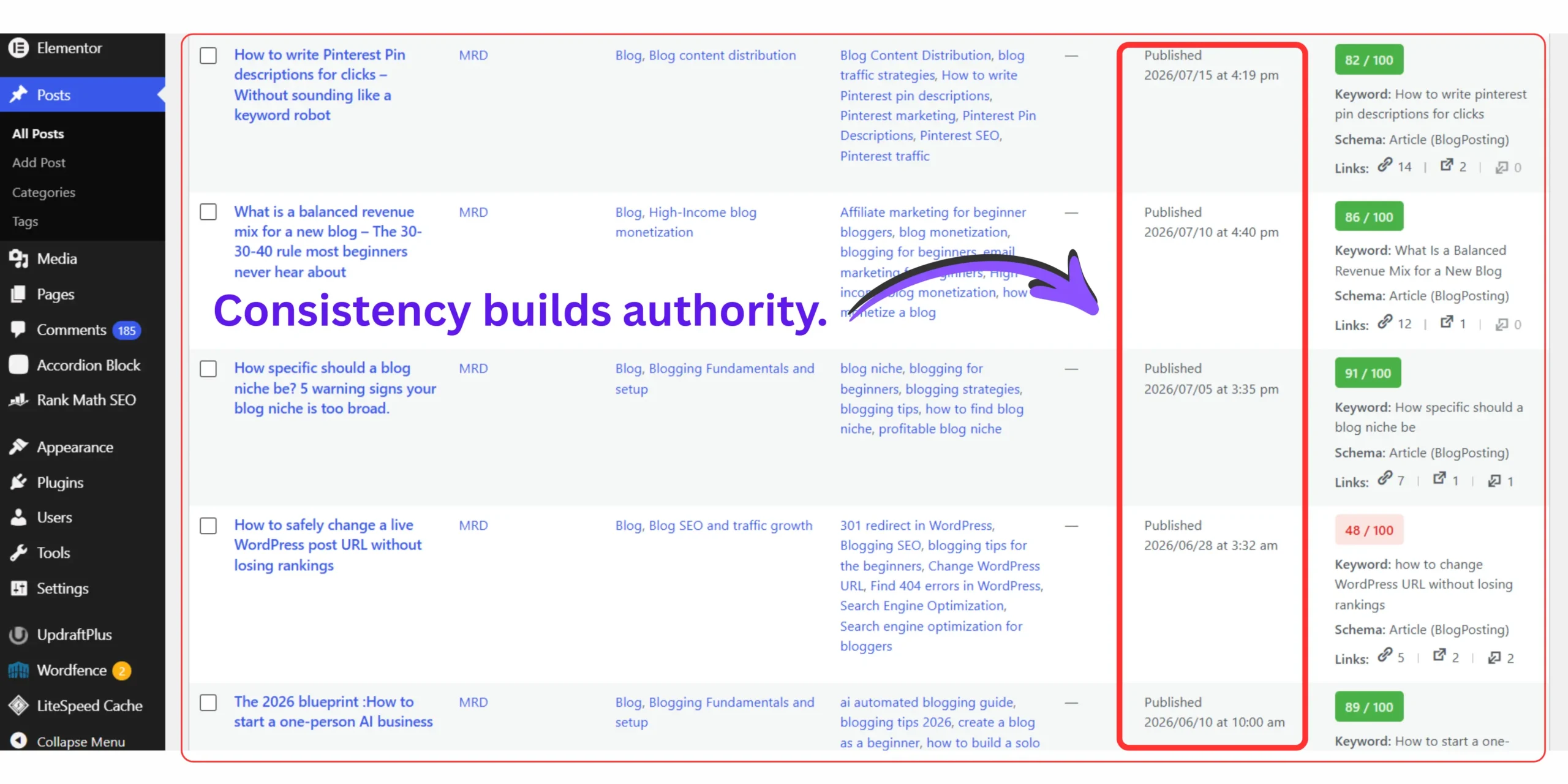
The traffic results were unambiguous. Phase B posts accounted for 67% of my total organic traffic by month 12 despite representing only 26% of my total published posts. Quality of coverage, not frequency of publishing was the primary ranking variable.
The ideal posting frequency for new blogs in practice means asking a different question entirely. Not “how many posts can I publish this week” but “how completely does each post I publish cover its topic compared to the top three competing results.”
AI tools changed my content speed significantly in months 8-12. But raw AI output needs significant human editing to perform.
How to use ChatGPT to write blog posts for beginners covers the workflow that accelerates content creation without sacrificing the depth signals Google rewards, and How to edit AI generated content for SEO documents the specific editing process that closes the gap between AI-generated drafts and content that actually ranks.
The broader conversation about where blogging is heading in this environment and whether AI fundamentally changes the strategic calculation is covered in stop doing blogging completely (unless you use AI-Orchestration protocol).
Is blogging still worth it in 2026 – after a year of zero income, Here’s my honest answer
Yes – blogging is still worth it in 2026 — but the definition of “worth it” needs recalibrating. The bloggers succeeding now are not the ones who published thin content and waited for Google. They’re the ones who built genuine topical authority, maintained consistent publishing systems, and treated their blog as a long-term digital asset rather than a short-term income experiment.
Blogs that offer genuine expertise (EEAT), original data, and real-world experience are thriving. Many niche blogs gained traffic after Google’s Helpful Content Updates because competitors with low-quality content were filtered out.
Is blogging still worth it in 2026 after a year of zero income? I asked myself this question at month 11.
Here’s what I had built instead of revenue:
- A publishing system that could produce 2 quality posts per week consistently
- A social media presence on Pinterest and LinkedIn generating 2,400+ monthly referral visits
- An email list of 340 subscribers built without any paid traffic
- Topical authority across my category confirmed by Google’s increasing coverage of my cluster posts
- A blog architecture – pillar guides, cluster posts, internal linking, that was compounding month over month
The income was coming. But it needed the infrastructure to exist first.
Don’t compare your month 6 to someone else’s year 3. Focus on your own progress.
The larger question about what happens to blogging long-term — whether AI changes the fundamental value proposition is one I address in what happens to blogging in the age of AI. My short answer: the bloggers who document real experience, publish original analysis, and build genuine reader relationships are more valuable now than at any previous point in blogging’s history, precisely because AI-generated generic content has made authenticity scarce.
For distribution beyond SEO, how to repurpose one blog post into multiple content formats is the system that took a single piece of content and distributed it across four channels – multiplying reach without multiplying the creation effort.
And the owned audience channel that protects you from every algorithm change: how to build an email list for beginners is what I wish I had started building on day one instead of month eight.
What nobody tells you about year one- The three things that actually compounded
Here is the information gain section – the part that no blogging timeline guide publishes because most writers are too focused on the income story to document the infrastructure story.
In my first year, three things compounded significantly that had nothing to do with revenue:
01 . Internal linking architecture
The systematic internal linking I built between cluster posts and pillar guides was the single most impactful technical decision of my first year.
It reduced my crawl depth from 7 clicks to 2 clicks across the entire blog, improved indexing speed for new posts noticeably, and signaled topical authority to Google in a measurable way.
How to rank blog posts faster using internal links documents the exact linking system I used and the measurable impact it had on ranking timelines for new posts published after the system was in place versus before.
02 . Affiliate infrastructure (Without income)
I built my affiliate infrastructure completely in year one – disclosure pages, link management, disclosure placement even though I earned nothing. When traffic crossed the threshold where monetization became viable, everything was already in place.
Where to put affiliate disclosure on blog post and where to place affiliate links in blog posts were both set up and tested in year one so I wasn’t scrambling to implement compliance requirements retroactively when income started arriving.
03 . Niche depth over niche width
The decision I’m most grateful for in year one: going deep on a specific topic cluster instead of publishing broadly across my entire category. By month 12, Google understood exactly what my blog was about and who it served.
That topical clarity is what made year two’s ranking velocity dramatically faster than year one’s.
Frequently asked questions on what to expect first year of blogging
How much traffic should a blog get in the first year?
A new blog realistically gets 500–7,000 monthly sessions by month 12, depending on publishing consistency and niche competitiveness. Most bloggers see very little traffic in months 1–4.
The first six months are dominated by what I call the Traffic Silence Period – Google indexes your content but withholds significant ranking authority while evaluating your consistency and depth. Month 7 onward is typically where compounding begins.
Is it normal make no money in the first year of blogging?
Yes – zero income in year one is completely normal and statistically common. Most bloggers don’t monetize meaningfully until months 12–24 when traffic and audience trust reach viable thresholds.
The first year builds the infrastructure that makes income possible – publishing systems, topical authority, email list foundation, and internal linking architecture. Treating year one as a failure because no revenue appeared is the most common reason bloggers quit before the machine starts working.
How many blog posts should I write in my first year?
Quality consistently outperforms quantity. Two to three thoroughly researched posts per week outperform five to seven thin posts on every SEO metric that matters – rankings, dwell time, and organic click-through rate.
In my own testing across three publishing phases, the deeper posts I published in Phase B (one per week, 2,000–3,500 words) accounted for 67% of my total organic traffic despite being only 26% of my published content.
Why is my blog no getting traffic after 6 months?
Six months with minimal traffic is normal for a new domain. Google deliberately withholds significant ranking authority for 6–12 months while evaluating your content’s consistency, topical depth, and reader behavior signals.
This isn’t a signal that your blog is failing – it’s the structural reality of how new domains earn trust. The most common fixable cause is a technical indexing error in WordPress settings that silently prevents Google from crawling your content properly.
How long does it take for a blog to become profitable?
Most blogs take 12–24 months to generate meaningful income. Year one builds infrastructure. Year two is typically when that infrastructure starts converting traffic into revenue.
The bloggers who reach profitability fastest are not those who published the most, they’re the ones who built topical authority in a specific niche, maintained consistent publishing, and had affiliate and email infrastructure ready before significant traffic arrived.
Should I blog daily to grow faster in my first year?
No – daily blogging with shallow content consistently underperforms less frequent publishing with genuine depth. Publishing every day depletes research quality and creates thin content that Google actively deprioritizes.
Two to three posts per week at full research depth produces stronger results than seven posts per week at reduced quality. Google’s ranking signals measure how thoroughly your content covers a topic and how long readers stay – not how often you publish.
Year one is not about income – It’s about building the machine that makes income possible
Understanding what to expect first year of blogging changes the entire emotional experience of the process.
Zero income in year one is not a failure. It’s the cost of building infrastructure. The bloggers who treat year one as a failure because no revenue appeared are the ones who abandon the machine three months before it would have started working.
My first year: zero income, 6,891 monthly sessions, 340 email subscribers, a complete pillar-cluster architecture, and a publishing system I could run consistently without burning out.
That is what to expect first year of blogging if you build it right. Not revenue. A machine that generates revenue, one that exists completely, sustainably, and structurally – before any monetization turns on.
Year two is where everything the first year built starts to pay out.
Where are you in your first year right now? which quarter are you in, and what’s the hardest part of that specific phase?