

Are you frustrated because your blog posts aren’t getting enough readers? If so, you need to learn how to update old bog posts to get more traffic. Many beginners think that publishing new content is the key to growth, but the real opportunity often lies in optimizing what you already have.
If you’ve ever wondered, Why my blog posts are not getting traffic ? it’s usually due to outdated information, weak SEO, or missing optimization. The good news is, you don’t need to start over. By understanding how to optimize old blog posts for SEO and applying simple updates, you can improve your rankings and drive more visitors.
This beginner-friendly guide will walk you through how to update old blog posts for SEO beginners This beginner-friendly guide will walk you through fix low traffic blog posts , giving your existing content the attention it deserves and turning neglected posts into consistent traffic sources.
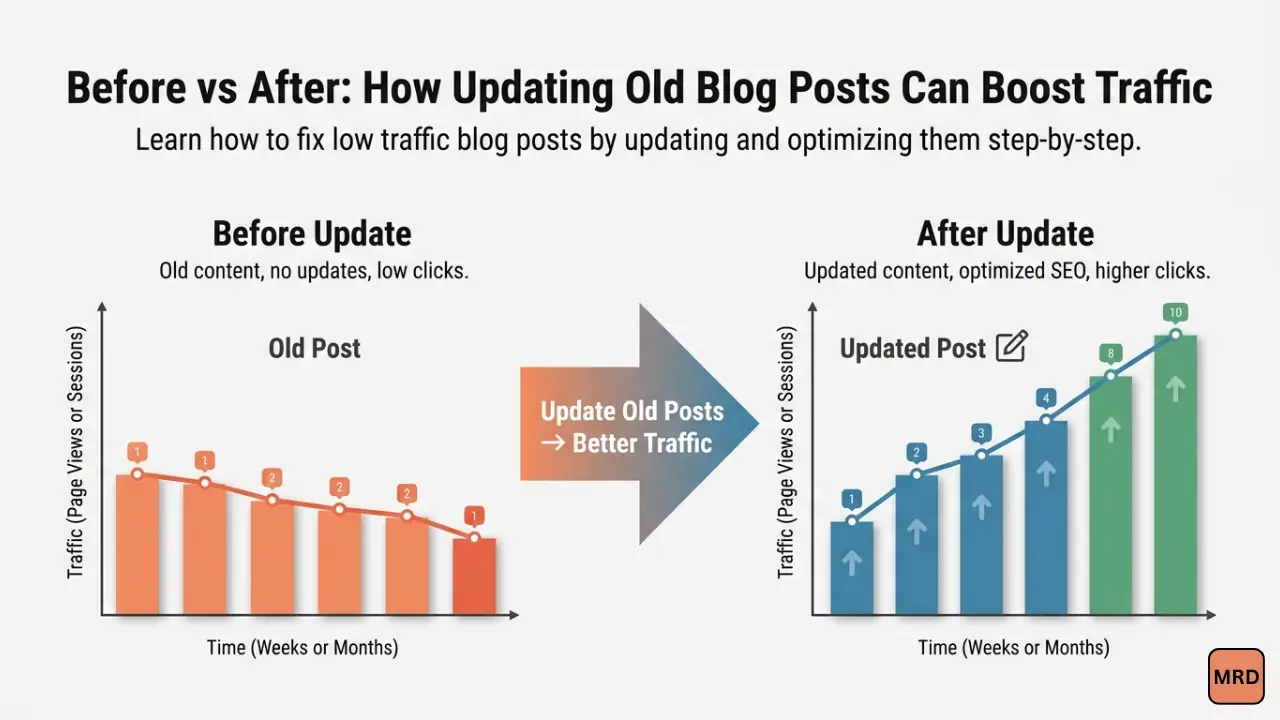
Why your blog posts are not getting traffic?
If you’re struggling to get readers, you might be asking yourself, why my blog posts are not getting traffic? The answer usually comes down to a few common mistakes. First, poor keyword targeting is a major culprit. Without proper research, your posts may not match what your audience is searching for.
Outdated content is another factor. A lot of beginners write a post once and never come back to it. Search engines prefer more recent content, and the information loses relevance over time. Visibility is further limited by poor SEO optimization, such as slow-loading pages, unoptimized headings, and missing meta tags.
Internal linking is also frequently ignored. Your posts cannot transfer authority throughout your website without links to relevant content, which makes it more difficult for them to rank. Lastly, even if your post shows up in search results, low CTR due to unattractive titles or meta descriptions may prevent clicks.
The first step to improvement is to understand these problems. You can transform overlooked content into useful assets that increase traffic by taking care of every part.
Most of my results improved only after I stopped guessing topics and learned how to use keywords the right way, which helped me update old posts based on what people are actually searching.
What it means to update old blog posts?
Updating old blog posts is more than just fixing grammar or typos. For beginners, learning how to update old blog posts for SEO beginners is crucial because search engines reward posts that are accurate, complete, and up-to-date.
improving SEO components, reorganizing content to make it easier to read, and adding fresh content that satisfies current search intent are all part of this process. To improve the post, you could include new data, images, or examples.
Beyond that, it involves improving internal links, headings, and keyword placement. You can keep your content current for both readers and search engines by updating older posts. With time, this approach boosts engagement and ranks, increasing the number of clicks on your blog without having to start from scratch.
At one point, I thought updating content meant just editing sentences, but everything changed when I understood how to optimize blog posts for SEO beginners, focusing more on search intent, structure, and real value.
When should you update a blog post?
Knowing when to update a blog post is key to maximizing traffic . Posts with low traffic or impressions but no clicks are a good place to start because they show unrealized potential. Another indication that updates are required is if a post’s ranking has decreased or if it is no longer in line with search intent.
Because they show untapped potential, posts with low traffic or impressions but no clicks are a good place to start. If a post’s ranking has dropped or if it is no longer in line with search intent, that is another sign that updates are needed.
Reduced ranking positions , high impressions with few clicks and low CTR are examples of practical signals. You can target the content that can produce the quickest improvements by focusing on these posts first. You can maintain your blog’s authority, relevance, and steady traffic by regularly examining older posts.
Step by step : How to update old blog posts to get more traffic
Updating old posts strategically can dramatically improve traffic. I will show you the detailed process;
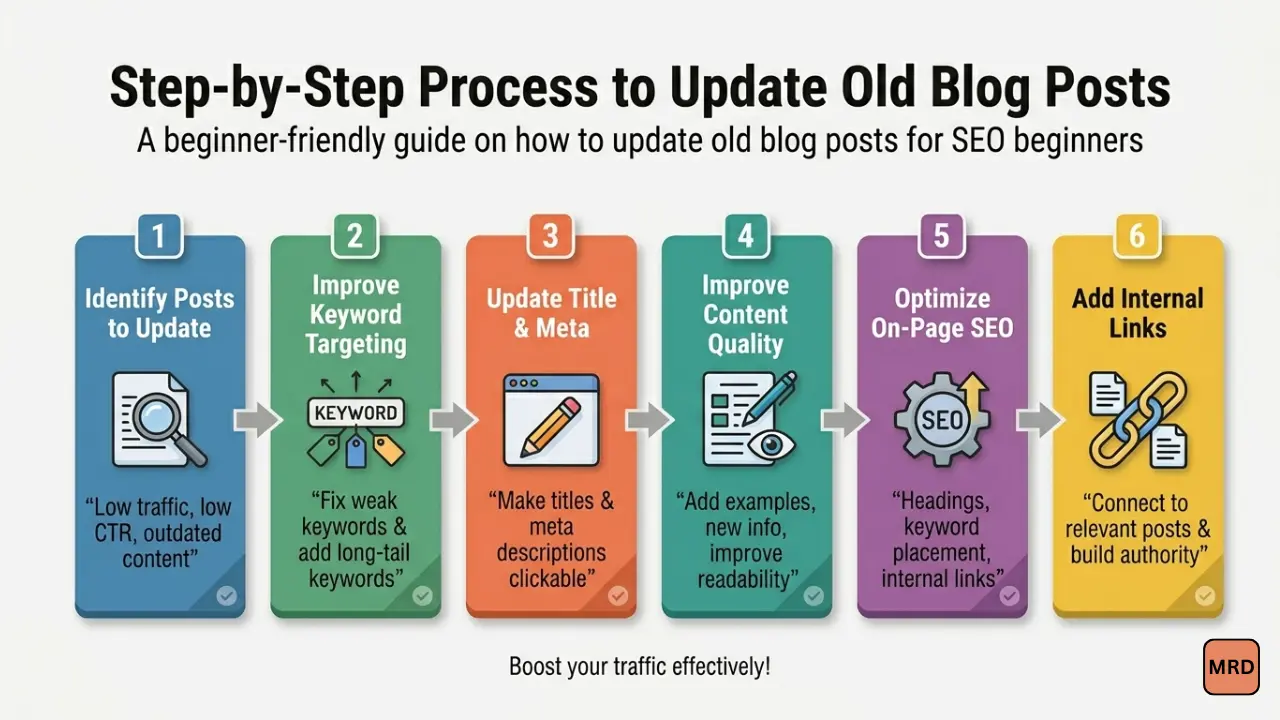
Step 01 . Identify posts that need updating
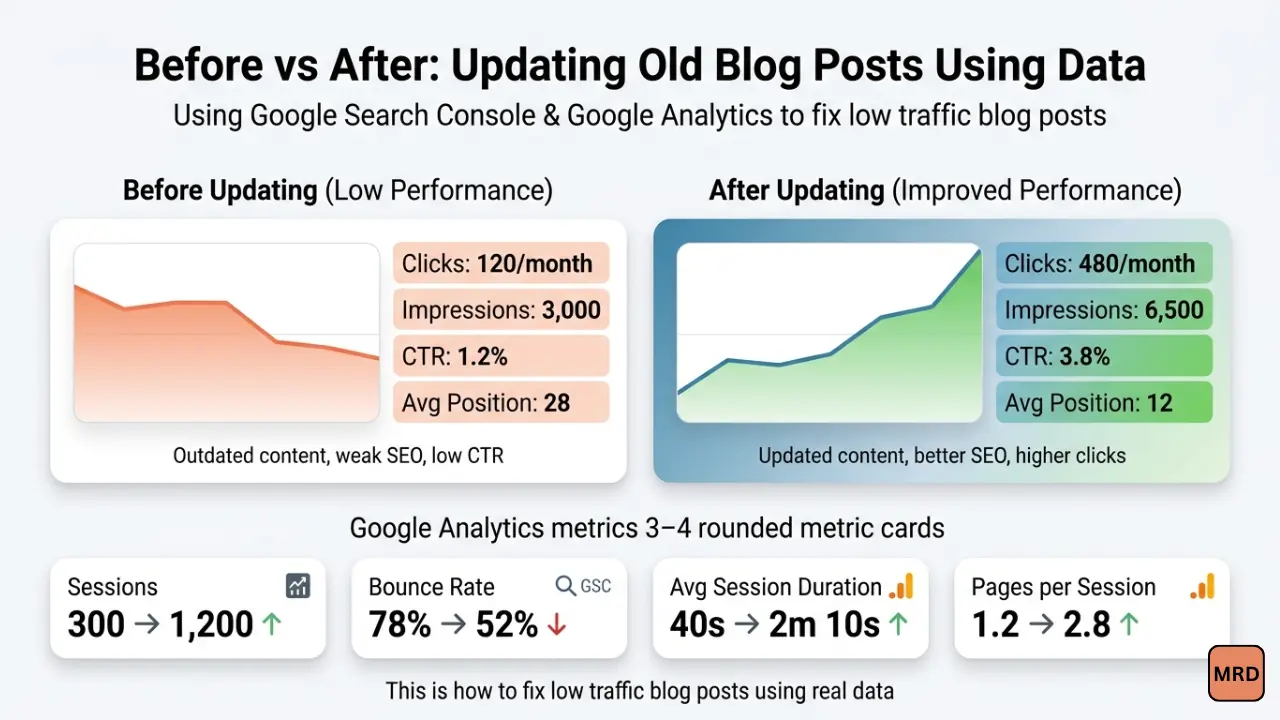
Look at your Google Search Console and analytics first. Look for posts that have unchanging rankings but low clicks, low CTR, or high impressions. There is unrealized potential in these posts. Setting priorities for these will ensure that your efforts produce measurable results in the shortest possible time.
When updating my posts, I rely on tools like Google Search Console to find low-performing pages and Google Analytics to track traffic changes, helping me make data-driven improvements instead of guessing what works.
Step 02 . Improve your keyword targeting
Next, evaluate the keywords for each post. Are they too broad, outdated, or competitive? Add relevant long-tail keywords that match search intent. This is a core part of how to optimize old blog posts for SEO and ensures your content aligns with what users are actively searching for. Avoid keyword stuffing, instead, integrate keywords naturally into headings, paragraphs, and meta descriptions.
Step 03 . Update your title and meta description
Clicks are influenced by your title and meta description. Make them appealing, understandable, and benefit-oriented. To indicate relevance to search engines, naturally include the primary keyword into the title and meta description. Make sure the variations accurately reflect the content and test various variations to see what increases CTR.
Step 04 . Improve content quality and depth
Make your content comprehensive by adding missing sections and explaining on examples. To make lengthy paragraphs easier to read, break them up and, if necessary, add lists or images. Make sure your post fully addresses the searcher’s intent. In-depth, high-quality content signals authority to search engines and improves engagement.
One thing I noticed is that even updated content won’t perform if it’s hard to read, which is why learning how to structure a blog for beginners helped me improve engagement and keep readers longer.
Step 05 . Optimize on page SEO
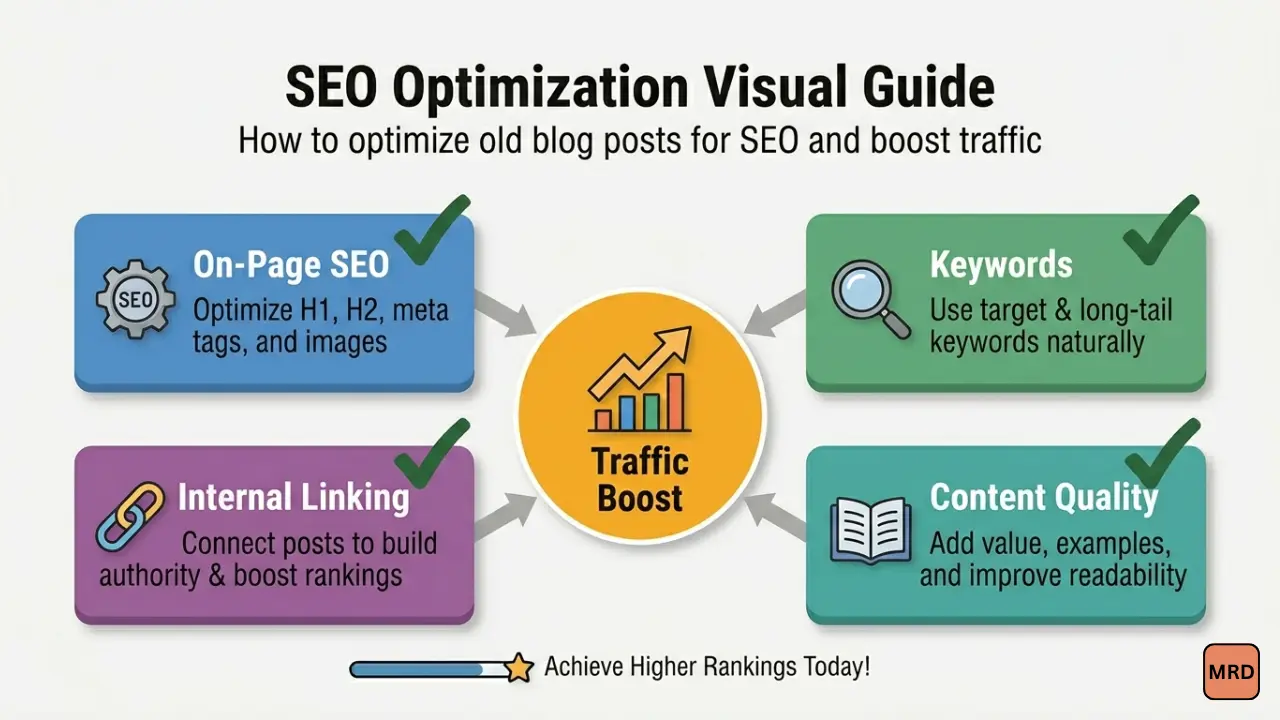
Verify that alt text for images is descriptive, headings (H1 , H2) are logically organized, and keywords naturally take place in the content. To increase site authority and enhance navigation, include internal links to important posts. This step guarantees that your post is ready to appear in search results and is fully optimized for search engines.
Step 06 . Add internal links to relevant
Provide a link to additional relevant content on your blog. In addition to keeping readers interested, this helps search engines in understanding the context and applicability of your posts. Strong internal linking guarantees that older posts contribute to the overall SEO of the website and increases topical authority.
When I started updating old posts, I realized small changes made a big difference, especially after learning how to do on page SEO for blog posts, like fixing headings, improving keyword placement, and optimizing structure.
How to fix low traffic blog posts (Action plan)
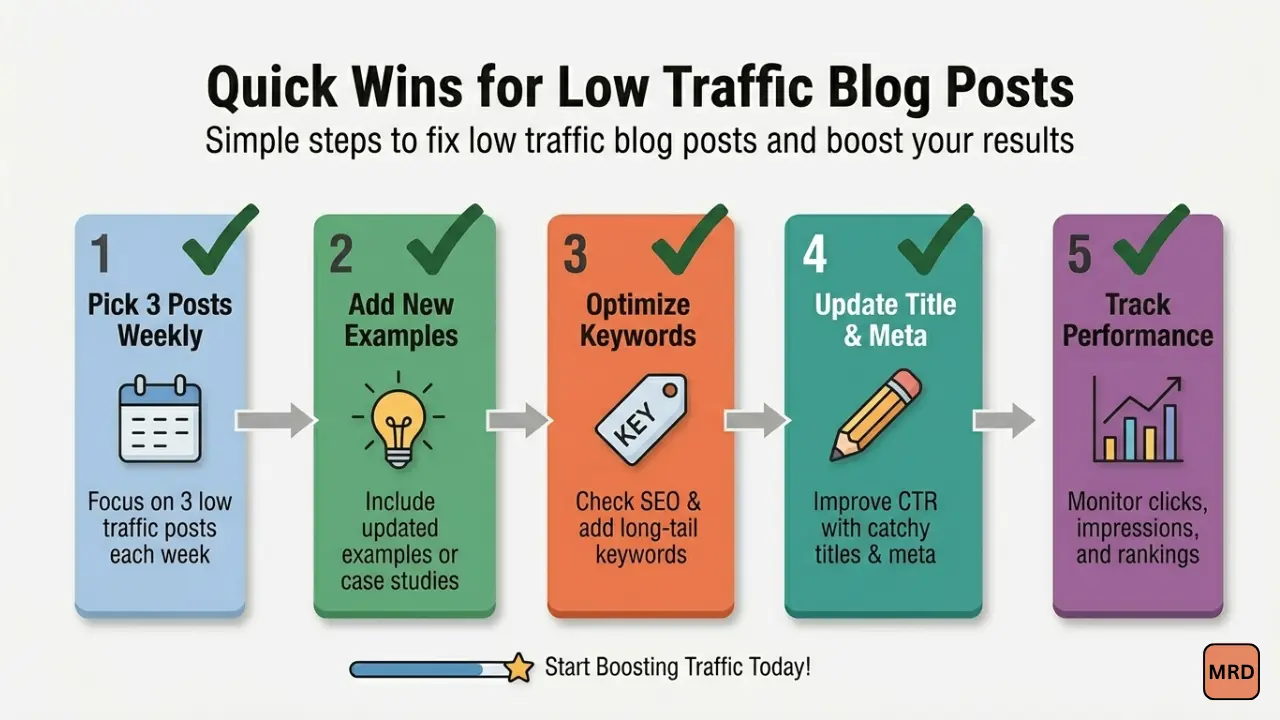
If you’re wondering how to fix low traffic blog posts, the solution is simpler than you think. Start by picking 3 posts per week that show potential, low clicks, low CTR, or dropping rankings. Focusing on a small, manageable number keeps you consistent without getting overwhelmed.
Next, update and optimize each post. Improve titles and meta descriptions to boost CTR, refresh outdated information, and add missing sections or examples. Don’t forget on-page SEO , use keywords naturally, optimize headings, and include internal links to strengthen authority.
Lastly, monitor performance. To determine which updates are most effective, track traffic, rankings, and engagement metrics. This systematic method guarantees that your older posts will eventually generate meaningful traffic, transforming overlooked content into valuable assets.
Updating content is powerful, but it works even better when combined with strategies I learned from how to get traffic to a new blog, especially using SEO and consistent content updates to drive long-term growth.
Common mistakes to avoid when updating posts
Beginners often make avoidable mistakes when updating old content. Key mistakes include ,
- Keyword stuffing – Overloading posts with keywords hurts readability and rankings.
- Not changing title or meta descriptions – Failing to improve CTR limits clicks even if rankings improve.
- Ignoring search intent – Updating content without aligning with what readers want reduces engagement.
- Skipping internal links – Neglecting to link to related posts weakens site authority.
Avoiding these errors ensures your updates are effective, helping you rank higher and get more clicks without wasting time.
Frequently asked questions on how to update old blog posts to get more traffic
Why are my old blog posts not getting traffic?
Many posts lose traffic because of outdated content, poor keyword targeting, and weak SEO. Updating them properly can revive clicks and rankings. Learn why my blog posts are not getting traffic and how to fix it.
How do I update old blog posts for SEO beginners?
Start by improving content quality, refreshing information, optimizing keywords, and updating titles and meta descriptions. This is the beginner-friendly way to how to update old blog posts for SEO beginners.
Can updating old blog posts really increase traffic?
Yes. Optimizing content and SEO signals can boost rankings, impressions, and clicks. Discover step-by-step methods on how to update old blog posts to get more traffic.
How often should I update my blog posts?
Focus on posts with low traffic, impressions but no clicks, or outdated info. A weekly plan of updating 2–3 posts works best to fix low traffic blog posts.
What is the easiest way to optimize old blog posts for SEO?
Use keyword research, add internal links, improve readability, and update your meta info. This is the practical approach to how to optimize old blog posts for SEO.
Turn old blog posts into traffic machine
Updating old content is one of the quickest ways to boost your blog without constantly writing new posts. By following this step-by-step guide on how to update old blog posts to get more traffic, even beginners can see results. Focus on improving SEO, refreshing outdated information and optimizing titles and internal links.
If you want to fix low traffic blog posts and learn how to optimize old blog posts for SEO, start with one post today, track performance, and stay consistent. Small, regular updates turn old content into a long-term traffic machine.