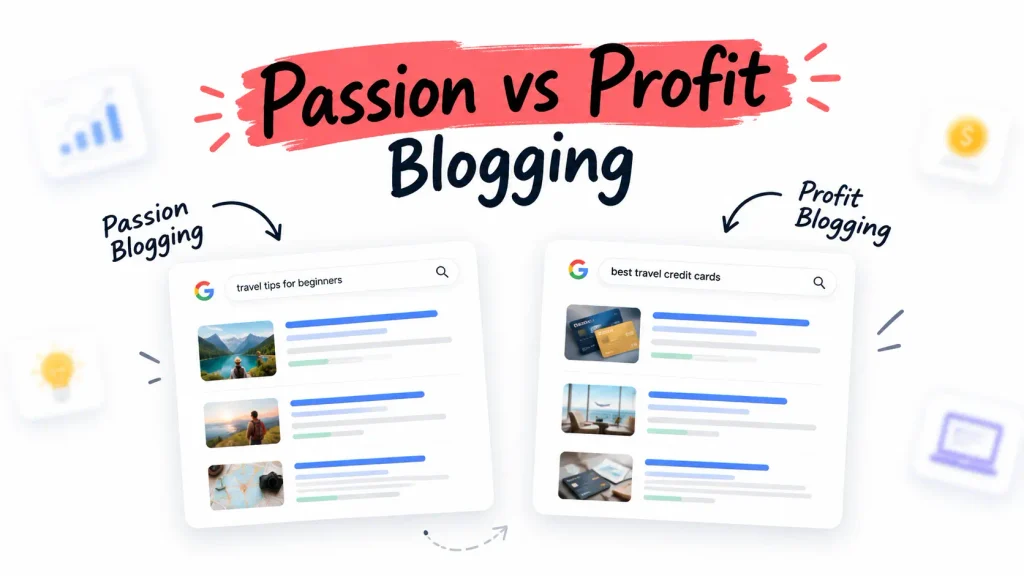

Passion vs profit blogging isn’t an either/or choice – it’s a fit test. The blogs that survive past month three are built on niches where genuine interest overlaps with real search demand and a monetization path, not on passion alone or profit alone. Use the Passion-Profit Fit Score below before you publish post #1.
I almost quit blogging after 47 days, not because I ran out of ideas, but because I picked a “profitable” niche I couldn’t stand writing about. Passion vs profit blogging is the exact fork in the road that decides whether your blog survives past month three or joins the graveyard of abandoned WordPress sites.
If you want the full roadmap for turning a blog into real income, my blog SEO and traffic growth strategies for beginners guide is the place to start once your niche is locked in, but none of that matters if you quit before you get there.
This post is part of a larger niche-selection framework. For the complete data-backed process – competitor scoring, demand validation, and monetization math, start with the pillar guide: Profitable Blogging Niche Validation & Market Research Frameworks.
And if you’re still deciding whether blogging is even the right business model for you, How to Start a Business Blog: Blueprint for Building a Real Digital Asset covers that groundwork first.
Key Takeaways: Passion vs Profit Blogging
The most sustainable blog niche is usually not chosen by passion or profit alone. It combines genuine interest, consistent demand, realistic monetization potential, and an angle you can keep developing over time.
- Passion vs profit blogging is not an either-or decision — the strongest niche ideas sit where genuine interest overlaps with market demand and a realistic path to monetization.
- Boredom and burnout can become a bigger long-term risk than low traffic — choosing a topic you cannot consistently write about can make it difficult to sustain the blog long enough to see results.
- A 90-day niche test gives you time to evaluate your commitment — use motivation, content ideas, search behavior, and early market signals to decide whether to continue, narrow, or pivot.
- The Passion-Profit Fit Score evaluates five important signals — enjoyment longevity, demand strength, monetization ceiling, competition gap, and skill or knowledge overlap can help screen a niche before you commit.
- Micro-niches and seasonal topics need a different sustainability check — narrower or time-sensitive topics can have different content-volume, demand, and burnout considerations than broad evergreen niches.
- Validate before building the entire blog — checking content depth, search demand, competition, and monetization potential before committing can reduce the risk of spending months creating content for a poor-fit niche.
What is passion vs profit blogging?
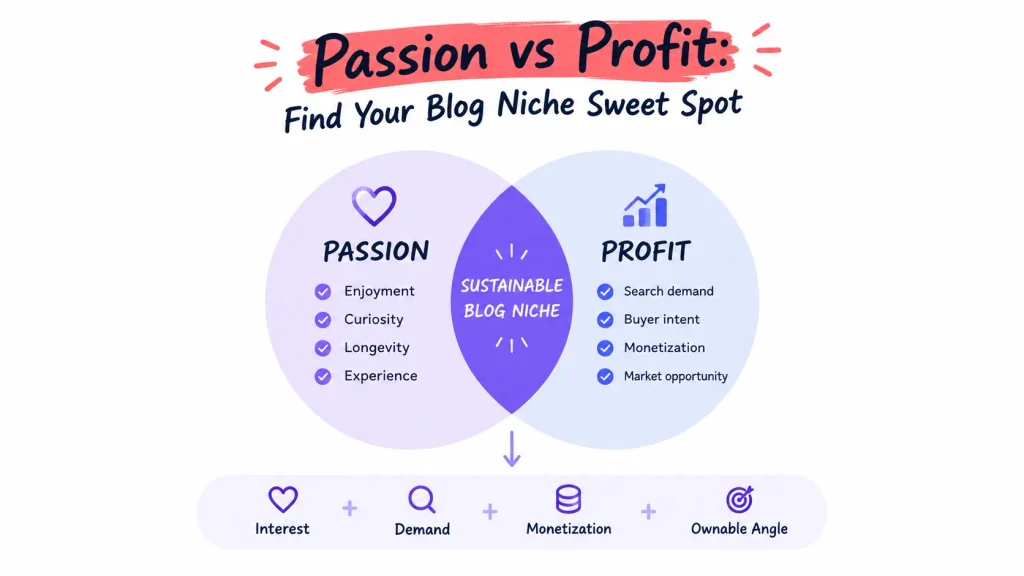
Passion vs profit blogging is a niche-selection approach that weighs a blogger’s genuine interest in a topic against that topic’s earning potential before committing to a long-term content strategy.
Passion vs profit blogging means deciding whether to build your blog around what you love writing about or around what search demand and advertisers pay for. In practice, the most sustainable blogs score reasonably well on both, high enough interest to survive slow months, and high enough demand to eventually monetize.
Neither extreme works well in isolation. A pure passion niche with no searchable demand becomes a journal nobody reads.
A pure profit niche with no personal interest becomes a chore you dread opening your laptop for. The real question isn’t “passion or profit”, it’s how specific should a blog niche be so that both can coexist.
Narrower niches tend to make this overlap easier to find, which is also why so many successful bloggers eventually operate what’s called a micro niche blog rather than a broad, generic one.
What’s the difference between a passion blog and a niche blog?
A passion blog is a website built primarily around a topic the author personally enjoys, while a niche blog is built around a specific, well-defined audience segment with identifiable search demand and monetization potential.
A passion blog centers on the writer’s interests first and audience second, which risks low search demand. A niche blog centers on a defined reader problem first, which risks the writer losing motivation if there’s no personal connection. The strongest blogs and the ones that tend to rank are niche blogs built from a genuine passion, not one or the other in isolation.
Here’s a distinction I didn’t understand early on: a passion blog can absolutely become a niche blog once you narrow the angle.
“I love personal finance” is a passion. “Debt payoff strategies for freelancers with irregular income” is a niche.
Same passion, dramatically more specific audience and dramatically more rankable, because the search intent is clearer to Google and to AI answer engines alike.
Should I blog about my passion or what makes money?
You should blog about a topic where your genuine interest overlaps with proven search demand and at least one realistic monetization path, not about your passion alone or the highest-paying niche alone.
Blog about your passion only if it also has search volume and buyer intent behind it. Blog about profit only if you can sustain writing about it without burning out within a few months. When the two conflict, look for a narrower angle inside your passion that intersects with a paying audience.
This is where most beginner advice oversimplifies things. “Follow your passion” ignores that some passions, stargazing, vintage stamp collecting, competitive birdwatching have almost no advertiser demand.
“Follow the money” ignores that grinding out content on a topic you find dull is exactly how blogs get abandoned by month three.
When I manually mapped out ten profitable niches against my own actual interests, only two overlapped, but those two are the ones I’m still writing about years later.
Here’s a decision framework I use whenever a niche idea feels conflicted:
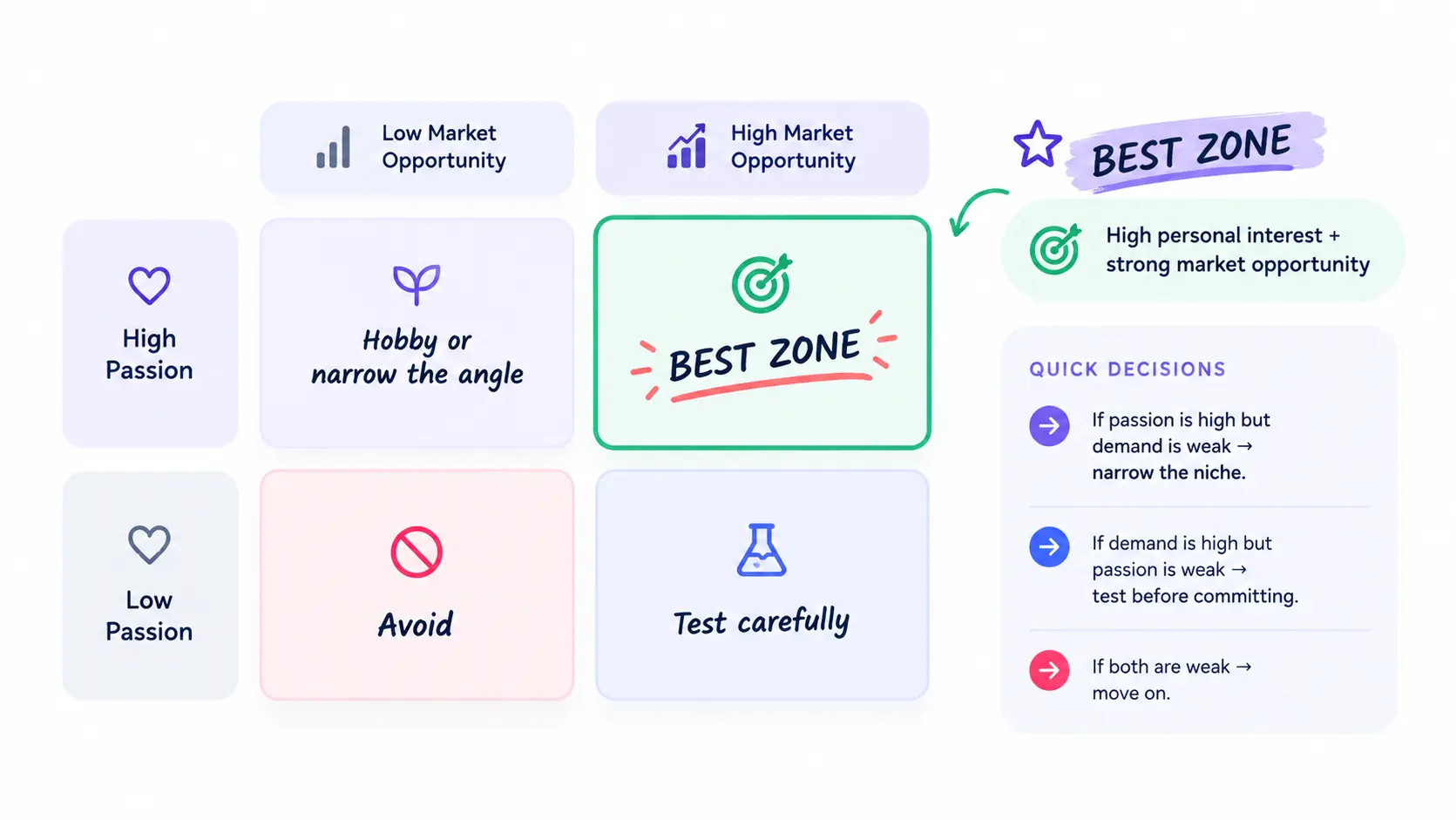
Passion vs Profit Blogging: What Should You Do?
Use this simple decision matrix to compare your personal interest with market opportunity before committing to a blog niche.
| Situation | What to Do |
|---|---|
| High passion + low demand | Narrow the angle until you find a paying sub-audience, or keep it as a hobby project rather than a business. |
| High demand + zero personal interest | Be cautious about choosing it solely for demand. Low personal interest can make consistent content production harder to sustain. |
| High passion + high demand + high competition | Find a narrower intent gap competitors haven’t covered — see how to find content gaps in blog competitors . |
| Moderate passion + moderate demand + low competition | Consider prioritizing this combination because it offers a balance between personal interest, market demand, and competitive opportunity. |
If your passion sits in a saturated space like fitness or personal finance, don’t panic, this is exactly what best low competition high-income blog niches and 10 evergreen blogging niches that attract high paying advertisers are built to help you find: the narrow, underserved angle inside a broad, profitable category.
How to know if you will stick with your blog niche
You’ll know you’ll stick with a blog niche if you can list at least ten sub-topics you’re excited to write about without researching them first, and if the topic has held your interest for more than a year before you even started the blog.
The clearest predictor of sticking with a niche is prior, unpaid interest – did you talk, read, or think about this topic before blogging was involved? If you have to force enthusiasm to write the first five posts, that’s an early warning sign, not something that improves with practice.
I built a simple scoring model for this after watching (and doing) the same mistake repeatedly: picking a niche that looked great on paper and dying of boredom by post twelve.
I call it the Passion-Profit Fit (PPF) Score. Score each niche idea from 1–5 on these five signals, then add them up:
The Passion-Profit Fit Score: A 25-Point Niche Test
I created the Passion-Profit Fit (PPF) Score to turn the passion-versus-profit decision into something you can actually evaluate.
Instead of asking, “Do I like this niche?” or “Can this niche make money?”, score the idea across five signals:
| Signal | 1 Point | 3 Points | 5 Points |
|---|---|---|---|
| Enjoyment Longevity | New or temporary interest | Interested for several months | Strong interest for 12+ months |
| Demand Strength | Little/no evidence of demand | Some consistent demand | Clear, sustained search interest |
| Monetization Ceiling | No obvious offer | Some affiliate/product opportunities | Multiple realistic monetization paths |
| Competition Gap | No obvious opening | Some weak spots | Clear underserved angle |
| Skill/Knowledge Overlap | Starting from zero | Some relevant experience | Strong first-hand experience |
How to Interpret Your Score
Your idea has a healthy balance between personal sustainability and business potential. Move into deeper validation rather than immediately building the website.
The idea has potential, but there is probably an unresolved weakness. Narrow the audience, problem, or content angle before committing.
The idea currently has too many weaknesses. Either find a stronger angle or keep it as a personal interest rather than forcing it into a business.
Example: Scoring a Hypothetical Niche
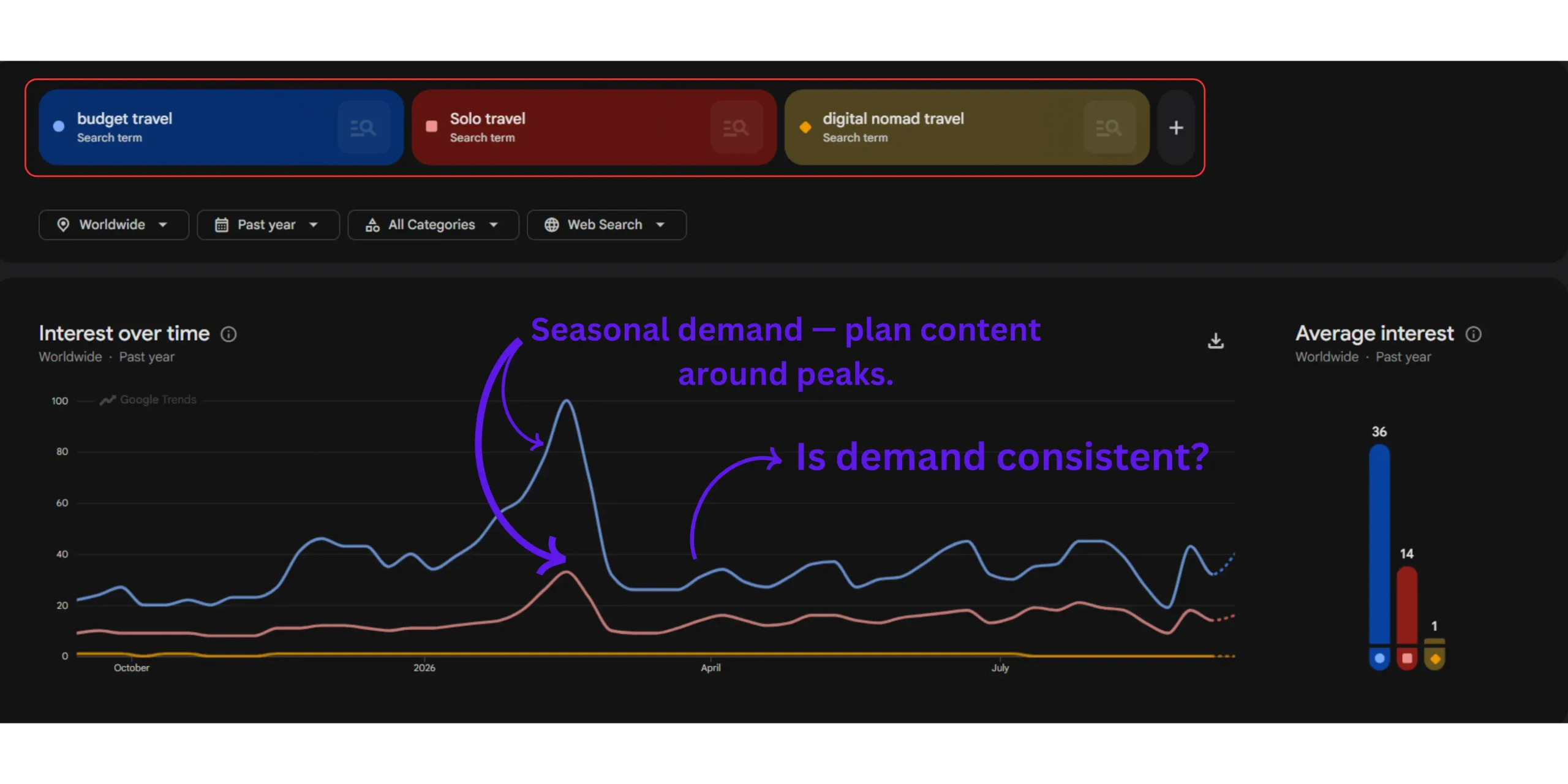
Imagine someone loves budget travel for solo digital nomads. They might score it like this:
The score doesn’t prove that the niche will succeed. It tells you that the idea deserves deeper validation.
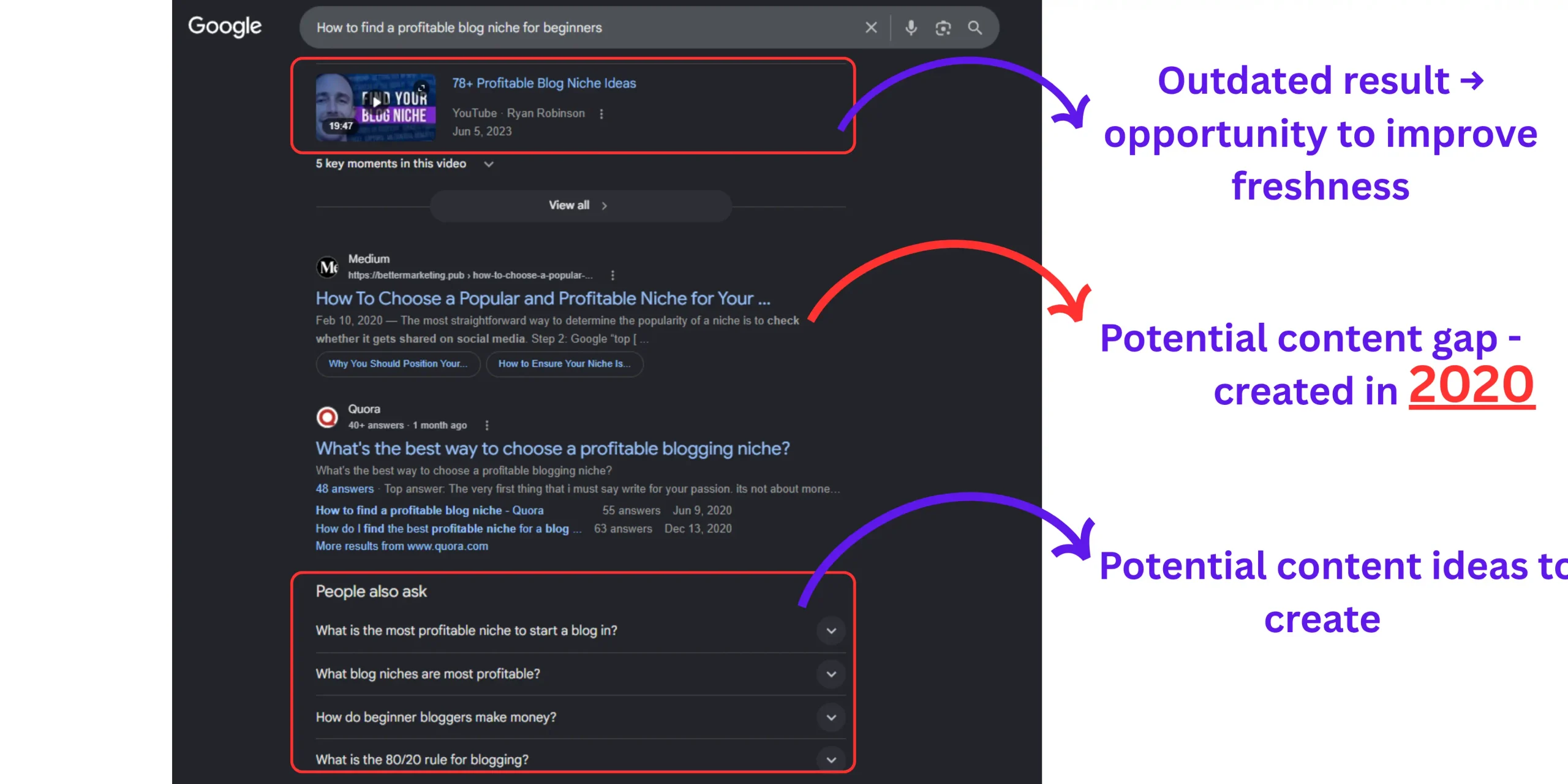
Why do bloggers quit in the first year?
Bloggers most commonly quit in the first year because they see no traffic or income within the first few months, not because the topic itself was wrong – though topic mismatch is usually the root cause underneath that discouragement.
The typical quitting pattern looks like this: publish 5–15 posts, see almost no organic traffic, lose motivation, then stop. The topic choice usually caused this indirectly, a mismatched niche produces content the writer struggles to finish, which slows publishing pace, which delays the traffic that keeps motivation alive.
If this cycle sounds familiar, it’s worth reading why your blog is not getting traffic after 06 months, because in my experience, the traffic problem and the passion problem are almost always tangled together.
Slow traffic isn’t just an SEO issue; it’s a motivation issue that compounds. The fix isn’t always “write more”, sometimes it’s “write about something that survives the slow months without you needing external validation to keep going.”
There isn’t one universal reason bloggers stop publishing. Traffic, income expectations, inconsistent publishing, lack of time, and losing interest in the topic can all contribute.
But for niche selection, one risk deserves special attention: motivation mismatch. If you choose a topic primarily because it looks profitable but have little genuine interest in it, maintaining the research and publishing workload can become harder over time.
That’s why I treat sustainability as part of niche validation, not as something to worry about after the blog is already built.
Passion niche vs profit niche : Side by side comparison
Passion-Only vs Profit-Only vs Passion + Profit
The strongest blogging model is usually not passion or profit alone. Passion + profit overlap gives you enough personal interest to sustain content creation while giving you a real audience and monetization opportunity to build around.
| Factor | Passion-Only Niche | Profit-Only Niche | Passion + Profit Overlap |
|---|---|---|---|
| Content consistency | High early, drops if no results | Drops fast without interest | Stays stable long-term |
| Search demand | Often low or untested | Usually high | Validated before writing |
| Monetization speed | Slow or unclear | Fast, if competition allows | Moderate, but sustainable |
| Burnout risk | Low until income stalls | High within 2–4 months | Lowest overall |
| Competitive edge | Personal voice, authenticity | Data and SEO structure | Authentic voice + data |
| Best for | Personal blogs, portfolios | Agencies, hired writers | Independent bloggers building long-term assets |
The 30-60-90 Day Niche Test
Don’t decide whether a niche is right for you after one exciting weekend.
Instead, treat your first 90 days as a controlled test.
“`htmlDon’t Commit to a Blog Niche Until You Pass These 4 Checkpoints
PASSION CHECK
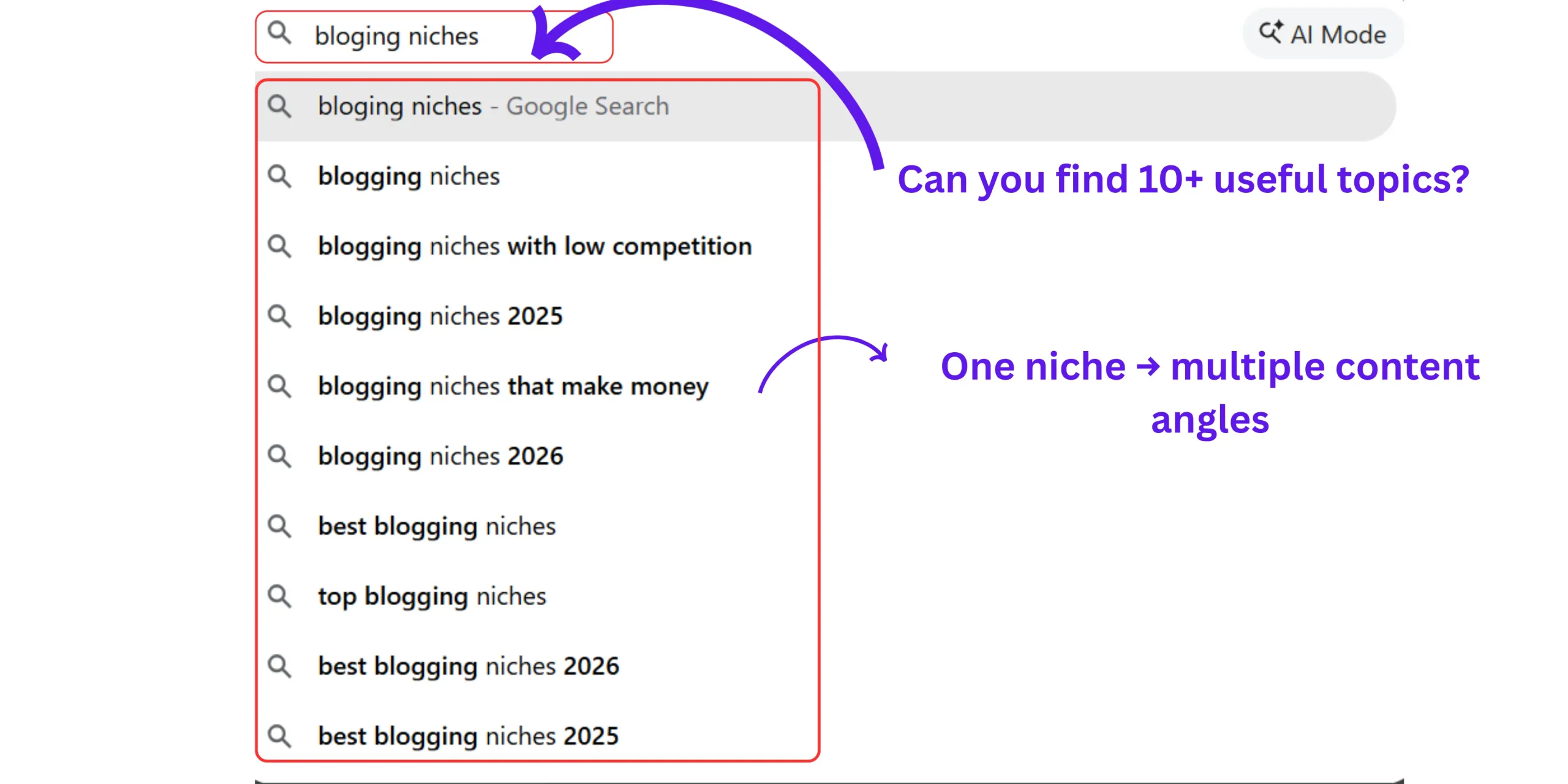
Can I produce 10–20 useful content ideas?
MOTIVATION CHECK
Do I still enjoy researching and writing about this topic?
MARKET CHECK
Are impressions, clicks, engagement, or other audience signals appearing?
DECISION
Continue / Narrow / Pivot
Your first niche is a hypothesis—not a life sentence.
Day 0: Before publishing
Ask yourself:
- Have I cared about this topic for at least several months?
- Can I name 10–20 realistic article ideas?
- Do I have first-hand experience, useful perspective, or a credible way to develop it?
- Can I identify at least one realistic monetization path?
If you already struggle here, don’t build the site yet.
Day 30: Motivation checkpoint
After creating your first batch of content, score your enjoyment from 1–5.
Ask:
“Would I still research this topic if nobody paid me yet?”
Also check whether you are naturally noticing new questions, problems, examples, or content opportunities.
Day 60: Market checkpoint
Now examine the market signals:
- Which topics are getting impressions?
- Which posts are attracting clicks?
- Are readers engaging with the content?
- Are competitors covering the same questions better?
- Have you discovered a narrower audience problem worth owning?
Your goal isn’t massive traffic yet. You’re looking for evidence of potential.
Day 90: Decision checkpoint
Recalculate your PPF Score.
Then choose one of three paths:
Continue: Your interest remains strong and the market shows potential.
Narrow: You still enjoy the topic, but a smaller audience/problem appears more promising.
Pivot: Your interest has collapsed or the market evidence consistently looks weak.
The important point is that a niche decision doesn’t have to be permanent.
Treat your first niche as a hypothesis that earns the right to become a long-term business.
Warning signs you picked the wrong blog niche
Watch for these patterns in your first 30–60 days:
- You’re relying entirely on AI or outside research for every single post idea, with zero first-hand input
- You’ve checked 101 content ideas for beginners or how to find content ideas for beginners more than once because you genuinely can’t think of your own angles
- You feel relief, not disappointment, when you skip a scheduled publishing day
- Every post feels like it needs “research mode” before you can write a single sentence
- You’ve started three unrelated blogs in under a year, each abandoned within weeks
None of these are fatal on their own. But two or more together, within the first two months, is a strong signal to revisit your PPF Score before sinking more time into the wrong niche.
How I validate a niche before committing
My actual process, in order:
- List 10 topics I’ve cared about for over a year, unrelated to whether they make money.
- Run each through Google Trends and autocomplete to confirm demand isn’t declining.
- Score each with the PPF framework above.
- Check for a monetization ceiling — are there real products, affiliate programs, or services people pay for in this space? High-ticket vs low ticket affiliate marketing for beginner bloggers is a useful gut-check here, since a niche’s income potential often depends more on the offer type than the traffic volume.
- Identify seasonality risk. Some profitable niches are seasonal by nature, if that’s you, how to identify seasonal blog niches helps you plan content cadence around it rather than get blindsided by it.
- Only then do I set up the technical side and if you haven’t started yet, how to start a WordPress blog for beginners step by step is the guide I’d follow before writing post #1.
I’ve made the mistake of reversing this order, building the site first, then trying to force interest into whatever niche seemed profitable. It’s a slower, more discouraging way to fail.
Frequently asked questions on passion vs profit blogging
Blog about a topic where your passion and market demand genuinely overlap, not about either extreme in isolation. A passion with zero demand won’t grow, and profit with zero interest won’t survive past a few months of content production.
Most bloggers quit because they see no meaningful traffic or income within the first few months, which is usually the downstream effect of choosing a niche that didn’t sustain their motivation long enough to publish consistently. The topic mismatch is often the real, hidden cause behind the “no traffic” complaint.
A passion blog is organized around the writer’s personal interests, while a niche blog is organized around a specific, searchable audience problem. The most successful long-term blogs are niche blogs built from a real passion, combining both structures rather than choosing one.
A blog niche should be specific enough that you never run out of sub-topics, but broad enough that you have at least ten realistic angles to write about without repeating yourself.
Extremely narrow niches burn out fast because the content well runs dry within a few months, while overly broad niches burn out just as fast because nothing feels focused enough to build momentum. For a deeper breakdown of finding that middle ground, see how specific should a blog niche be.
Yes, you can change your blog niche after you start, and many successful bloggers do exactly this once they see which topics actually hold their interest and attract readers.
The cost of pivoting early, within the first few months and a handful of posts, is far lower than the cost of forcing yourself through a niche that’s already showing burnout signs. Treat your first niche choice as a tested hypothesis, not a permanent commitment.
You should test a blog niche for at least 90 days and roughly 10–15 published posts before deciding whether to continue or pivot.
Shorter than that, and you’re judging the niche on too little data, both search traffic and your own sustained interest take a few months to show a real pattern. Use the PPF Score checkpoints at day 30 and day 90, described earlier in this guide, to make that decision on evidence rather than frustration.
Final thoughts on passion vs profit blogging
Passion vs profit blogging was never really about picking a side, it’s about finding where your genuine curiosity and real market demand meet, and being honest enough with yourself to walk away from a niche that fails either test.
Score your niche idea with the PPF framework, run the 90-day burnout test before you fully commit, and revisit both checkpoints instead of assuming your first pick is permanent.
If you want the deeper, data-driven version of this process, competitor scoring, demand validation, and full market research, the pillar guide, Profitable Blogging Niche Validation & Market Research Frameworks, walks through it step by step.