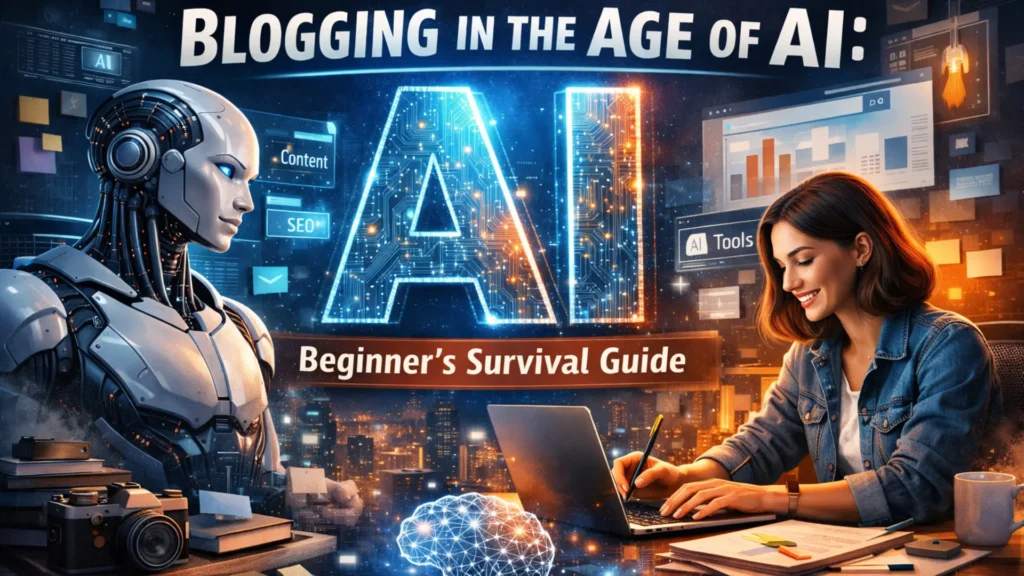

Blogging feels confusing right now, especially for beginners. Everywhere you look, people are saying AI will replace writers, blogs are dying and tools like ChatGPT can create content in seconds. So it’s natural to ask, What Happens to Blogging in the Age of AI? (Beginner’s Survival Guide) and whether starting a blog still makes sense at all. AI and blogging are now deeply connected and that change has created fear, doubt and a lot of misinformation.
Many beginners feel overwhelmed because AI writing tools are growing fast. Some blogs are publishing hundreds of AI articles, while others are disappearing from search results. This leads to big questions about the future of blogging with AI for beginners . Is blogging becoming harder ? Does AI kill blogging for beginners ? Or is this simply the next evolution of online content ?
The purpose of this explanation is to provide you with clarity rather than hype or fear. You’ll learn what AI is really changing in blogging, what it cannot replace and why human-driven blogs still matter. Most significantly, you’ll learn how beginners can adapt, build authority, and decide whether blogging is still valuable in the years ahead.
Table of Contents What happens to blogging in the age of AI? (Beginners survival guide)
What is really happening to blogging because AI?
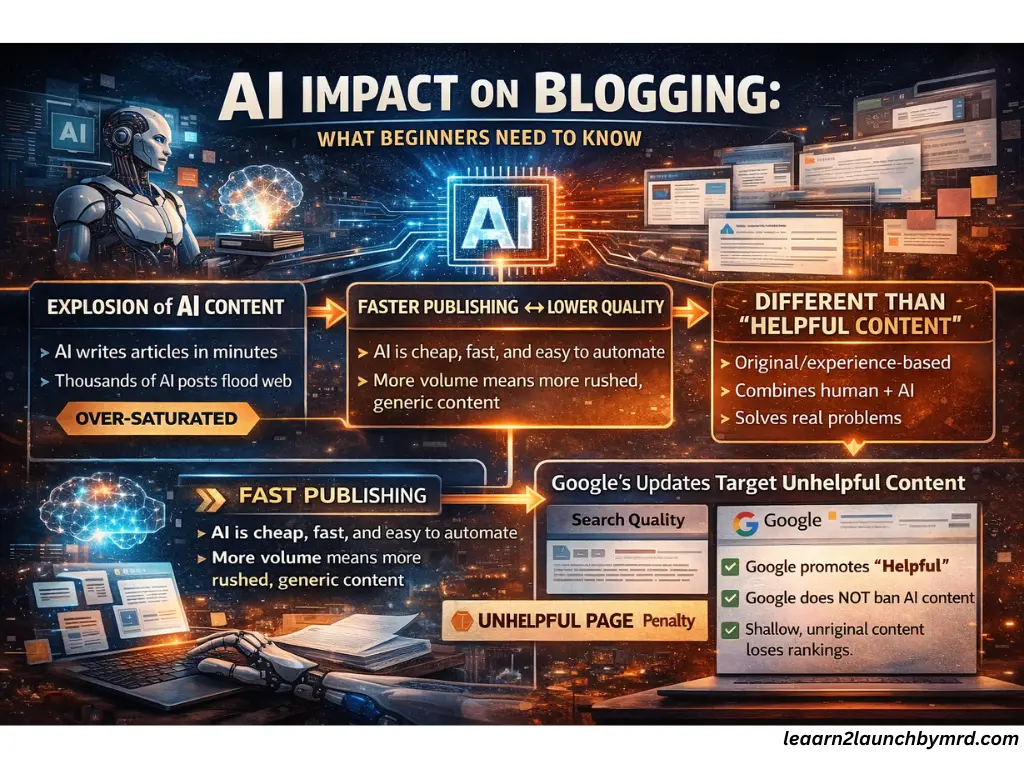
Blogging is changing quickly, but it is not going away. The biggest change comes from the rapid growth of AI-generated content. These days, anyone can use AI tools to quickly publish dozens of articles. Online content creation has completely changed as a result of this.
Here is what actually happens behind the scenes ,
- More content than ever before – Speed has increased, but much of this content repeats the same ideas without real value.
- Readers feel overwhelmed – People now struggle to find clear, helpful answers and Google notices this.
- Faster publishing , lower quality food – Speed has increased but much of this content repeats the same ideas without real value.
Because of this, Google has released multiple updates. These updates are not against artificial intelligence by itself. They target unhelpful content that exists only to rank, not to help users.
There is now a clear difference between ,
- Content – words written to fill pages
- Helpful content – content written to solve real problems
Helpful content shows experience, clarity, and intention. It answers questions fully and honestly. This is why blogs that rely only on AI-written articles often struggle.
One important shift in the AI era is that expertise no longer means being a “perfect expert.” If you’re worried about experience, learning how to create content without being an expert can help you understand how beginners can still publish helpful, trustworthy posts by focusing on clarity, problem-solving and honest learning journeys instead of authority titles.
Future of blogging with AI for beginners
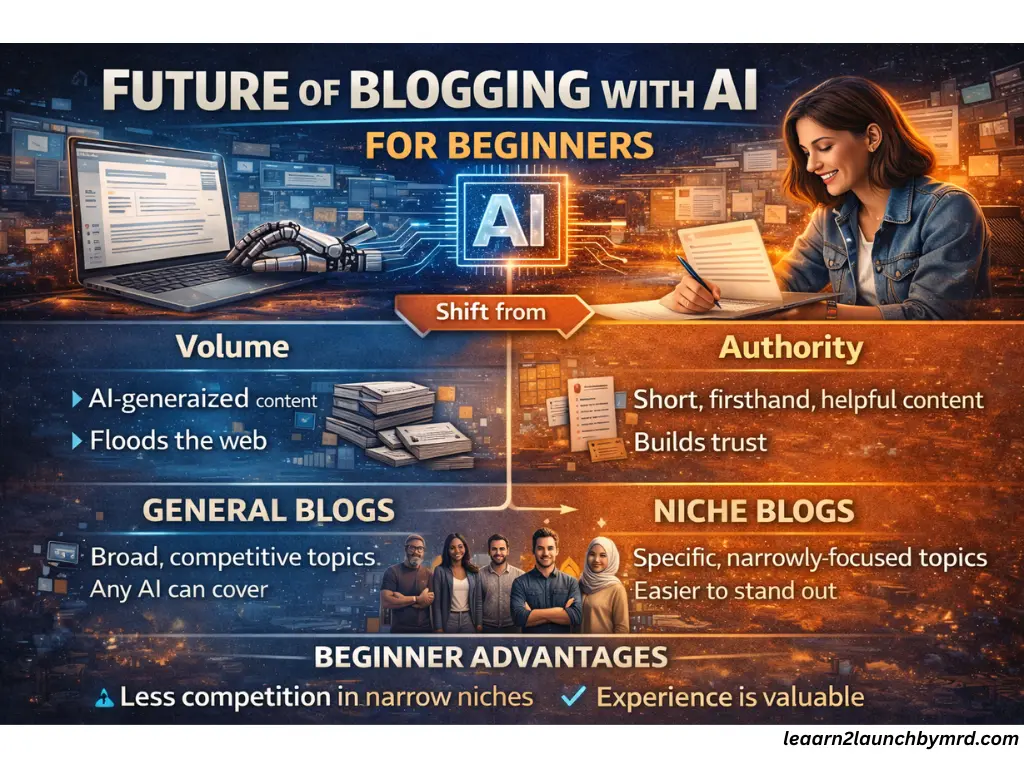
The future of blogging with AI for beginners is not about competing with machines , it’s about adapting to how blogging is evolving. Blogging is shifting , not ending . AI has changed how content is created but it has not removed the need for real knowledge, opinions and guidance.
As blogging becomes more competitive, niche selection matters more than ever. Understanding how to choose the perfect blog niche helps beginners avoid broad topics that AI floods easily and instead focus on narrow, specific problems where real human insight still wins in search results and reader trust.
In earlier times, publishing more articles often meant better results. That strategy is no longer useful. These days, authority is more important than volume. Search engines now reward blogs that show depth, consistency, and understanding of a specific topic.
Here is what matters more than ever,
- Experience based content – Posts that include real insights, examples or lessons perform better than generic summaries.
- Writing topic focus – Writing deeply about one area builds trust with both readers and search engines.
- Helpful structure and clarity – Simple explanations are valued more than complex or keyword stuffed writing.
In this new environment, niche websites have a significant advantage. Focused blogs are better able to focus on specific problems rather than a wide range of unrelated subjects. For this reason, in the era of AI, niche blogs are stronger than general blogs.
This is actually good news for beginners. Large websites often publish in bulk and follow trends, which leaves gaps in smaller, more focused topics. Narrow niches are typically easier to rank because there is less competition.
Blogging is still an important long-term skill and opportunity for beginners who pick a clear niche, write intentionally, and use AI as a support rather than as a replacement.
Does AI kill blogging for beginners?
Many people ask the same question again and again, Does AI kill blogging for beginners? The fear is understandable. AI tools can now write full articles in minutes, which makes blogging look crowded and competitive. When beginners see thousands of AI-written posts published daily, it’s easy to believe there’s no room left.
This belief comes from a few common reasons,
- AI makes content creation very fast
- Some blogs publish hundreds of posts using automation
- Beginner blogs struggle to rank or lose traffic suddenly
But this is the truth , AI is not what causes most beginner blogs to fail.
Beginner blogs usually fail because of,
- Copying what others write without adding value
- Choosing topics that are too broad
- Publishing without a clear content strategy
- Relying fully on AI generated text without human input
Unhelpful content, or content created just for search engine optimization rather than to benefit readers, is what really kills blogs. Google’s Helpful Content System is useful in this situation. AI content is not restricted by Google. Rather, it targets pages that provide no experience, clarity or, actual usefulness.
AI can help bloggers, but when it’s misused, it produces articles that are uninteresting and ignore issues. Blogs with unique ideas, organization, and purpose continue to do well.
So no, AI does not kill blogging for beginners. Poor strategy, lack of focus and low-value content do.
Many blogs fail not because of AI, but because they run out of meaningful ideas. Learning how to find content ideas for beginners makes it easier to spot real questions people ask, create helpful posts consistently and avoid publishing generic content that search engines now ignore.
Will AI replace bloggers completely?
A common concern today is whether will AI replace bloggers completely n the near future. AI tools are impressive, and they can handle many blogging-related tasks efficiently. Understanding what AI can and cannot do helps clear this confusion.
AI works well at,
- Generating drafts quickly
- Summarizing existing information
- Rewriting and organizing content
- Assisting with research and outlines
These abilities make AI a useful support tool. However, AI has clear limitations that matter deeply in blogging.
AI cannot –
- Share real life experience
- Build genuine trust with readers
- Form original opinions
- Understand context the way humans do
Human judgment is still important in this situation. Writing is only one part of blogging. It includes understanding issues, selecting what actually helps, explaining ideas in a way that is relatable. AI cannot make decisions based on empathy, connect ideas, or adjust tone like a human blogger can.
Simple comparison –
- AI thinking follows patterns
- Human thinking creates meaning
- Automation increases speed
- Creativity increases value
Because their content is weak and repetitive, AI-only blogs often fail in the long run. Readers and search engines quickly pick this up. Blogs that mix AI support with human insight keep to be popular.
AI can support bloggers, but it cannot replace the human voice that makes a blog worth reading.
Is blogging still worth it in 2026 for beginners?
Many bloggers wonder , is blogging still worth it in 2026 for beginners? The short answer is yes, but with some important conditions. Blogging is no longer a “ quick-win ” strategy and success depends on how you approach it.
Blogging success today isn’t only about massive traffic. Learning how to monetize a blog with low traffic shows beginners how focused content, trust, and intent based monetization can generate income , even before reaching large visitor numbers.
Blogging is worth it when you,
- Focus on a specific niche where you can provide real value
- Write content that solves problems for your readers
- Build authority through consistency and experience
- Use AI as a support tool , not a replacement
This makes blogging more than just a means of making money. You improve knowledge of research, writing, SEO, audience understanding, and content strategy, all of which are essential for continued online success. The process becomes much faster and more effective when you integrate your human perspective with AI tools.
But , blogging is not worth it if you,
- Rely only on AI content without adding your voice
- Fail to plan or target the right audience
- Expect instant results
- Treat it like a shortcut to money
Rushing, ignoring audience needs, or skipping strategy are common mistakes made by beginners. Learning, patience, and focus are essential. Keep in mind that the goal of blogging + AI is to intelligently boost effort rather than to replace it.
Great content needs visibility. Learning how to write hooks for social media as a beginner helps you promote blog posts effectively, attract the right readers and reduce dependence on search engines alone an important survival strategy in the AI era.
In short, blogging in 2026 is still a strong opportunity for beginners but only for those willing to combine human insight, careful strategy and smart AI use. With this approach, your blog can grow into a valuable and lasting online presence.
Many beginners hesitate because they think blogging is technically complex. Following a clear guide on how to create a WordPress blog for beginners step by step removes that fear and allows you to focus on content quality, consistency and strategy instead of platform confusion.
How beginners can survive blogging in the age of AI?
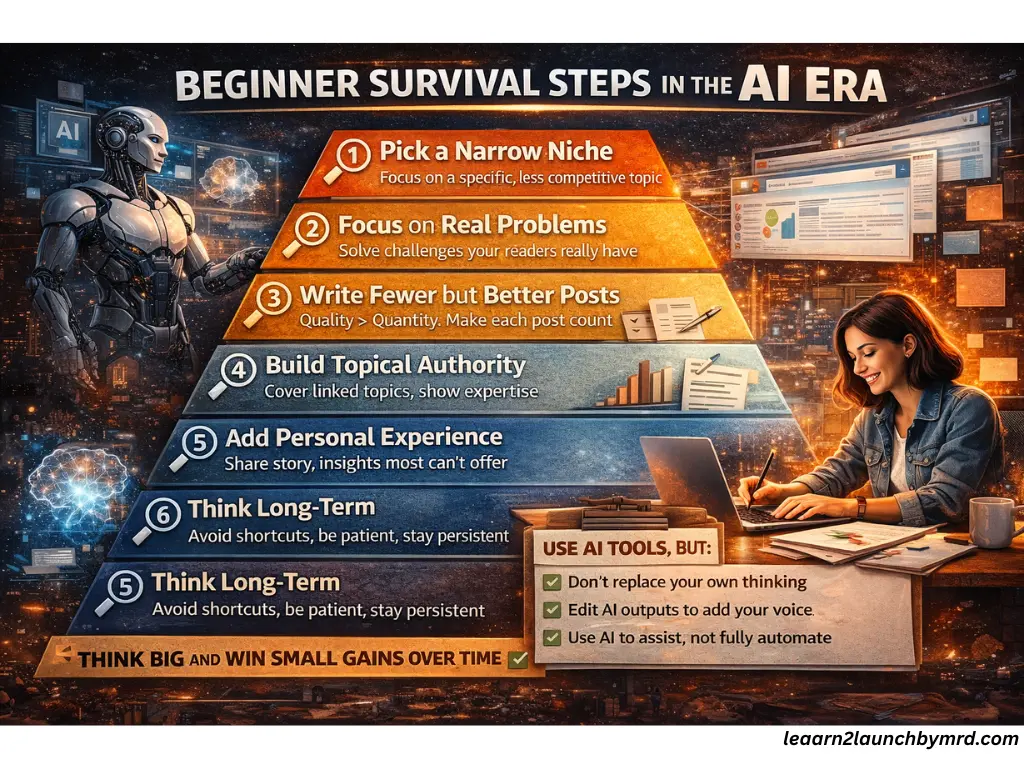
Surviving blogging in the age of AI might seem overwhelming, but beginners have a real advantage if they follow the right steps. Success is no longer about producing a huge volume of content, it’s about strategy , value and human insight. This is the step by step guide to thrive in this new blogging era.
- Pick a narrow niche – Focus on a specific topic instead of covering everything. Narrow niches face less competition and make it easier to become an authority.
- Focus on real problems – Focus on a specific topic instead of covering everything. Narrow niches face less competition and make it easier to become an authority.
- Write fewer but better posts – Quality beats quantity. One well researched, helpful post can outperform ten generic AI-generated articles.
- Build topical authority – Consistently cover subtopics within your niche. Google rewards blogs that show depth and expertise over time.
- Add personal experience (even small ones) – Share your insights, lessons or mistakes. This human touch is something AI cannot replicate and makes your content unique.
- Thinking long term – Avoid shortcuts. Focus on building a blog that grows steadily over months and years. Traffic, trust and authority compound over time.
Beginners may succeed in the AI era by using this strategy. AI tools need to be your helper, supporting you with research, writing outlines, and editing, but never taking the place of your unique point of view.
Smart bloggers don’t guess , they measure. Learning how to use analytics to improve monetization strategy allows beginners to see what content works, what converts and where to focus efforts instead of publishing blindly in an AI-saturated environment.
Your blog will be readable, valuable, and search engine friendly if you follow these steps. This strategy fits Google’s preference for useful, actionable content in along with satisfying the “how to survive blogging with AI” search intent. Your blog will stand out if you start small, maintain consistency and allow your human perspective to shine.
Surviving blogging in the AI era starts with strong fundamentals. If you’re just starting out, learning how to write your first blog post for beginners helps you focus on structure, intent and clarity skills that matter more than volume in today’s AI-influenced search landscape.
With search results changing fast, owning your audience is critical. Understanding how to build an email list for beginners helps you protect your blog from algorithm changes and build long-term relationships that AI tools and platforms can’t replace.
How to use AI tools without hurting your blog
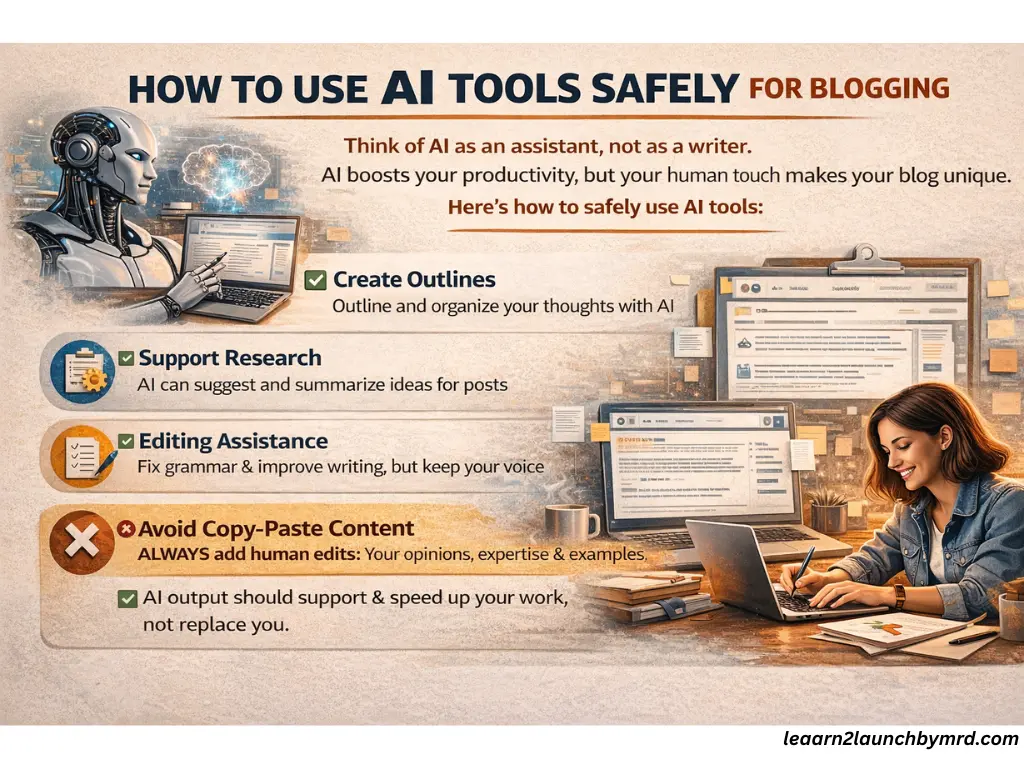
Although AI tools are powerful, beginners often fear they might harm their blog’s quality or SEO. The secret is to use AI as a helper rather than a complete writer. When applied properly, AI may improve ideas, save time and make your blog stronger without replacing your human voice.
AI is only one part of the bigger picture. Exploring the best content creation tools and strategies for beginners helps you combine AI, SEO, writing systems and consistency creating a workflow that supports quality blogging rather than replacing human thinking.
This is how beginners can use AI safely,
- Create outlines – Use AI to organize your thoughts and structure posts before you write. This ensures your content flows clearly.
- Support research – AI can help summarize topics, suggest references, or find statistics but always double-check accuracy.
- Editing assistance – Use AI to check grammar, simplify sentences, or suggest improvements. This speeds up the writing process without replacing your insights.
- Avoid copy paste content – Never publish AI output as is. Copying text can lead to generic content and poor rankings.
- Always add human edits – Add your opinions, experience, and personal examples. This makes your content original, trustworthy and helpful for readers.
Beginners should focus on clarity and simplicity. AI is not a replacement for your effort; rather, it is a tool to improve it. When used properly, it increases your output while maintaining the authenticity and SEO-friendliness of your blog.
AI can be powerful when used correctly. If you’re unsure where to start, this guide on how to use ChatGPT to write blog posts for beginners explains how to use AI for outlines, research and clarity without replacing your voice or harming long-term SEO performance.
Frequently asked questions on What Happens to Blogging in the Age of AI? (Beginner’s Survival Guide)
Does AI kill blogging for beginners?
No, AI does not kill blogging for beginners. While AI tools can produce content quickly, blogs fail mainly due to poor strategy, low-quality content and lack of focus. Beginners who use AI responsibly as an assistant for research, outlines, and editing ,can still create successful, high-quality blogs.
Is blogging still worth it in 2026 for beginners?
Yes, blogging is still worth it in 2026 for beginners, especially for niche topics. By combining human insights with AI tools, beginners can write helpful, experience based content, build authority and grow their blogs long-term. Patience and consistency remain the key to success.
Will AI replace blogging completely ?
No, AI cannot replace bloggers completely. AI can assist with drafting, research and editing, but it cannot replicate human experience, trust and original opinions. Blogs that combine AI support with human creativity and personal insights perform best.
How can beginners survive blogging in the age of AI?
Beginners can survive by choosing a narrow niche, focusing on solving real problems, writing fewer but higher-quality posts and adding personal experience. Using AI as a tool not a replacement and thinking long-term will help blogs stand out.
How should beginners use AI tools for blogging without hurting SEO?
Beginners should use AI tools to create outlines, assist with research and edit content. Avoid copy-pasting AI generated text. Always add human edits, insights and examples to make content original, helpful and SEO friendly.
Final thought on blogging in the AI era
What happens to blogging in the age of AI? (Beginner’s survival guide) shows that AI is not your enemy, it’s a tool to help you work smarter. Blogging is evolving, and while the landscape is changing, beginners who adapt and focus on quality will still succeed.
The future of blogging with AI for beginners is full of opportunity. By understanding that AI does not kill blogging for beginners , and that strategic, helpful content still wins, you can create blogs that grow over time. Even if you wonder is blogging still worth it in 2026 for beginners, the answer is yes ,if you approach it with focus, patience and intention.
Visual content plays a growing role in blog promotion. Using tools like Canva becomes easier when you understand how to use Canva for social media content creation, allowing beginners to repurpose blog posts into simple visuals without design experience or heavy tools.
Ultimately, blogging in the AI age is about strategy, not shortcuts. If your goal is sustainability, learning how to create a WordPress blog that makes money helps connect content, traffic, trust and monetization into one long-term system, even as AI continues to evolve.
Your goal should be to use AI effectively, add a unique viewpoint, and gain the audience’s trust. Blogs that combine AI support with human viewpoints will be more memorable and last longer.
Take action today, pick a niche, write for real readers, and use AI as a tool. The blogging industry is changing, and those who adapt now will take the lead in the future.