
Wondering how to edit AI generated content for SEO ? You are not alone , many beginners are publishing AI written blog posts and then asking the same question ,
“Does AI content rank on Google?”
The honest answer ? It can , but not without proper editing.
Raw AI content often sounds;
- Generic
- Repetitive
- Surface level
- Lacking real experience
That’s why simply copying and pasting from ChatGPT rarely works. Search engines don’t reward “AI content” . They reward helpful , structured , optimized content .
The good news? You don’t need to rewrite everything from scratch.
In this guide , you will learn,
- How to Humanize AI generated content for SEO
- Practical steps for editing ChatGPT content for SEO
- How to rewrite AI content for better rankings
- And how to optimize AI written content for SEO without keyword stuffing
If you’re a beginner publishing raw AI drafts, this step by step editing framework will help you turn average content into something that can actually rank and build authority over time.
Table of Contents – How to edit AI generated content for SEO?
Does AI content rank on Google?
So , Does AI content rank on Google?
Yes , but not simply because it was written by AI.
Google has clearly stated that it does not automatically penalize AI generated content. What matters is quality , not whether a human or a tool wrote it. If the content is helpful, accurate and satisfies search intent, it can rank.
Here’s what actually matters;
- Depth and usefulness
- Clear structure
- Accurate information
- Strong on page SEO
- Trust signals ( experience, clarity, credibility )
This connects to something called E-E-A-T , Experience – Expertise – Authoritativeness – Trustworthiness. In simple terms, Google wants content that feels reliable and written with understanding, not robotic or generic.
Understanding whether AI content ranks also ties into how to do on page SEO for blog posts. Even AI-written content benefits from proper on-page optimization, helping your articles stand out and align with search intent effectively, which is essential for any beginner blogger.
Myth busting
“AI content is banned by Google”
No , It’s not.
“Publishing AI content guarantees rankings.”
Also false
The truth ? AI is just a tool. If you publish raw drafts without editing, your content will likely feel thin and repetitive. But when you properly refine and optimize it, AI assisted content can absolutely rank.
Editing is what turns average AI text into search worthy content.
Why raw AI content fails to rank
Many beginners assume AI content doesn’t rank because it’s “ AI”. But the real problem isn’t the tool , it’s the lack of refinement.
Raw AI drafts often fail because they lack search intent depth . They answer a topic broadly but don’t fully match what the user is actually looking for. Ranking pages go deeper, clearer and more specific. You will also notice, You will also notice,
- Generic phrasing that sounds repetitive
- No real examples or practical insights
- Surface level explanations
- Overused or awkward keyword repetition
Another major issue is weak structure . AI content sometimes mixes ideas without clear H2 and H3 organization. That makes it harder for both readers and search engines to understand the content hierarchy.
Then there’s internal linking. Most AI drafts don’t naturally include relevant internal links to related posts. This weakens topical authority and SEO signals.
Finally, beginners often over-optimize by stuffing keywords everywhere. That makes the content feel unnatural, and Google notices.
The takeaway? AI drafts are a starting point. Without editing, structure and strategic optimization, they rarely compete with well crafted human refined content.
Many AI drafts struggle because they miss structured guidance, similar to how How to structure a blog for beginners emphasizes clear headings and logical flow. Applying that mindset ensures AI content feels coherent and reader friendly, not just algorithmically generated.
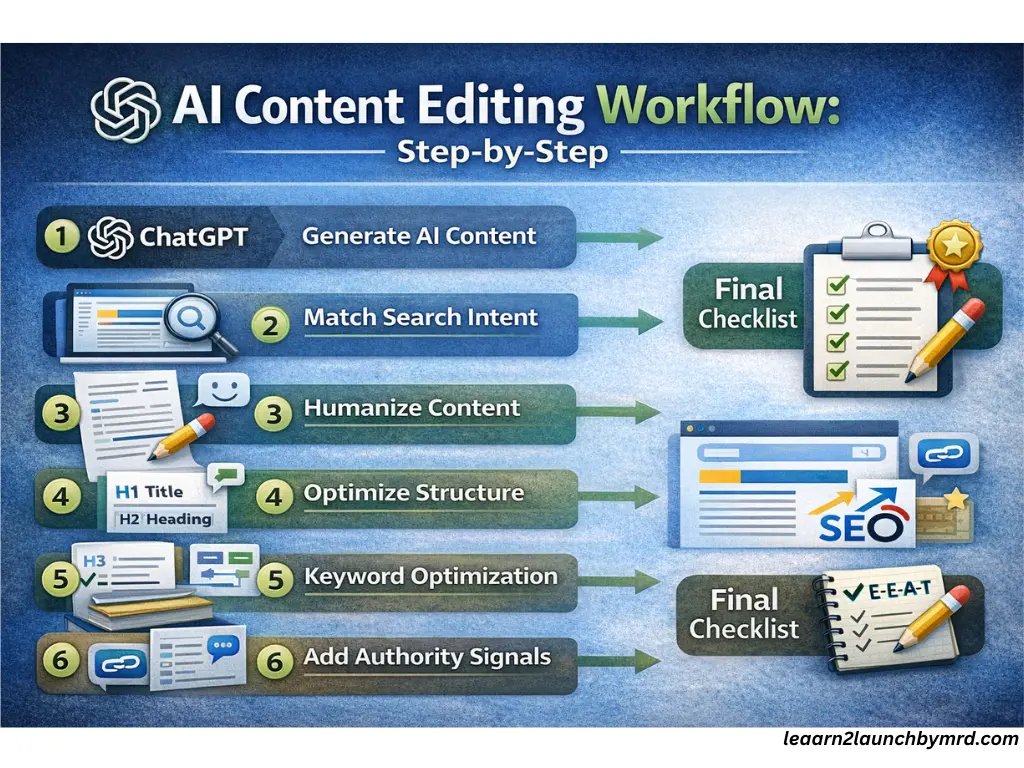
Step 01 . Match search intent before editing.
Before you start rewriting anything, stop and check one thing first ; Search intent.
If you truly want to learn how to optimize AI written content for SEO, you must understand what Google already rewards.
Here’s what to do,
- Analyze the top 5 ranking pages
- Identify the content format (guide, list, tutorial, case study)
- Check the average word count and depth
- Look for patterns in headings and structure
Ask yourself ,
- Are they detailed step by step guides?
- Do they include examples?
- Are they beginner focused or advanced?
Next, compare headings.
Open the top pages and scan their H2 and H3 sections. What subtopics are they covering that your AI draft missed?
For example,
- Do they include a checklist?
- Do they address common mistakes?
- Do they explain myths?
If your draft lacks those angles, add them.
This step alone can dramatically improve rankings. AI content often stays surface-level. Matching search intent ensures your edited version aligns with what users and Google actually expect to see.
Focusing on relevance also links to what is Quality content for a new blog. Identifying missing angles in AI content ensures your blog provides genuine value, engages readers and meets the standards of quality content that Google favors.
Step 02 . Humanize AI generated content
If you want your content to rank, you must humanize AI generated content for SEO
Most raw AI drafts sound technically correct but emotionally flat. They lack personality, rhythm, and real experience. That’s a problem because readers ( and Google ) respond better to content that feels authentic.
Start by removing robotic phrasing.
AI often writes things like:
“Moreover, it is important to note that…”
“In today’s digital landscape…”
These phrases feel generic and overused.
Next, add:
- A natural, conversational tone
- Simple language
- Real examples
- Personal insights or observations
- Clear transitional phrases like “ Here’s why”, “Now let’s look at” or “The real reason is…”.
Also, vary your sentence structure. AI tends to repeat patterns like:
“This is important because…”
“This helps improve…”
“This allows you to…”
Break that rhythm.
As you humanize content, keep in mind insights from what happens to blogging in the age of AI. Readers notice generic phrasing and understanding AI’s role helps you create personable content that resonates and feels authentic.
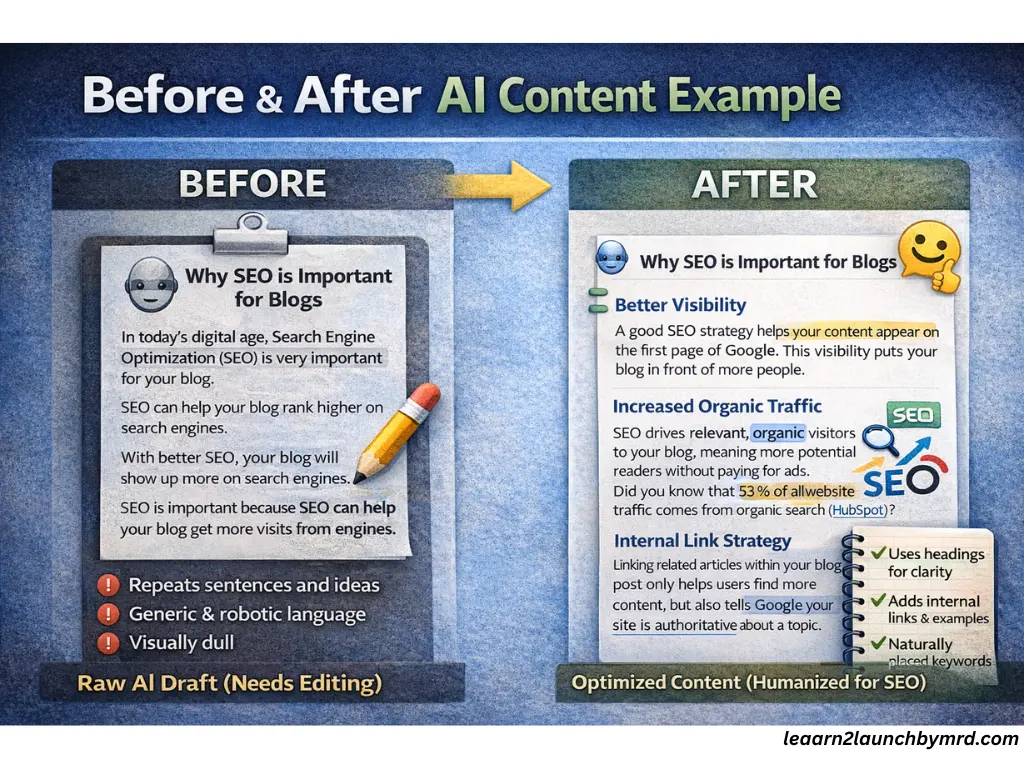
Before and after example
Before (AI draft) –
“Optimizing AI content is essential for better rankings because it improves SEO performance.”
After (Humanized) –
“If you don’t edit your AI draft, it will likely stay buried in search results. Optimization is what turns a decent draft into something that actually ranks.”
See the difference? Same idea , but stronger, clearer, and more engaging.
That’s how you transform average AI output into content that feels real and rank worthy.
Step 03 . Editing ChatGPT content for SEO structure
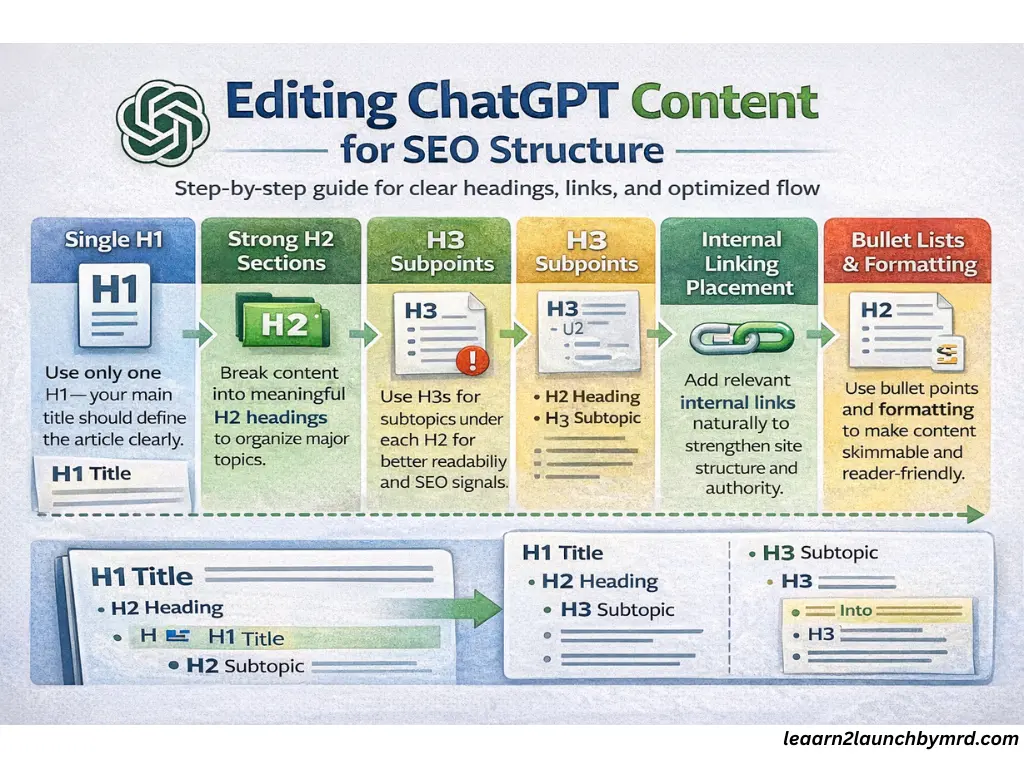
When it comes to editing ChatGPT content for SEO , structure is everything. Even well written content can struggle to rank if it’s poorly organized.
Start with the basics:
- Use only one H1 (Your main title)
- Break content into clear H2 sessions
- Use H3 subpoints to organize deeper ideas
This helps both readers and search engines understand your content hierarchy.
Each major section should also have a short introduction. Don’t jump straight into bullet points. A 1 – 2 sentence intro improves flow and clarity.
Next, think about internal linking. Add relevant internal links naturally inside paragraphs, not randomly. Place them where they genuinely support the reader.
Bullet points are powerful too. They,
- Improve readability
- Highlight key ideas
- Increase time on page
- Make scanning easier
A structured approach also prevents mistakes highlighted in why most blogs fail before making money. Proper headings, bullet points and internal links make your AI content both readable and strategically positioned for long term success.
Step 04 . How to rewrite AI content for better rankings
If you’re serious about rankings, you need to understand How to rewrite AI content for better rankings , not just lightly edit it
Most AI drafts are informative but thin. They touch the surface without going deep enough to compete with top-ranking pages.
Start by expanding weak sections.
Ask yourself:
- Does this section fully answer the reader’s question?
- Is there a missing explanation?
- Can I add a practical example?
Next, consider adding,
- A short FAQ section to capture related search queries
- Relevant statistics (only if they truly add value)
- Simple case style examples to make the advice practical
Also, clarify vague statements. AI often writes lines like:
“Optimizing content improves visibility”.
That’s too broad.
Rewrite it to explain how and why.
For example:
“Optimizing headings and internal links helps search engines understand your topic, increasing your chances of ranking higher”.
In the end, improve headline clarity. Replace generic subheadings like “Important Tips” with specific ones like “ How to Optimize AI Headlines for Higher Click Through Rates”.
Depth wins. Usefulness wins. When your rewritten content provides clearer, more detailed answers than competitors, rankings follow.
Adding real life examples or personal insights links to how to build trust on social media as a beginner. Demonstrating expertise and sharing actionable tips builds credibility, making your AI generated content feel more human and trustworthy.
Step 05 . Optimize keywords without stuffing
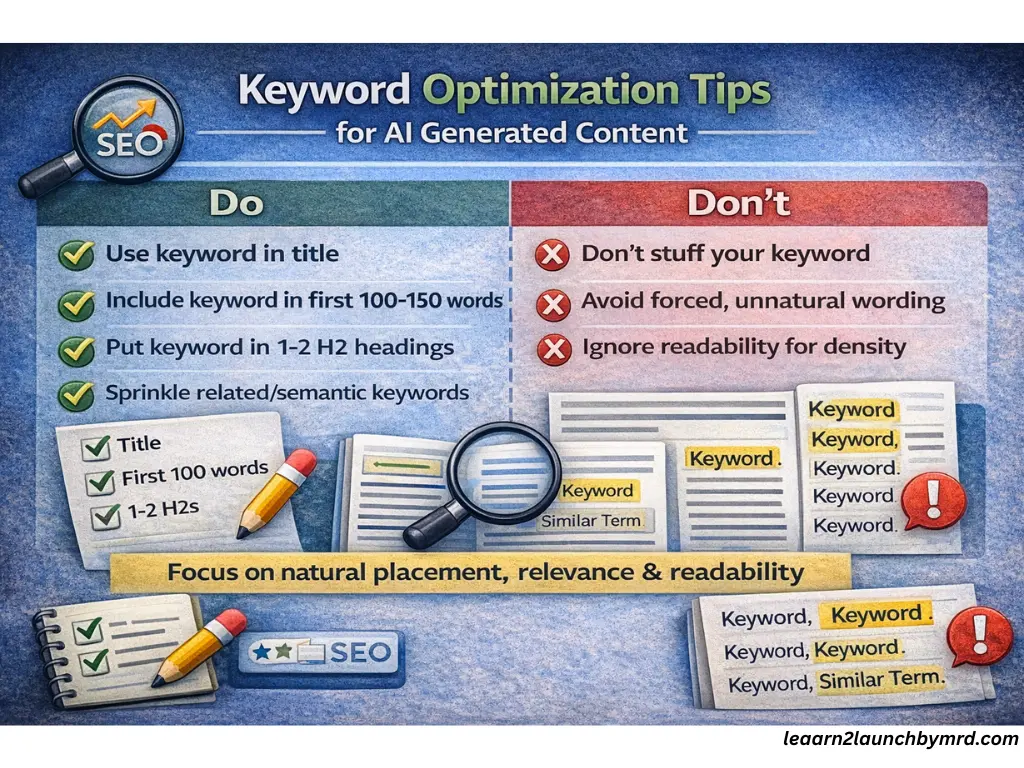
Once your AI content is humanized and structured, it’s time to focus on , how to optimize AI written content for SEO , without overdoing it. Start by placing your primary keyword strategically,
- In the title
- Within the first 100 words of your post
- In 1 – 2 H2 headings
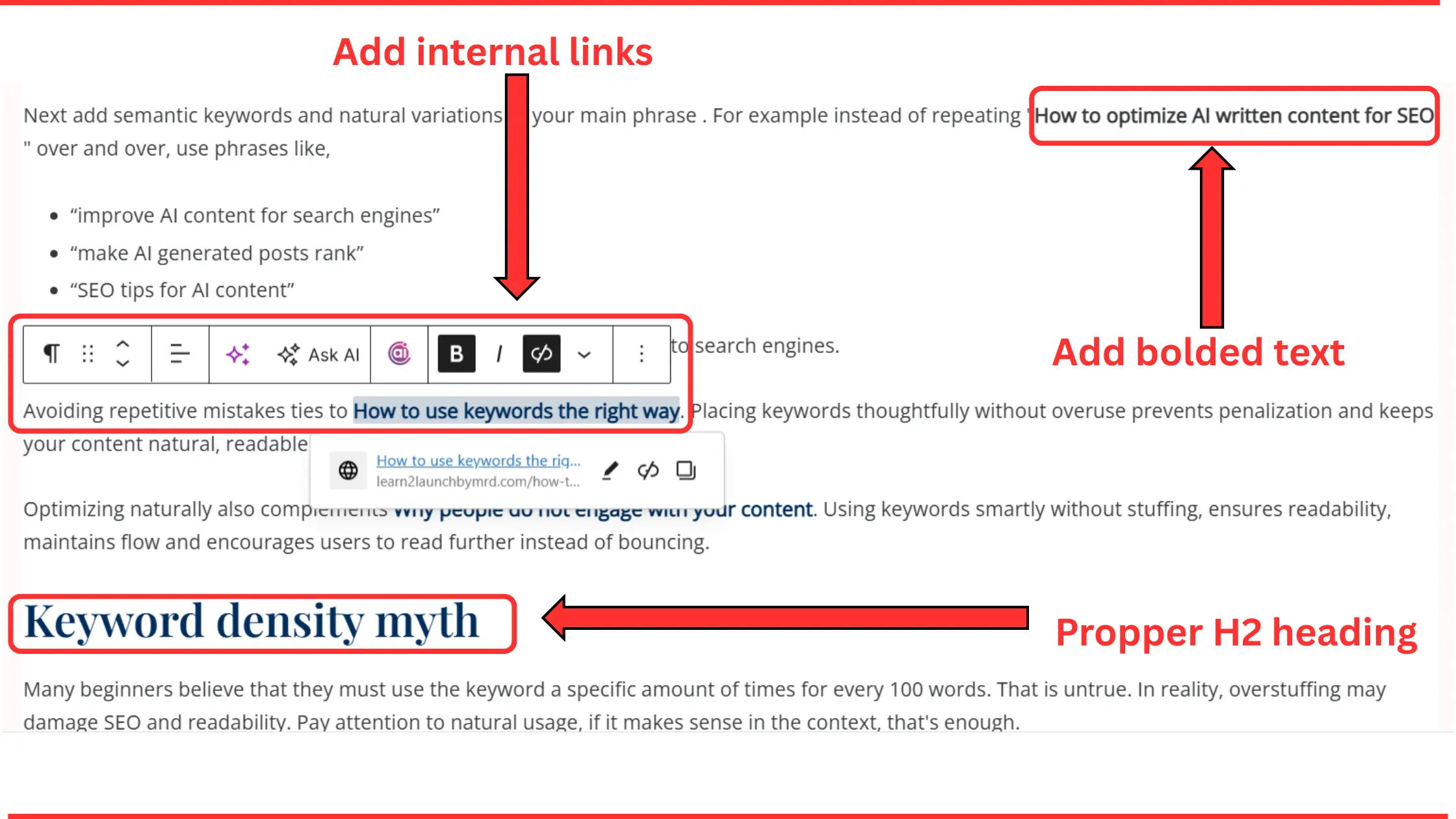
Next add semantic keywords and natural variations of your main phrase . For example instead of repeating “How to optimize AI written content for SEO ” over and over, use phrases like,
- “improve AI content for search engines”
- “make AI generated posts rank”
- “SEO tips for AI content”
This approach keeps your content readable while signaling relevance to search engines.
Avoiding repetitive mistakes ties to How to use keywords the right way. Placing keywords thoughtfully without overuse prevents penalization and keeps your content natural, readable and effective for SEO.
Optimizing naturally also complements Why people do not engage with your content. Using keywords smartly without stuffing, ensures readability, maintains flow and encourages users to read further instead of bouncing.
Keyword density myth
Many beginners believe that they must use the keyword a specific amount of times for every 100 words. That is untrue. In reality, overstuffing may damage SEO and readability. Pay attention to natural usage, if it makes sense in the context, that’s enough.
Your AI content will feel natural and interesting to readers while being optimized for search engines by combining semantic variations with strategic placement.
Step 06 . Add authority signals to AI content
It’s important to include authority signals in your AI content to show to readers and Google that your post is reliable in order to improve its ranking.
Internal links should come first. In order to improve topical authority and help search engines in understanding the structure of your website, naturally link to related posts on your blog, such as case studies or guides.
Next, if required, take into account external references. Trust is increased by reputable sources, data, or quotations; just be sure they are reliable and relevant.
Citing sources and linking internally can be reinforced by insights from How to use ChatGPT to write blog posts for beginners. Combining AI assistance with authoritative references strengthens credibility and user trust.
Formatting is also important. To make content readable, use bullet points, brief paragraphs, and bolded key phrases. A well-defined structure enhances user experience and shows professionalism.
Keep your author tone unchanged throughout. Your voice should sound confident, friendly, and knowledgeable. Whenever possible, use examples to support your points, this improves credibility and clarity.
E-E-A-T (Experience, Expertise, Authoritativeness, Trustworthiness) is related to each of these steps. Clear formatting, links and simple, humanized explanations make it easier for Google to recognize the value and reliability of your AI-edited content.
Common mistakes when editing AI content
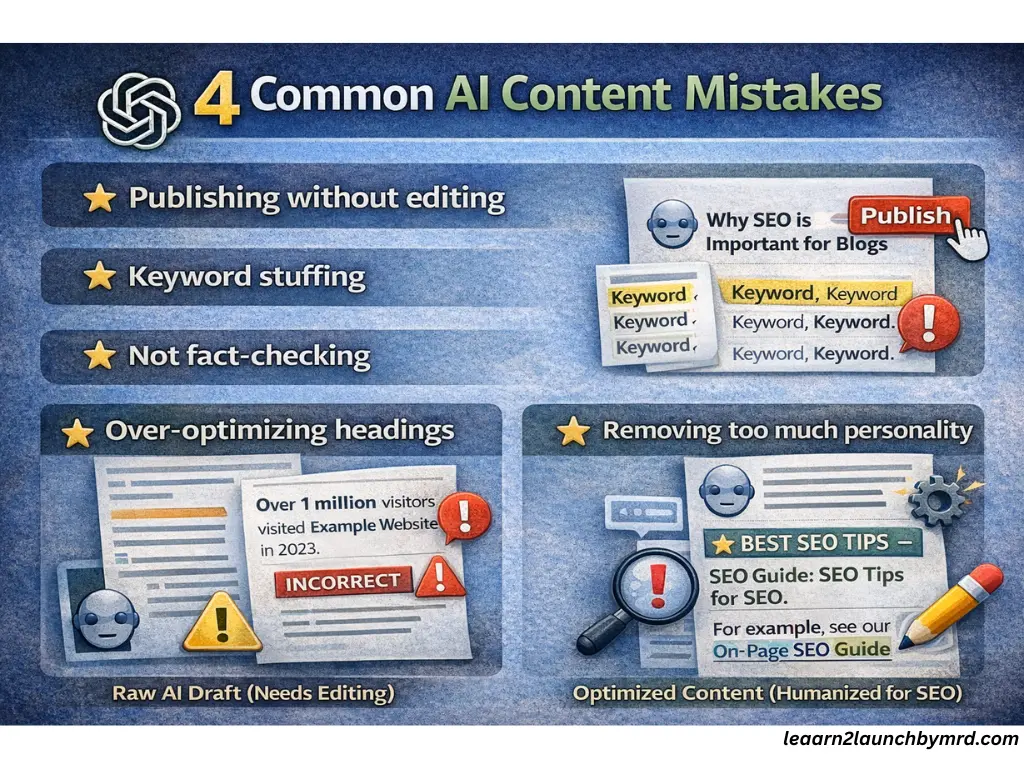
Even after generating AI content, beginners often make mistakes that prevent posts from ranking. Avoid these pitfalls,
- Publishing without editing – Raw AI drafts usually feel generic and lack depth. Always refine before hitting publish.
- Keyword stuffing – Repeating your main keyword unnaturally can hurt readability and SEO. Use natural variations instead.
- Not fat checking – AI can produce inaccurate statements. Verify statistics, dates, and claims before publishing.
- Overoptimizing headings – Stuffing H2s or H3s with keywords makes content robotic. Keep headings clear and human friendly.
- Removing too much personality – While editing, don’t strip your content of examples, opinions, or human tone. Readers engage with relatable content.
Your AI generated content will be both reader-friendly and search engine optimized if you stay clear of these common mistakes. Additionally, using this easy checklist increases the chance that your post will show up in Google’s featured snippets.
AI content editing checklist
Here is a simple , scannable checklist to make sure your AI content is fully optimized and ready to rank
- Search intent matched – Ensure your content answers what users are actually searching for.
- Human tone added – Make the content engaging, relatable, and free from robotic phrasing.
- Clear heading structure – Use one H1, meaningful H2s, and H3 subpoints for easy readability.
- Internal links inserted – Link to relevant posts naturally to improve SEO and topical authority.
- Keyword placed naturally – Include your primary keyword and variations without stuffing.
- Meta description optimized – Write a clear, enticing description including your main keyword.
- Images optimized – Add relevant images with descriptive file names and alt text.
Leveraging tools also relates to best content creation tools for bloggers. Using the right apps can help streamline editing, format headings, check keyword placement, and ensure AI content meets SEO and quality standards efficiently.
How long does it take AI content to rank?
If you’re wondering how long it takes for AI-edited content to rank, the realistic answer is 4 – 12 weeks on average.
Timing depends on several factors,
- Domain authority – Established sites rank faster.
- Competition – Highly competitive topics take longer.
- Internal linking – Well linked posts perform better.
- Content depth – Detailed, useful posts outrank shallow content.
The secret is consistency. Keep going publishing well-written, edited AI content while following to SEO best practices. This improves rankings, increases authority, and helps your posts attract consistent, long-term organic traffic over time.
Frequently asked questions on how to edit AI generated content for SEO
Does AI content automatically rank on Google?
No. AI content does not automatically rank on Google. Search engines prioritize helpful, well-structured, and humanized content. Proper editing, adding depth and optimizing headings and keywords are essential to improve rankings.
How can I humanize AI generated content for SEO?
You can humanize AI content by removing robotic phrases, adding personal examples, using a conversational tone and improving transitions. This makes the content more engaging and trustworthy for readers while boosting SEO.
What is the best way to rewrite AI content for better rankings?
Focus on expanding thin sections, clarifying vague statements, adding FAQs, including statistics and improving headline clarity. This ensures the content satisfies search intent and provides value beyond a standard AI draft.
How do I optimize AI written content for SEO without keyword stuffing?
Place your primary keyword in the title, first 100 words, and a few H2s. Include semantic variations naturally, avoid repetition, and focus on readability. Keyword density myths should not guide your strategy.
How long does it take AI content to rank on Google?
AI-edited content typically takes 4 – 12 weeks to rank. Factors include domain authority, competition, internal linking, and content depth. Consistent publishing and proper SEO optimization speed up results.
In the end of this , how to edit AI generated content for SEO is the real game-changer. AI alone doesn’t rank by default, without editing, most drafts feel generic and lack depth.
By humanizing AI generated content for SEO , structuring it properly, and strategically placing keywords, you turn basic drafts into valuable, reader-friendly posts. Remember to focus on editing ChatGPT content for SEO and learning how to rewrite AI written content for better rankings , these steps improve both authority and readability.
When combined with a human touch, SEO performs at its peak. To make your content acceptable and interesting, include examples, internal links, and unique headings.
When combined with a human touch, SEO performs at its peak. To make your content acceptable and interesting, include examples, internal links, and unique headings.