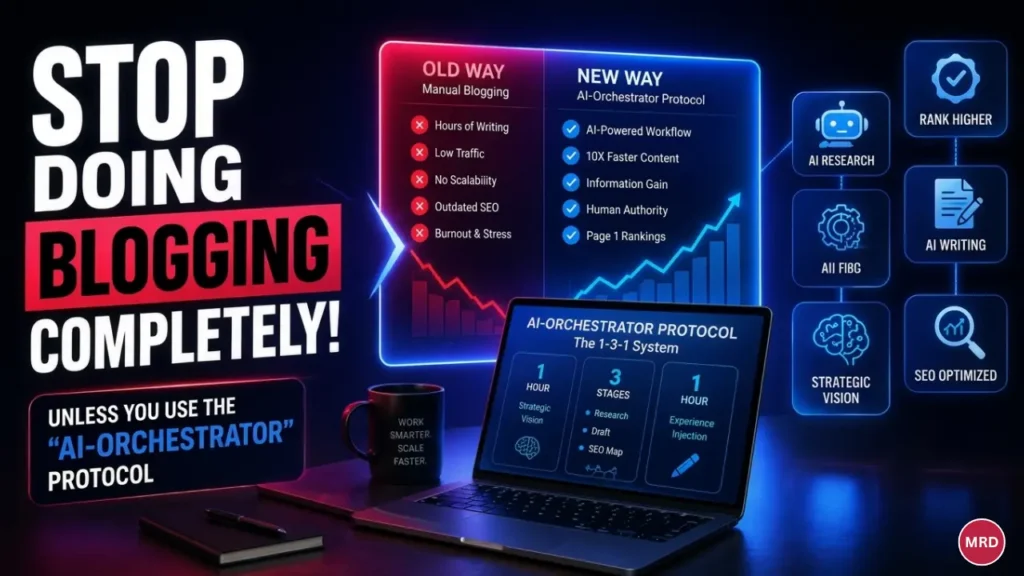

Most people treat blogging like a hobby, but the “1% of online business owners” treat it like an automated machine. If you are still following the 2022 playbook of manual writing and basic SEO, you are effectively shouting into a void. In this guide, I’m going to introduce a new system, the AI-Orchestrator Protocol. This isn’t just about using “better prompts”, it is a fundamental shift in how we create, rank, and monetize. We are moving past the era of the writer and into the era of the systems architect.
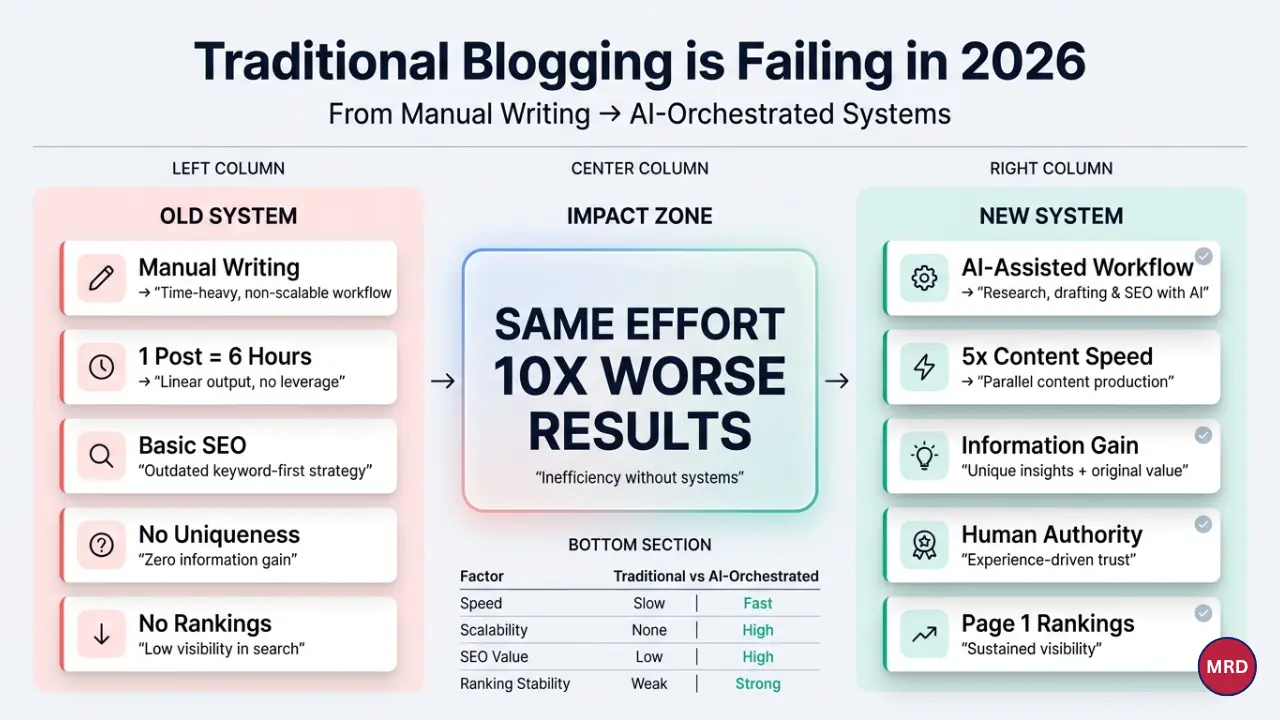
The content density trap : Why traditional blogging is failing in 2026?
If you’re still sitting at your desk for six hours a day, painstakingly typing out every single sentence of a “How-to” guide, I have a difficult truth for you: You aren’t building a business, You are working a low paid clerk job for a boss that doesn’t exist.
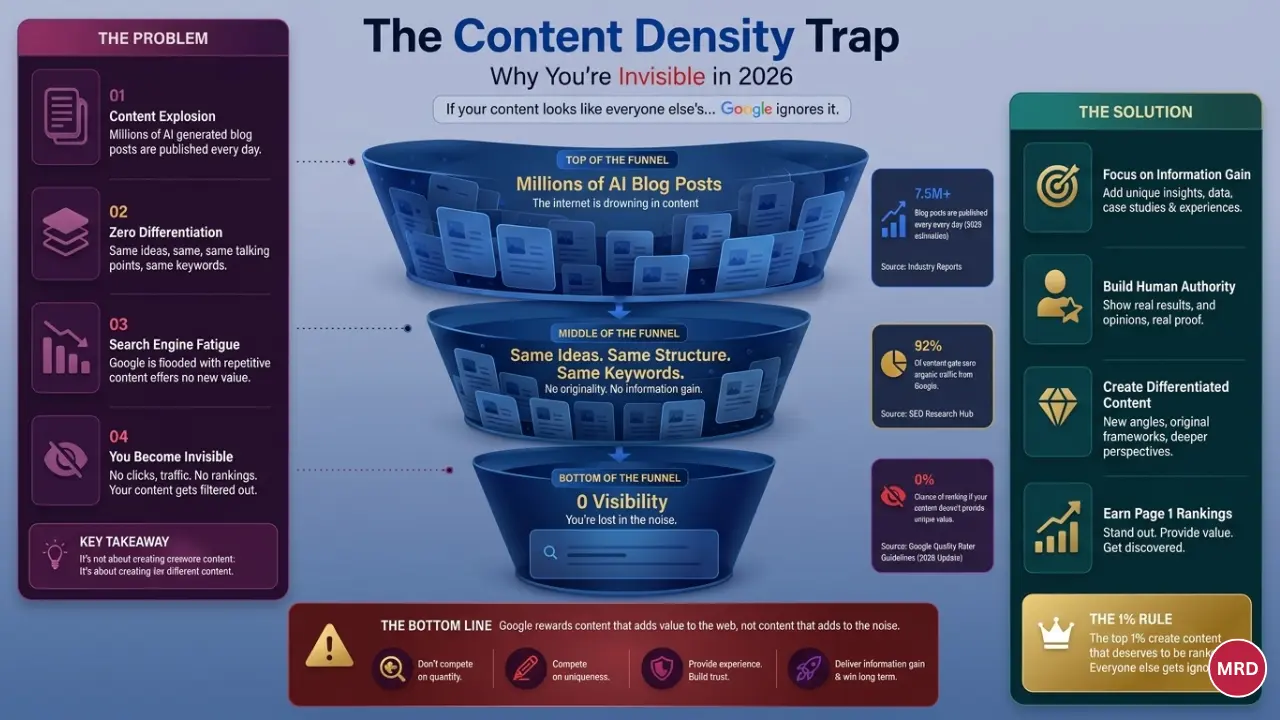
I’ve spent years in the digital marketing trenches, and I’ve seen the shift firsthand. In the past, “consistency” was the only king. If you wrote enough words and sprinkled enough keywords, Google rewarded you. But today, the landscape has suffered a permanent fracture. We have entered what I call the “content density trap”.
The web is currently drowning in “average” AI content, millions of perfectly grammatical, deeply boring articles that say exactly the same thing. When everyone has access to a “Generate” button, the value of a standard blog post drops to zero. This is exactly why traditional blogging is failing in 2026. The old “Write – > SEO – > Publish” cycle is no longer a strategy, it’s a race to the bottom.
“The secret of change is to focus all of your energy not on fighting the old, but on building the new.” – Socrates
To escape this trap, we have to move toward human in the loop authority. Google’s latest EEAT updates aren’t looking for more information, they are looking for information gain. They want the “1% perspective”. The unique systems, the messy personal experiences, and the strategic “why” that a machine simply cannot hallucinate.
- The 1% reality – Winners today act as system architects, Not typists
- The content density trap – If your post looks like everyone else’s, it is invisible to search engines.
- The human edge – Your value lies in your judgement , Your theory and your results. Not your word count
We’re moving away from being “bloggers” and stepping into the role of AI Orchestrators. It’s time to stop grinding and start building a system that actually scales.
The AI-Orchestrator protocol : The ultimate AI workflow for one person online business 2026
When I first started my journey, I fell into the same trap as everyone else. I thought that to be a “real” creator, I had to suffer through the blank cursor for hours. But as I scaled my one person business with the support of artificial intelligence, I realized that the 1% don’t “write”, they orchestrate.
The AI-Orchestrator protocol is my personal framework for moving from a content slave to a content CEO. It is built on the “1-3-1 system“, a workflow designed to satisfy Google’s hunger for EEAT (Experience, Expertise, Authoritativeness, and Trustworthiness) while leveraging the raw speed of modern LLMs. If you’ve ever wondered what happens to blogging in the age of AI, this is the answer.
The 1-3-1 system breakdown
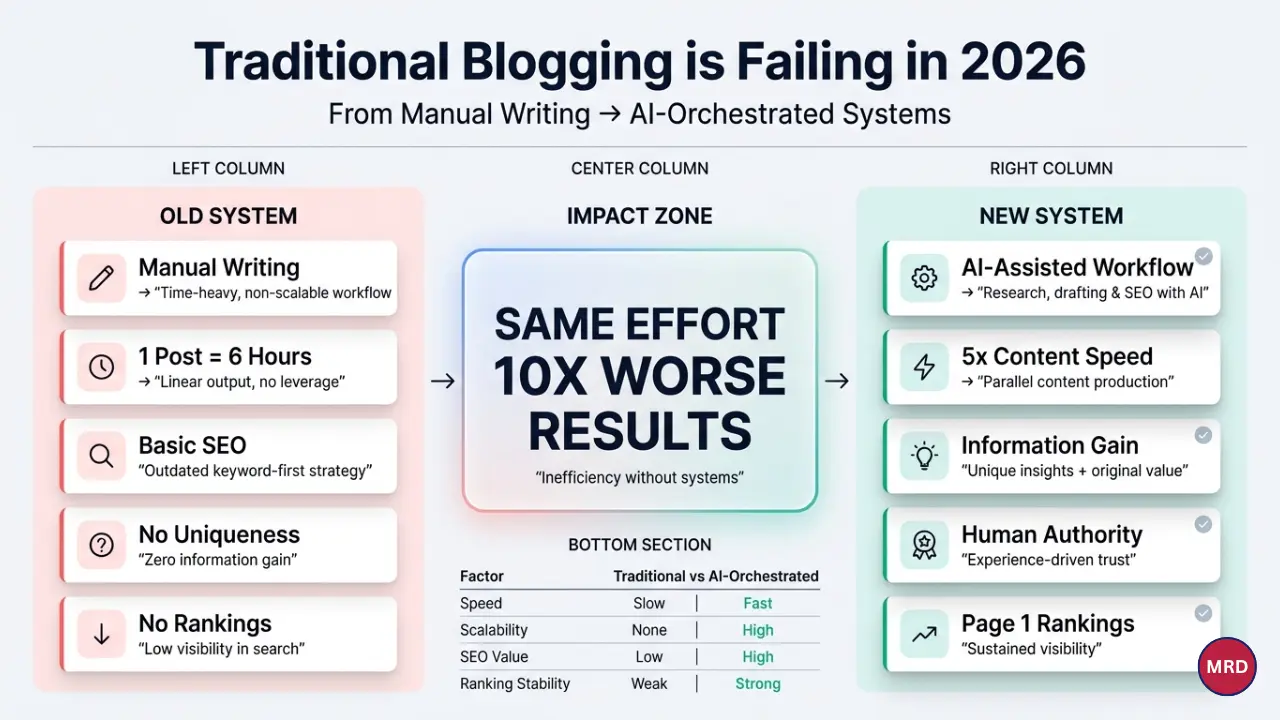
- 1 hour of strategic vision (Human) : This is where you do what AI cannot. You identify the “Information Gap.” You look at the current search results and ask, “What is missing?” This is the core of what is quality content for a new blog , it’s not about length; it’s about unique value.
- 3 stages of AI synthesis (Machines) : Here, we use the machine for the heavy lifting.
- Deep research – AI scans data points
- Drafting – AI generated the “skeleton”
- SEO mapping – AI ensures we hit the technical marks.
- 1 hour of experience injection (human) : This is the “Secret Sauce.” This is where you add your personal stories, your iPhone photos, and your specific opinions. If you don’t do this, you’re just another bot. Learning how to edit AI generated content for SEO is the difference between ranking on page one and being buried on page ten.
“Efficiency is doing things right; effectiveness is doing the right things.” – Peter Drucker
We often see why most blogs fail before making money , it’s usually because the owner is stuck in the “middle.” They are too slow to be a machine and too robotic to be a human. By using this AI workflow for one person online business 2026, you effectively split the work: the AI handles the volume, and you handle the soul.
This isn’t just a theory; it’s a survival mechanism. As you develop the AI skills that will make you money in 2027, you’ll find that “Orchestration” is the highest-paid skill in the digital economy.
The reality check : Human VS AI blogging results for new websites
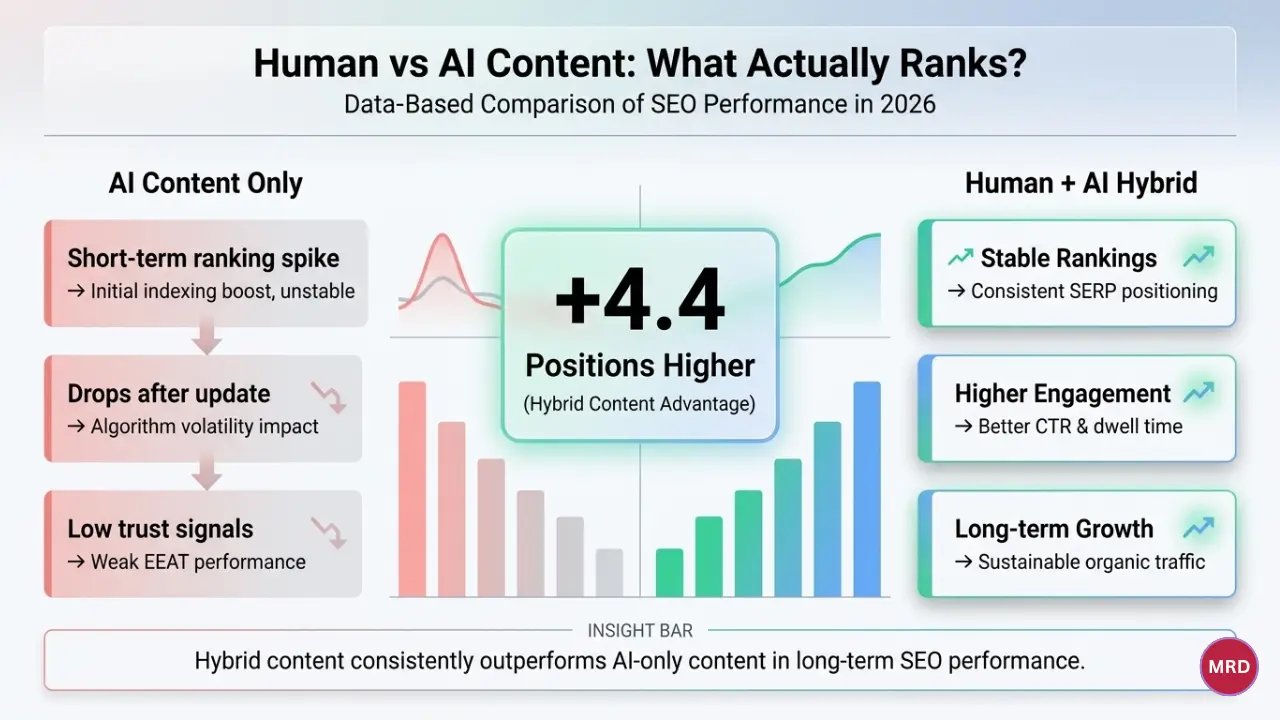
I get asked this every single day ;“Can AI content actually rank in 2026?” The short answer is yes. The long answer is : Yes, but it won’t stay there. Through my own testing and monitoring of the latest industry case studies, a clear pattern has emerged. Pure, unedited AI content often sees a “honeymoon phase”, a quick spike in rankings, followed by a steady, painful decline into invisibility. When we look at human vs AI blogging results for new websites, the data shows that human-led content ranks on average 4.4 positions higher and more importantly, stays on page one.
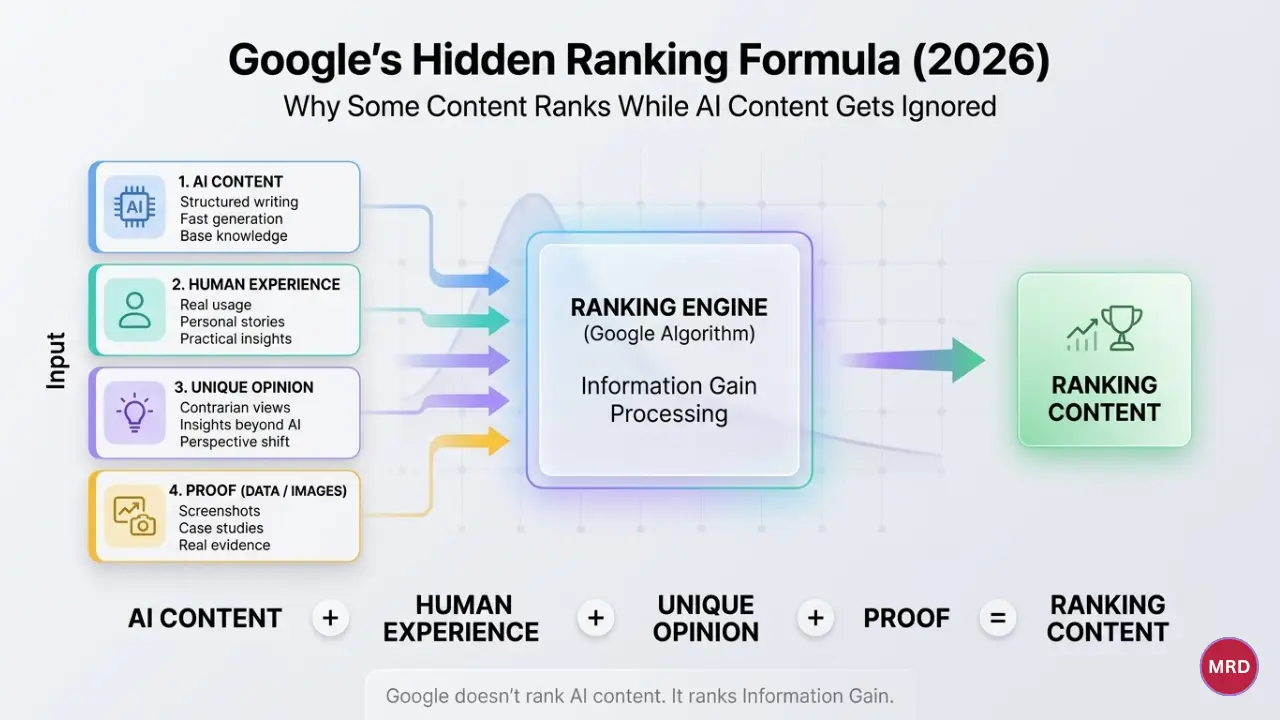
The reason? Google’s “Information Gain” score. If your blog is just a remix of what ChatGPT already knows, you are providing zero new value to the internet. Google’s algorithms are now sophisticated enough to detect “recycled knowledge.” To rank, you need to prove you’ve actually “done the thing.” This is the core of what is quality content for a new blog today, It’s original data, messy personal photos and opinions that go against the grain.
Why the “1% hybrid” Always wins:
- The stagnation point : AI can synthesize existing info, but it cannot create new insights. If you want to know how to create content without being an expert , you don’t use AI to fake it, you use AI to research while you provide the unique perspective.
- The trust factor – Readers in 2026 are skeptical. They can smell “bot talk” a mile away. When I share a personal mistake I made in my business, my engagement triples. A bot doesn’t make mistakes; therefore, a bot isn’t relatable.
- Long term sustainability – Following a how to use ChatGPT to write blog post for beginners guide is fine for a start, but if you don’t inject your “Human-in-the-loop” authority, you are building your house on rented land.
“Data is a tool for enhancing intuition, not a replacement for it.” – Unknown
In my experience, the websites that are absolutely crushing it right now aren’t “Anti-AI.” They are “Pro-Human.” They use AI to handle the 80% of the grunt work, the outlines, the initial research, the formatting but they never, ever let the machine have the final word. If you want to avoid the common pitfalls and understand why most blogs fail before making money , look no further than their lack of original, human-anchored evidence.
The 1% stack : best AI blog writers for high volume content 2026
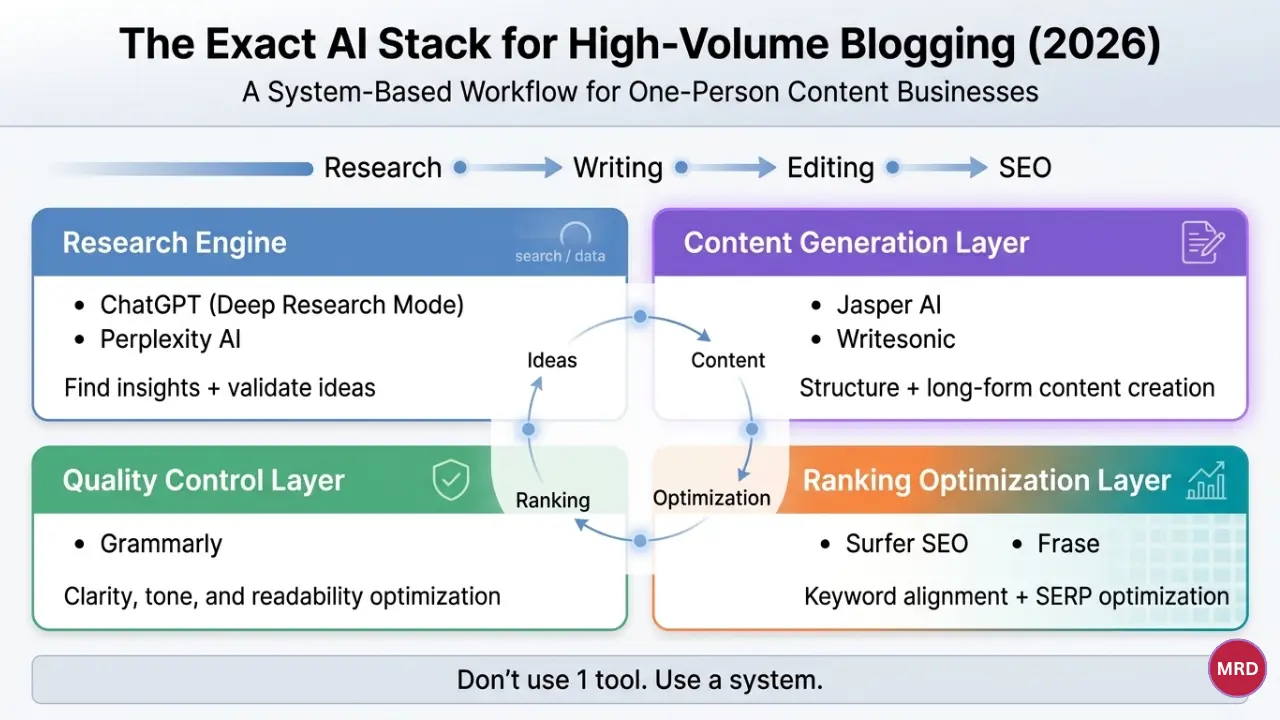
If you want to play at the professional level, you have to stop thinking of AI as a “magic button” and start seeing it as a workforce. In my own one person business, I have tested dozens of platforms and I can tell you that the “best” tool isn’t the one that writes the most words. It’s the one that integrates most seamlessly into your specific workflow.
When searching for the best AI blog writers for high volume content 2026, I look for #3 specific pillars: SEO depth , brand voice control and fact checking capabilities. Here is the exact stack I recommend for those following the AI-Orchestrator Protocol.
01 . The research engine : Perplexity and ChatGPT (Search mode)
Before I write a single word, I use Perplexity or ChatGPT’s deep research features. Why? Because these tools don’t just “hallucinate” text; they browse the live 2026 web to find real-time data. This is how you achieve information gain. If you are just starting out , learning how to use Chat GPT to write blog post for beginners is a great first step, but using it as a research librarian is where the real power lies.
02 . The heavy lifters : Jasper and Writesonic
For high-volume output that actually sounds human, Jasper and Writesonic remain the industry leaders.
- Jasper – Best for “Brand Voice.” It learns my specific tone so my blog doesn’t sound like a generic manual.
- Writesonic – Exceptional for long-form guides. If you want to know how to write your first blog post for beginners without spending three days on it, Writesonic’s Article Writer 6.0 is a game-changer.
03 . The final gatekeeper : Grammarly
I never hit “Publish” without a final pass through Grammarly. While the other tools handle the “what,” Grammarly handles the “how.” It’s my go-to for ensuring that my personal interjections, the “human” part of the post, are sharp, clear and tonally consistent. In 2026, Google rewards readability as a major part of the user experience. By using Grammarly to clean up the “AI-isms” and refine my own dictations, I maintain a level of professionalism that builds trust with my audience. It’s the final layer of how to edit AI generated content for SEO that keeps my content looking like it came from a boardroom , not a bot.
04 . The SEO guardrail : Surfer SEO and Frase
This is non-negotiable. I never publish an AI draft without running it through an optimization engine. These tools analyze the top 20 ranking pages and tell me exactly which terms are missing. It’s the ultimate shortcut to understanding what is quality content for a new blog.
“The tool doesn’t make the craftsman, but a great craftsman knows exactly which tool to reach for.” – Unknown
My personal “orchestrator” pro tip
Don’t get stuck using just one tool. I often use ChatGPT to brainstorm the “angle,” Jasper to draft the sections, and Grammarly to polish my personal stories. This multi-tool approach is one of the key AI skills that will make you money in 2027 , It’s called tool chaining . And it’s how the 1% create content that is both high-volume and high-authority.
The 1% blueprint : How to build an automated affiliate blog using AI
If you’ve ever wondered why most blogs fail before making money, it’s almost always because they lack a systematic approach to “Commercial Intent.” They write for clicks, but they don’t write for sales. To build a successful automated affiliate blog using AI, you have to stop thinking like a writer and start thinking like a Conversion Architect.
In 2026, the game has changed. You can’t just scrape Amazon reviews and expect to rank. Google’s February 2026 update made it clear: “Thin affiliate content” is being wiped out. To survive and thrive, your automated system must prove information gain by prove information gain by providing insights that the manufacturer’s page doesn’t have.
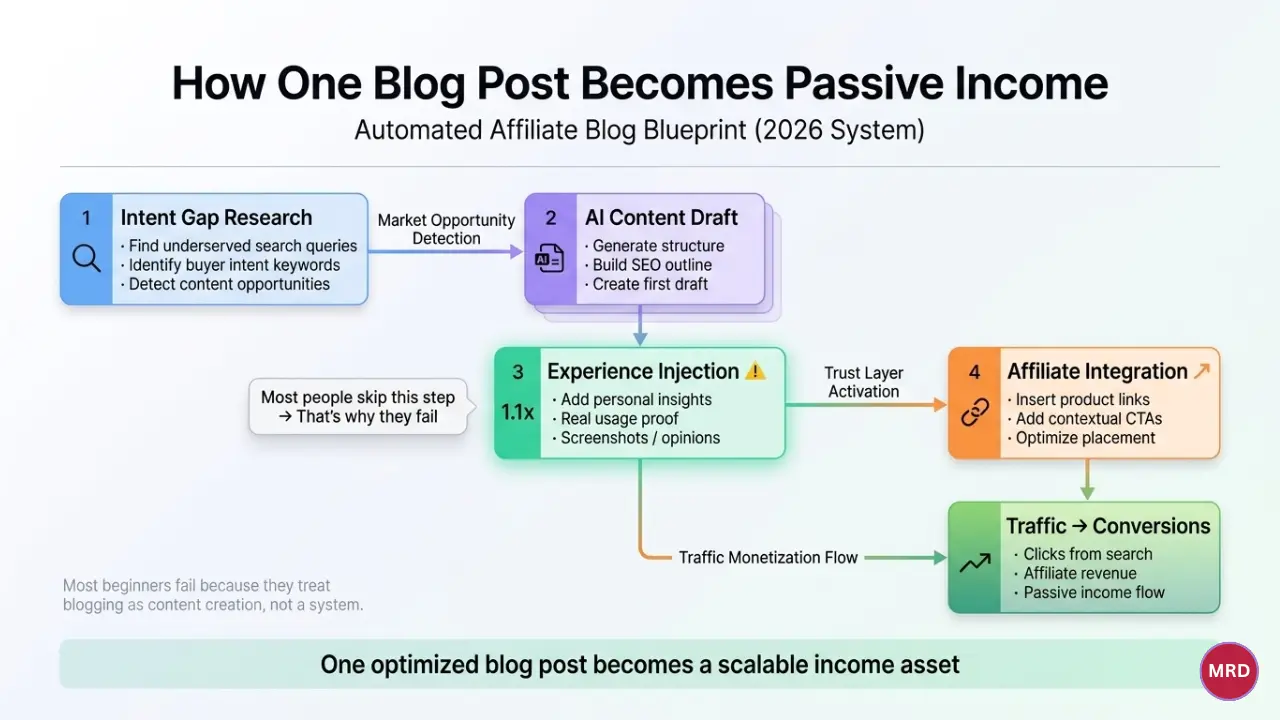
Step 01 . Intent mapping and the “Unwanted questions”
I start by using AI to find “gaps” in the market. I don’t just search for “best laptops” , I use my AI workflow for one person online business 2026 to find specific, long tail queries like “best laptop for 4k video editing under $1200 that doesn’t overhead“. This is the secret to how to create content without being an expert , you use AI to find the specific pain points and then use the machine to solve them.
Step 02 . The experience injection (EEAT)
This is where 99% of people fail. Once my AI (like Jasper or Writesonic) generates the “Commercial Skeleton,” I step in for 15 minutes to add “Proof of Life”.
- The “How we tested” section – I describe the specific criteria used.
- The visual proof – I add original photos or screenshots. Even if it’s a software review, a screenshot of the dashboard with my personal settings adds massive trustworthiness. This is the difference between “spam” and what is quality content for a new blog.
Step 03 . Closing the “verification loop”
Before I publish, I run my affiliate links through a “link cloaking” system and use Grammarly to ensure the tone is persuasive but not “salesy.” I also check my internal linking strategy. For example, I’ll link my new affiliate review to an older guide like how to write your first blog post for beginners to build topical authority.
Automation is not about replacing the human, it’s about amplifying the human’s most valuable asset: their judgment.
Scaling with “Agentic” automation
The 1% are now moving toward “Agentic” tools like Gumloop or Lindy. These aren’t just writers; they are bots that can check if an affiliate link is broken, update prices automatically and even scout for new high-ticket programs. If you want to stay ahead, you need to develop the AI skills that will make you money in 2027, such as managing these automated workflows.
By building your site this way, you aren’t just creating a blog; you are creating an affiliate engine that works 24/7. While others are struggling with how to drive website traffic from Pinterest 2026 , your AI-Orchestrator system is already ranking, converting and scaling.
Frequently asked questions on AI blogging strategy 2026
Is traditional blogging dead in 2026 because of AI?
Traditional blogging is dead for those who rely on manual, slow content creation, but it is thriving for “System Architects.” In 2026, success requires the AI-Orchestrator protocol, which uses AI for high-volume drafting while maintaining human-led authority. This ensures your site provides information gain rather than just repeating existing web data.
When we look ad what happens to blogging in the age of AI, we see that Google is filtering out “hollow” content. By shifting from a writer to a CEO of your content system, you avoid the Content density trap and build a scalable asset that machines cannot replicate.
How do you rank AI generated content on Google in 2026?
You rank AI content by using the “experience injection” method to satisfy Google’s 2026 EEAT requirements. While AI handles the structure, you must manually add personal data, unique photos, and specific case studies. Google rewards “Human-in-the-loop” content that offers value beyond what a standalone LLM can generate.
Purely automated sites are failing because they lack trust. Learning how to edit AI generated content for SEO is now a mandatory skill. I personally use a verification loop, using tools like Grammarly and Surfer SEO, to ensure my “1% perspective” is polished and optimized for both readers and crawlers.
What is the best AI workflow for a one person online business?
The most effective AI workflow for solo creators is the 1 – 3 – 1 system. This protocol consists of 1 hour of human strategic vision, 3 stages of AI synthesis (research, drafting, and mapping), and 1 final hour of human-led experience injection. This allows one person to act with the power of a full marketing agency.
This workflow is the backbone of any high-performing one person online business 2026. It prevents burnout and ensures your “Strategic Soul” is in every post. If you are a beginner, knowing how to use Chat GPT to write blog posts for beginners is just the start, the 1-3-1 system is how you actually scale to professional income.
Can I build a profitable automated affiliate blog using AI?
Yes, you can build a profitable automated affiliate blog by targeting Intent Gaps, specific, long-tail questions that generic AI hasn’t answered yet. In 2026, successful affiliate blogs use “Agentic Automation” to track price changes and link health while the owner focuses on high-level conversion strategies.
Most people fail because they create thin reviews. By focusing on What is quality content for a new blog, you build a “Hub” that Google trusts. Combining AI speed with high-ticket affiliate programs is one of the top AI skills that will make you money in 2027.
Why are my blog posts not getting traffic despite using AI?
Most blogs fail to get traffic because they produce “Average AI Content” that lacks Information gain. If your blog post says exactly what the top 10 results already say, Google has no reason to rank you. You must introduce new theories, systems, or data to break through the 2026 search filters.
I often see why most blogs fail before making money, it’s usually a lack of topical authority. To fix this, you need to bridge your content. Don’t just publish one post; create a cluster. If you’ve just started, ensure you know how to write your first blog post for beginners with the right SEO foundation from day one.
The 1% transformation – moving from blogging to CEO
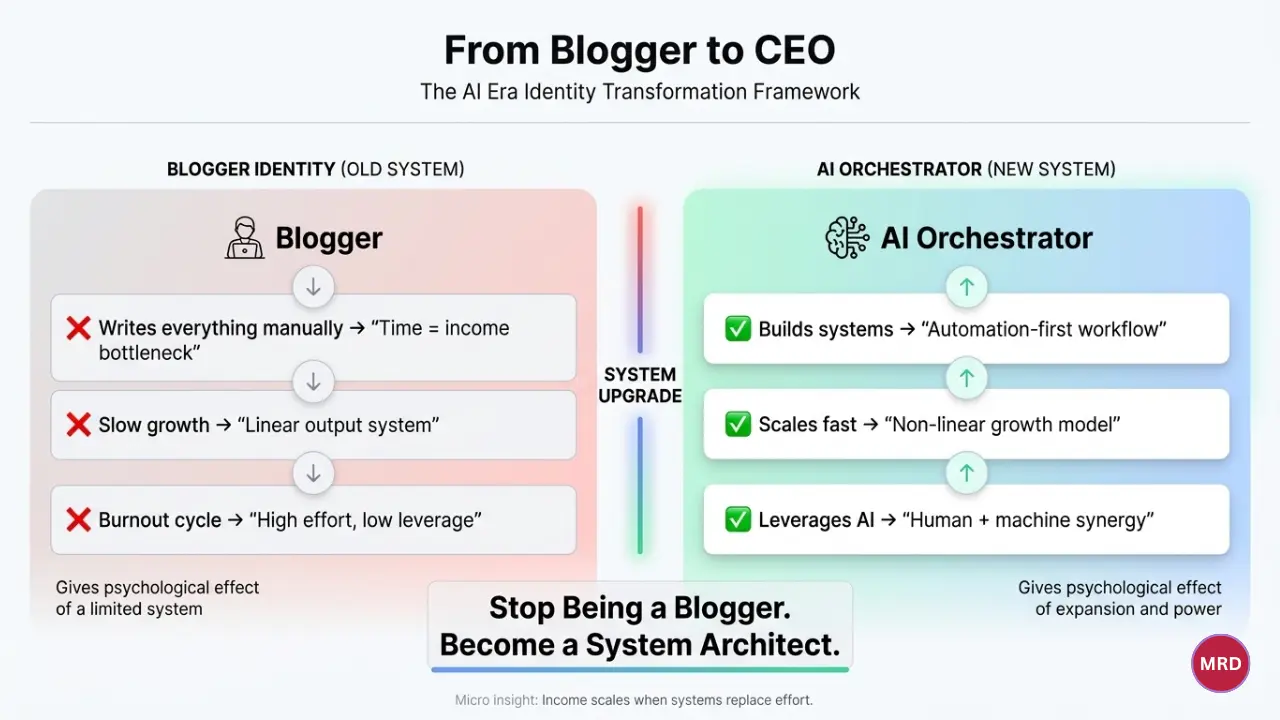
If there is one thing I want you to take away from this guide, it’s this: The “manual grind” is no longer the path to digital freedom. We have reached a turning point where AI blogging strategy 2026 is the only way to compete in an oversaturated market. As we’ve discussed, the goal isn’t just to produce more words, it’s to provide information gain through the AI-Orchestrator protocol.
I’ve seen far too many talented creators give up because they were stuck in the old “write-and-pray” model. But by mastering the AI workflow for one person online business 2026, you are no longer just a writer, you are a CEO managing a digital workforce. You now have the blueprint for how to build an automated affiliate blog using AI that doesn’t just sit there, but actively scales your income while you focus on the next big strategy.
Success in this era requires a specific set of AI skills that will make you money in 2027. It’s about knowing how to edit AI generated content for SEO to maintain that human touch and understanding what is quality content for a new blog so you never fall into the “Content Density Trap”.
“The best way to predict the future is to create it.” – Peter Drucker
If you’re ready to stop the manual struggle and start building a real system, I invite you to join our community of 1% creators. Whether you’re learning how to use Chat GPT to write blog post for beginners or looking for advanced ways to make money blogging with AI , the journey starts with one decision: To work smarter, not harder.
What is the first part of your Workflow you are going to automate today? Let me know in the comment below!