

Did earning just $5 on your blog feel useless ? Or seeing only a handful of email subscribers made you question if blogging was even worth it? Believe it or not, these tiny wins are more powerful than they seem. Understanding the early income psychology for beginner bloggers can completely change how you approach monetization and growth.
Small earnings aren’t a failure, they’re a sign that your actions are working. In fact, why small wins in blogging are important goes beyond just the dollars. Each small success builds confidence, teaches strategy, and sets the stage for bigger results over time.
It’s easy to get stuck waiting for viral traffic or a massive payout, but the real value comes from the decisions you make today, not hypothetical future earnings. Building consistency with small earnings is a skill and learning it early gives you a long-term advantage over bloggers who chase quick wins.
Benefits of celebrating small wins early ,
- Creates a feedback loop that motivates action and consistency
- Teaches practical lessons about what works before investing heavily
Finally , you’ll see why focusing on micro successes first can be far more effective than chasing massive traffic and how to turn even tiny earnings into a sustainable, confident blogging journey.
Table of Contents on early income psychology for beginner bloggers
Why small wins matter more than big wins
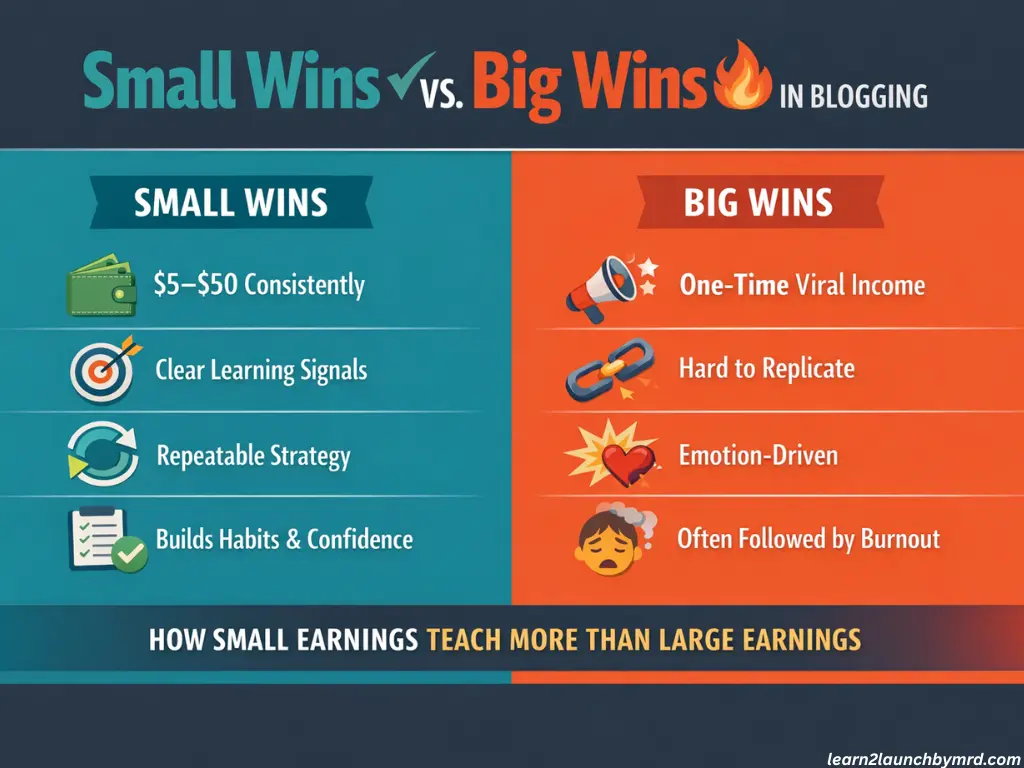
When you’re just starting out, it’s easy to dismiss small earnings as meaningless. But in reality, why small wins in blogging are important is rooted in psychology. A $1 affiliate sale, your first email subscriber or a single product purchase may seem tiny, yet each one teaches lessons that a sudden $1000 payout never could.
Small victories generate a feedback loop that speeds up learning. Rather than becoming overwhelmed by ambitious goals, you can concentrate on what truly works, improve your techniques, and gradually gain confidence.
Psychological benefits of small wins include ,
- Confidence boost – Seeing tangible results reinforces your abilities and motivates action.
- Dopamine reward loop – Every small success releases a positive trigger in your brain, making you more likely to continue consistent efforts.
- Habit formation – Repeated small wins establish productive routines and habits that scale over time.
- Practical learning – How small earnings teach more than large earnings by showing what resonates with your audience and what doesn’t, without risking too much too soon.
Beginners get clarity and a sense of progress by concentrating on micro-successes. These early victories teach strategy, show what your audience values, and make developing consistency with small earnings a natural part of your blogging journey, all of which are far more instructive than occasional large payouts.
Income psychology improves when beginners stop seeing blogging as “ too technical .” Knowing how to start a WordPress blog for beginners removes intimidation and creates forward motion. Action reduces doubt faster than endless research ever will.
How income motivates beginner bloggers
Early income plays a powerful psychological role for beginners because it creates something most new bloggers are missing, proof. Even a small amount of money turns blogging from a “ hope ” into a real system. That’s why early income psychology for beginner bloggers is less about the amount earned and more about what it teaches you to repeat.
Small earnings create an immediate feedback loop. When you see a $1 – $50 result, you know something worked , your topic choice , your wording , your offer placement or your audience intent. This feedback makes it much easier to keep going and start building consistency with small earnings instead of relying on motivation alone
These initial results teach you to act over time. Instead of chasing superficial metrics, you improve your offers, publish more purposefully, and concentrate on what converts. A beginner who makes $20 in a determined manner frequently gains more knowledge than someone who makes $1,000 at random once and is unable to repeat it.
How early income builds momentum,
- Confirms that your blog can generate real results
- Encourages consistent publishing and optimization
- Helps you identify which content and offers actually work
- Builds confidence to improve instead of starting over
Long term growth starts when beginners realize how small earnings operate and begin to improve what already exists rather than waiting for “perfect” situations.
Early income confidence often comes from proof, not money. Learning how to get your first 1000 followers as a beginner for free builds psychological safety. Small audiences validate effort and reduce the urge to quit before monetization compounds.
Early income psychology often shifts when bloggers realize money doesn’t come from traffic alone, but from clarity. Understanding how to monetize your knowledge online reframes blogging as value transfer, not selling. When beginners focus on solving one real problem deeply, income becomes a byproduct of usefulness rather than pressure.
Small blog income consistency strategies that work
Consistency is where most beginner blogs struggle, not because of lack of effort, but because the actions aren’t focused. The most effective small blog income consistency strategies are simple , repeatable and designed to produce feedback quickly . You don’t need more content or more traffic , you need clearer signals that you are moving in the right direction
Micro monetization methods
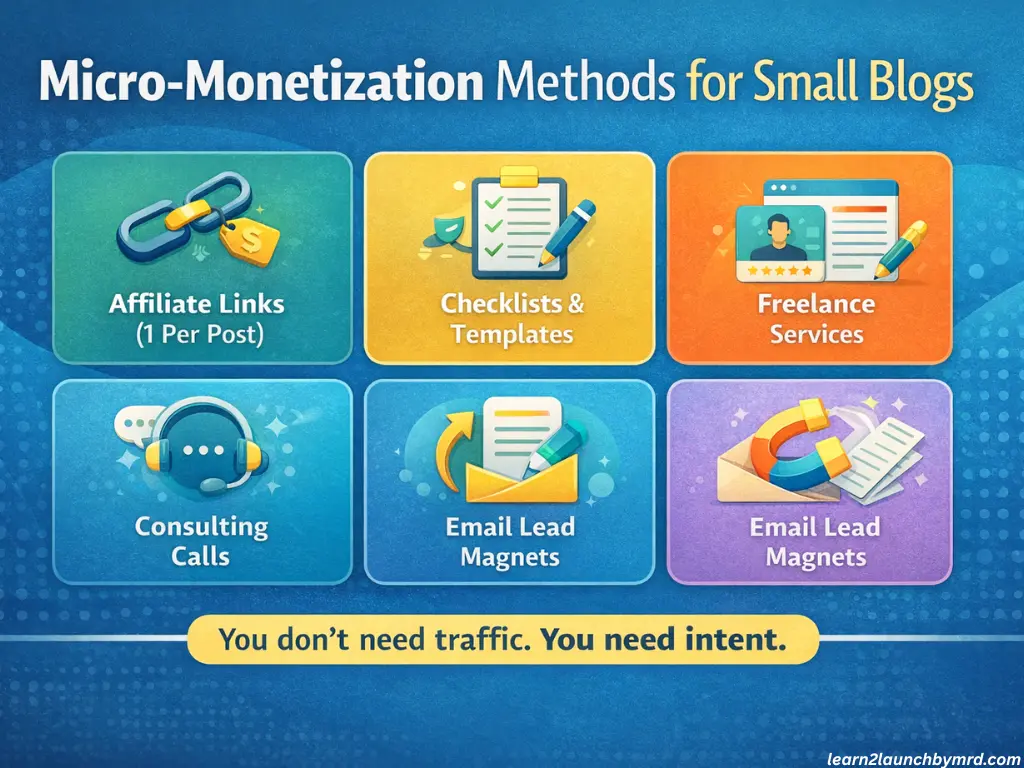
Micro-monetization is effective because it increases clarity while reducing pressure. Beginners benefit from testing one small monetization action at a time rather than trying multiple income streams at once.
- Use a single affiliate link per post that directly solves the reader’s problem
- Create simple digital products like checklists, templates or short guides
- Offer small service based solutions such as consulting, audits or beginner friendly freelancing
These methods allow you to earn small amounts while learning exactly what your audience responds to.
Many beginners fear monetization because they associate it with selling. Affiliate marketing for beginners reframes income as recommendation-based trust. When aligned with genuine use, it reduces psychological resistance and helps bloggers earn without feeling pushy or inauthentic.
Track small wins
Because they monitor the incorrect metrics, many beginners give up. You can’t tell if monetization is successful just by looking at traffic. Monitoring small actions keeps motivation founded on improvement.
- Track clicks and conversions , not just page views
- Pay attention to your first sale or first sign up , no matter how small
- Treat early results as data, not final outcomes
This habit reinforces building consistency with small earnings because each win shows you what to improve next.
Income psychology changes when bloggers stop treating their site like a diary. Knowing how to create a WordPress blog that makes money shifts decisions , from content topics to structure, toward sustainability. Monetization clarity early prevents burnout caused by publishing without purpose.
Engagement wins
Not every win shows up as money immediately and that’s okay. Engagement is often the first signal that monetization will work later.
- Your first 5-10 email subscribers indicate growing trust
- Early social shares show content relevance
- Reader comments or replies reveal real problems you can monetize
When you recognize these signals early, you stay consistent longer and consistency is what turns small blogs into sustainable income sources.
How small earnings teach more than large earnings
One of the most overlooked lessons in blogging is how small earnings teach more than large earnings . For beginners, learning happens through repetition, not sudden success. Small, frequent wins create faster learning loops because they allow you to test, observe, adjust and repeat without pressure.
This is where early income psychology for beginner bloggers becomes powerful. When you earn $5, $10 or $25 consistently, you start noticing patterns. You see which posts attract clicks, which topics trigger action and where readers drop off. These insights rarely come from one time viral success.
Example 01 – $10 in steady affiliate income
A beginner earning $10 from affiliate links across multiple posts learns
- Which keywords attract problem aware readers
- Where to place links naturally
- How content intent affects conversions
This knowledge is repeatable and scalable.
Example 02 – $1000 from a viral spike
A sudden traffic surge might feel exciting, but it often leaves beginners confused
- Which traffic source caused it?
- Why didn’t it happen again?
- What should be repeated?
Without clarity, large spikes rarely build consistency.
mistakes are also safer when earnings are small. Mistakes cost very little when offers, headlines or CTAs are tested at low volume, but the lessons learned are permanent. These small changes develop strategy, confidence and long-lasting habits over time.
Over time, bloggers who value small victories build stronger systems than those who pursue major achievements. They are able to convert early income into long-term growth because they know what works, why it works and how to repeat it.
Common beginner mistakes with small wins
One of the biggest reasons beginners struggle with monetization isn’t lack of effort, it’s misinterpreting early results. Many bloggers earn their first few dollars and dismiss it as “ not enough to matter. ” This mindset overlooks why small wins in blogging are important . Early income is not about the amount; it’s about proof, feedback and learning what works.
Another common issue is comparison. Beginners often measure their small wins against established blogs with years of content and traffic. This creates unnecessary pressure and leads to inconsistent action. In reality, small blog income consistency strategies only work when you respect the stage you’re in and build from there instead of skipping steps.
The first post often carries unrealistic expectations. Learning how to write your first blog post helps beginners detach income from perfection. Publishing creates feedback loops that thinking never will.
Common mistakes that slow progress –
- Ignoring early wins – Treating small earnings as meaningless instead of data
- Comparing to large blogs – Measuring day one results against year five success
- Quitting too soon – Abandoning strategies before patterns can form
- Overcomplicating monetization – Trying multiple methods instead of refining one
Many income delays are self-inflicted. Awareness of 10 social media mistakes beginners must avoid prevents burnout caused by wrong expectations. Avoiding these errors protects motivation and keeps beginners aligned with long-term growth.
Beginner bloggers struggle mentally when effort doesn’t equal earnings. Learning how to monetize a blog for beginners sets realistic expectations early. It replaces emotional guessing with systems, making income feel achievable instead of accidental.
Beginners make better decisions, maintain consistency longer and create systems that truly scale when they learn to value small victories. It’s more important to pay attention to the right signals at the right time than to put in more effort in order to avoid these mistakes.
Many beginners delay income because they overthink tools instead of starting. Learning how to create a website with WordPress for the blogging start removes mental friction early. A simple, functional setup helps bloggers focus on content and audience trust, which directly impacts confidence and income momentum.
Actionable steps to build consistency with small earnings
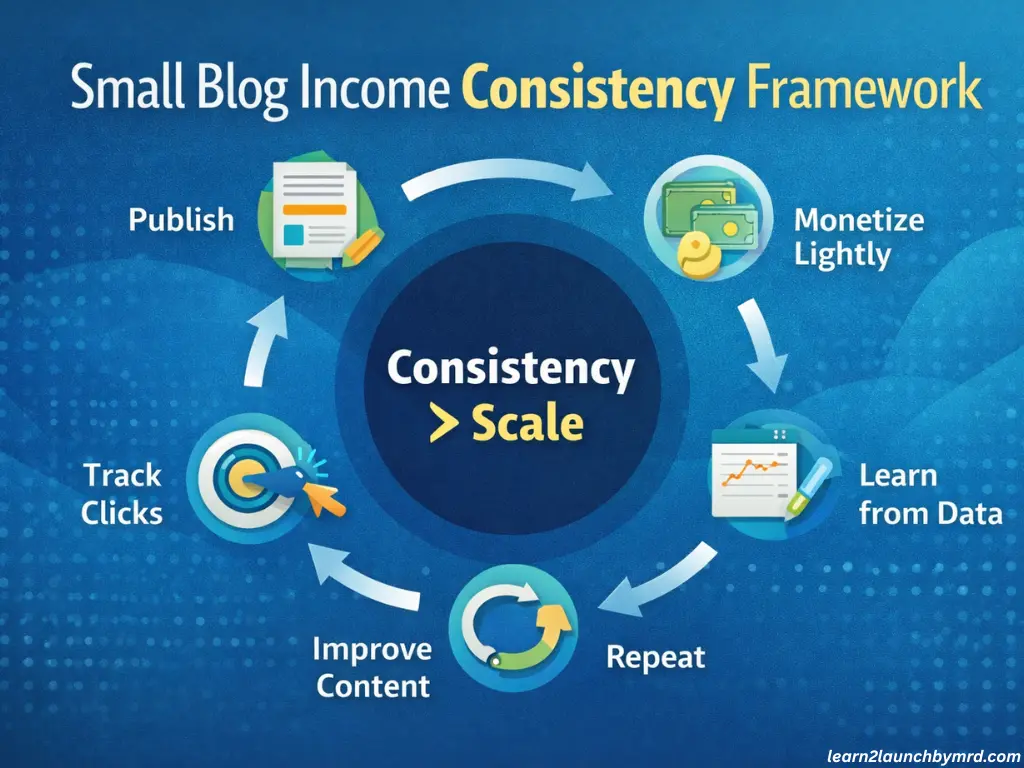
Understanding the early income psychology for beginner bloggers is only useful if you turn it into action. Consistency doesn’t come from motivation alone, it comes from simple systems that are easy to repeat. The goal at this stage isn’t scale, it’s building consistency with small earnings that you can grow over time
01 . Pick one monetization method
Choose a single method that matches your content and audience. This could be affiliate links, a simple digital product or a small service offer. Focusing on one method reduces overwhelm and makes results easier to measure.
02 . Track every small win
Track clicks, email signups and sales, even if the numbers feel small. These metrics show what’s working and help you improve intentionally instead of guessing.
Tracking small wins becomes easier when you rely on simple data instead of guesswork. Tools like Google Analytics help you see which pages get clicks, where visitors spend time, and what actions they take next. Even basic insights like link clicks or page engagement, can reveal what’s working before traffic ever grows.
03 . Celebrate progress consciously
Acknowledge each win. This reinforces positive behavior and strengthens the habit of showing up consistently, which is essential for long term growth.
04 . Refine offers based on what converts
Look at which posts, links or emails produce results. Improve those first before creating anything new.
05 . Repeat , then scale slowly
Once you see consistent results, repeat the process. Scaling works best when it’s built on proven actions, not assumptions.
Small earnings, repeated consistently, create momentum and momentum is what turns beginner blogs into sustainable income systems.
Income follows trust, not followers. Understanding how to build trust on social media as a beginner shifts focus from numbers to consistency. This mindset reduces anxiety around monetization and creates warmer conversions over time.
Income stability begins with ownership. Understanding how to build an email list for beginners shifts focus from chasing algorithms to nurturing relationships. This mindset change helps bloggers think long-term instead of relying on unpredictable traffic spikes.
Realistic expectations for small blogs
One of the healthiest shifts beginner bloggers can make is resetting expectations. Earning $1 – $50 per week or month is completely normal in the early stages, especially when traffic is still growing. These numbers may seem small, but they play a critical role in learning how small earnings teach more than large earnings when it comes to monetization.
The first income matters psychologically more than financially. It proves that your blog can generate real value, not someday, but now. That moment changes how you approach content, offers and consistency. Instead of guessing, you start improving intentionally, which is the foundation of all small blog income consistency strategies.
Early on, consistency always beats scale. Publishing steadily, refining what converts, and repeating small actions creates stronger long-term results than chasing rapid growth too soon. Early income often comes from distribution, not perfection. Understanding how to use social media to grow your online business helps beginners see platforms as leverage, not noise. When content supports a clear outcome, confidence grows faster than waiting for organic blog traffic alone.
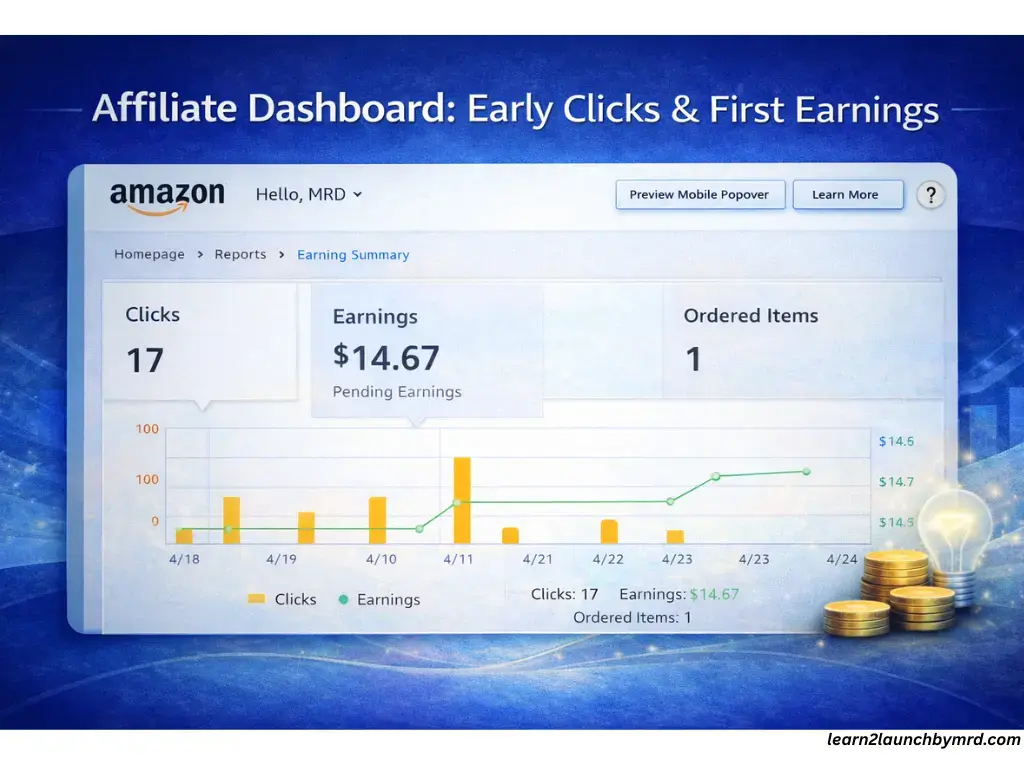
What realistic early progress look like,
- First affiliate sale after weeks of testing
- A few email subscribers converting into clicks
- One post consistently generating small income
- Learning which topics attract problem aware readers
These signals are more valuable than big spikes because they’re repeatable. When beginners respect small wins and stay consistent, income grows naturally, without burnout or unrealistic pressure.
Income feels impossible without visibility. Knowing how to get traffic to a new blog reframes patience as strategy, not delay. When beginners understand traffic as a process, income becomes predictable rather than emotional.
Frequently asked questions on Early income psychology for beginner bloggers
Why is early income important for beginner bloggers?
Early income is important because it provides proof that your blog can generate real results. From an early income psychology for beginner bloggers perspective, even small earnings validate your strategy, build confidence and encourage consistency. This psychological reinforcement helps beginners stay committed long enough to improve skills and grow sustainably.
Why are small wins in blogging more important than big income early on?
Small wins in blogging are important because they create faster learning loops. Instead of guessing what worked, beginners can clearly see which content, offers or links convert. This explains why small wins in blogging are important , they teach repeatable skills, while large one-time income spikes often lack clarity.
How do small earnings teach more than large earnings ?
Small earnings teach more than large earnings because they happen frequently and with less risk. When beginners earn $1 – $50 consistently, they can test ideas, make adjustments and learn from mistakes without pressure. This is exactly how small earnings teach more than large earnings , through repetition, feedback and skill building.
How can beginners build consistency with small earnings ?
Beginners can start building consistency with small earnings by focusing on one monetization method, tracking small wins like clicks or email signups and refining what converts. Consistency grows when actions are simple, measurable, and repeated regularly rather than chasing fast growth.
What are the best small blog income consistency strategies ?
The most effective small blog income consistency strategies include micro monetization, tracking early conversions and improving existing content instead of constantly creating new posts. These strategies help beginners stay focused, learn faster and build momentum without needing high traffic.
The biggest shift beginner bloggers can make is understanding that early income isn’t a milestone to chase, it’s a skill to develop. The early income psychology for beginner bloggers is about learning how systems work, how readers respond and how consistency compounds over time. Small wins aren’t a sign you’re behind, they’re proof you’re building something real.
Early income anxiety often comes from financial pressure. Learning how to start a high-quality blog for on a budget removes the fear of wasted investment. When beginners feel safe experimenting, they publish faster and learn what actually converts.
When you focus on small earnings, you learn faster. Each $1 – $50 result strengthens habits, sharpens decision-making and removes guesswork. That’s why building consistency with small earnings , matters more than waiting for a big breakthrough. Progress becomes repeatable, confidence grows naturally and momentum replaces motivation.
What matters most now is action. Pick one monetization method. Track one small win. Improve one thing at a time. Celebrate progress , even when it feels insignificant. Those small, intentional steps are what turn beginner blogs into sustainable income systems.
If you apply just one small win strategy today, you’re already ahead of where you were yesterday. Keep refining, keep showing up, and let consistency, not pressure, do the heavy lifting.