
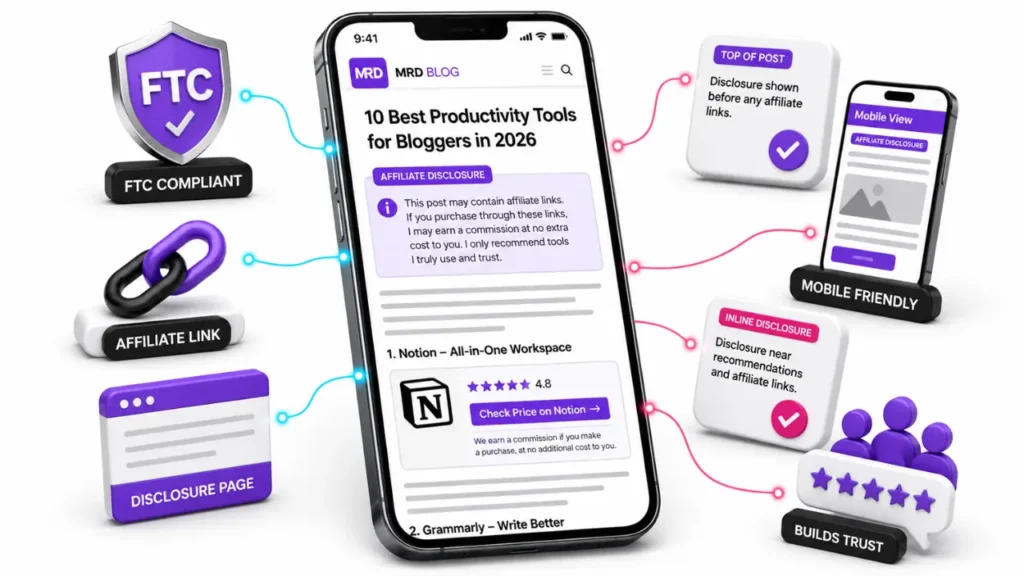

I almost skipped my affiliate disclosure entirely on my first monetized post.
Not because I was trying to hide anything. I just had no idea where to put affiliate disclosure on blog post pages in a way that actually satisfied the law. I dropped a one-liner into my footer, assumed that it covered everything, and hit publish with full confidence.
It didn’t cover it. Not even slightly.
The FTC can issue penalties of up to $51,744 per violation for non-compliant disclosures and each undisclosed post counts as a separate violation. Getting this wrong doesn’t just create legal exposure. It quietly destroys the reader’s trust that takes months to build.
This guide is part of the complete affiliate marketing for beginner bloggers resource, covering everything from choosing your first program to writing content that earns without feeling dishonest.
If you’re building from the very beginning, understanding how to start affiliate marketing without a website in 2026 gives you the foundational context that makes disclosure requirements make sense before you ever publish your first affiliate post.
Here is exactly where your disclosures need to go – legally, practically, and in a way that builds trust instead of breaking it.
The correct placement of affiliate disclosure on website – What the FTC 4-point test actually requires
The correct placement of affiliate disclosure on a website means positioning it before any affiliate content, in a visually distinct format, written in plain language, and close enough to the recommendation that readers cannot possibly miss it. The FTC evaluates every disclosure using four factors: Proximity, Prominence, Presentation, and Placement.
Most beginner bloggers read “put it somewhere visible” and assume anywhere on the page qualifies. The FTC is significantly more specific than that. Their four-factor test evaluates every disclosure against these criteria:
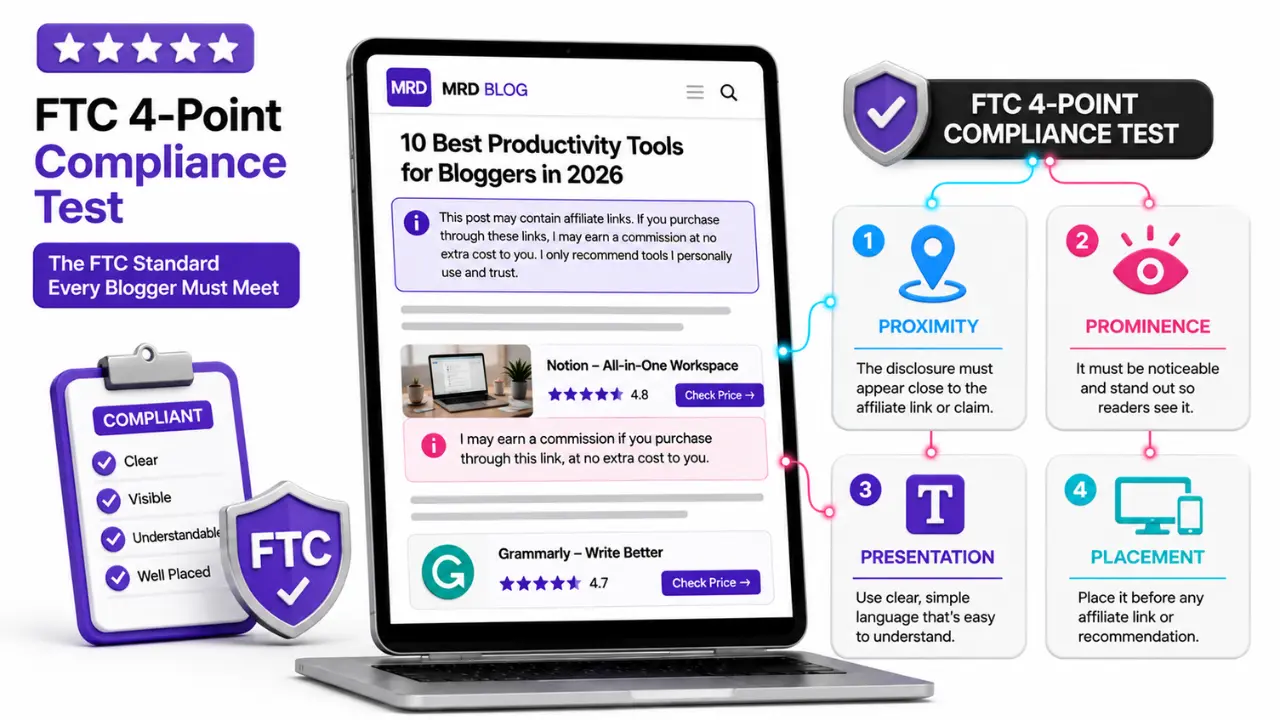
- Proximity – Is it physically close to the affiliate link or recommendation it covers?
- Prominence – Is it visually distinct enough that a reader cannot scroll past it without noticing?
- Presentation – Is it written in plain, everyday language a general audience immediately understands?
- Placement – Is it positioned where the reader encounters it before engaging with the affiliated content?
A disclosure that passes all four tests satisfies the requirement. One that fails any single factor does not, even if it technically exists somewhere on the page.
This is why correct placement of affiliate disclosure on a website is not a checkbox. It is a performance standard the FTC applies to each individual piece of content independently.
For anyone who wants the complete picture of affiliate marketing compliance before diving into monetization, the affiliate marketing for beginners complete guide covers the full framework, disclosures, program selection, and content strategy in one place.
Does affiliate disclosure have to be before the link? The answer is more specific than you think
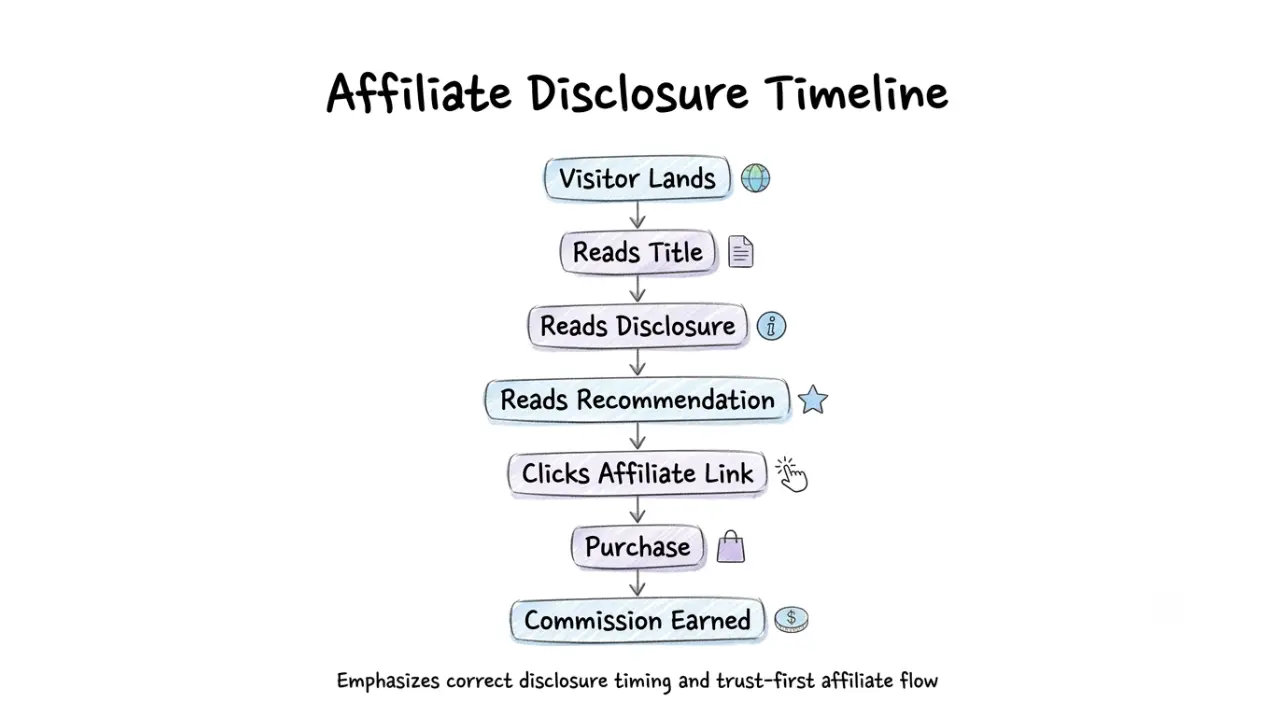
Yes. Affiliate disclosure must appear before the affiliate link it relates to. A disclosure placed after the link, at the bottom of the post, or only in the footer does not satisfy the FTC requirement because the reader has already engaged with the recommendation without being informed first.
This is the placement rule that catches most beginners off guard.
“Before” does not mean somewhere on the page. It means before the reader reaches the link itself.
For written content on websites, place your disclosure at the very top of the article, before any affiliate links appear. The ideal position is immediately after the article title or within the first paragraph of the post body.
Does affiliate disclosure have to be before the link in practical terms? Here’s exactly how that translates to a real post:
- Your first affiliate link appears in paragraph 4
- Your disclosure must appear in paragraphs 1, 2, or 3 at the latest
- A disclosure in paragraph 6, even if it’s close to other affiliate links – does not retroactively cover the link in paragraph 4
The “before” rule applies specifically to the first instance of affiliate content.
For long posts where affiliate links appear across multiple sections, inline disclosures near individual links reduce compliance risk significantly.
Which Affiliate Disclosure Placements Actually Meet FTC Expectations?
Not every disclosure location provides the same level of compliance. Use this quick comparison to identify which placements satisfy FTC expectations and which should only be used as supplementary transparency.
| Disclosure Placement | FTC Compliant? | Recommended? | Why It Matters |
|---|---|---|---|
|
Top of the article (before any affiliate links) | ✅ Yes | ⭐⭐⭐⭐⭐ | The strongest and clearest placement. Readers see the disclosure before encountering any affiliate recommendation. |
| Immediately before the first affiliate link | ✅ Yes | ⭐⭐⭐⭐⭐ | Meets FTC expectations by informing readers before they engage with affiliate content. |
| Inline disclosure near individual affiliate recommendations | ✅ Yes | ⭐⭐⭐⭐☆ | Excellent for long-form articles with multiple affiliate sections and helps reinforce transparency. |
| Footer only | ❌ No | Not Recommended | Most readers never reach the footer before clicking affiliate links, making it insufficient on its own. |
| Sidebar only | ❌ No | Not Recommended | Sidebars are easy to ignore, especially on mobile devices, and should never replace a page-level disclosure. |
| Separate disclosure page only | ❌ No | Not Recommended | Useful as supplementary information, but it does not replace visible disclosures within individual affiliate posts. |
One pattern becomes obvious: the closer your disclosure appears to the affiliate recommendation, the stronger both your compliance and reader trust become. Site-wide disclosure pages and footer notices still have value, but they work as supporting transparency, not as replacements for a visible disclosure before affiliate links. When in doubt, assume your reader should understand the affiliate relationship before they ever have the opportunity to click.
This principle connects directly to how affiliate links are physically placed inside your posts. Where to place affiliate links in blog posts breaks down the exact in-post positions that drive the highest click-through rates and how to structure them in a way that works alongside a clear, visible disclosure rather than competing with it.
Can affiliate disclosure be in the footer? Here’s why that’s risky legal mistake
Quick answer :
No, a footer-only disclosure is not FTC-compliant. The FTC requires disclosures where readers will actually see them before engaging with affiliated content. Most readers never reach the footer, making it legally insufficient as a standalone placement for blog post disclosures.
This was my exact mistake on my first monetized post and it’s the most consistently repeated mistake I see among beginner bloggers.
Readers who land on a specific post from Google never see your footer until they scroll past all your affiliate links. By that point, the disclosure has already failed its entire purpose.
So can affiliate disclosure be in the footer? Yes, but only as a supplementary layer, never as your only disclosure.
The footer serves a different purpose in your compliance structure:
- It signals site-wide transparency about your general business model
- It satisfies some affiliate program requirements (Amazon Associates, for example, requires “As an Amazon Associate, I earn from qualifying purchases” to appear on your site)
- It gives readers a place to find your full disclosure policy when they want the complete picture
What the footer cannot do is substitute for a post-level disclosure appearing before your affiliate recommendations. These serve different compliance functions.
The practical question isn’t whether affiliate disclosure can be in the footer, it’s whether you’ve treated the footer as a replacement for top-of-post disclosure. If you have, that’s the gap that needs fixing before anything else.
5 Affiliate Disclosure Mistakes That Can Hurt Compliance & Reader Trust
Most affiliate disclosure problems don’t happen because bloggers are trying to hide anything—they happen because of poor placement and unclear presentation. Before publishing your next affiliate post, make sure you’re not making one of these common mistakes.
-
❌Footer Only The disclosure appears after readers have already reached affiliate links.
-
❌Tiny Grey Text Low contrast or small fonts fail the FTC’s prominence requirement.
-
❌Legal Jargon Readers should instantly understand your disclosure without legal language.
-
❌After the First Affiliate Link Readers must see the disclosure before any affiliate recommendation.
-
❌Hidden on Mobile Always verify that the disclosure is visible without scrolling on phones.
Understanding this is part of the broader foundation of building a blog that earns sustainably. How to monetize a blog with low traffic covers the exact monetization approaches that work at early traffic levels – all of which require compliant disclosure regardless of how many readers you currently have.
Conversational affiliate disclosure examples for beginners that build trust instead of killing it
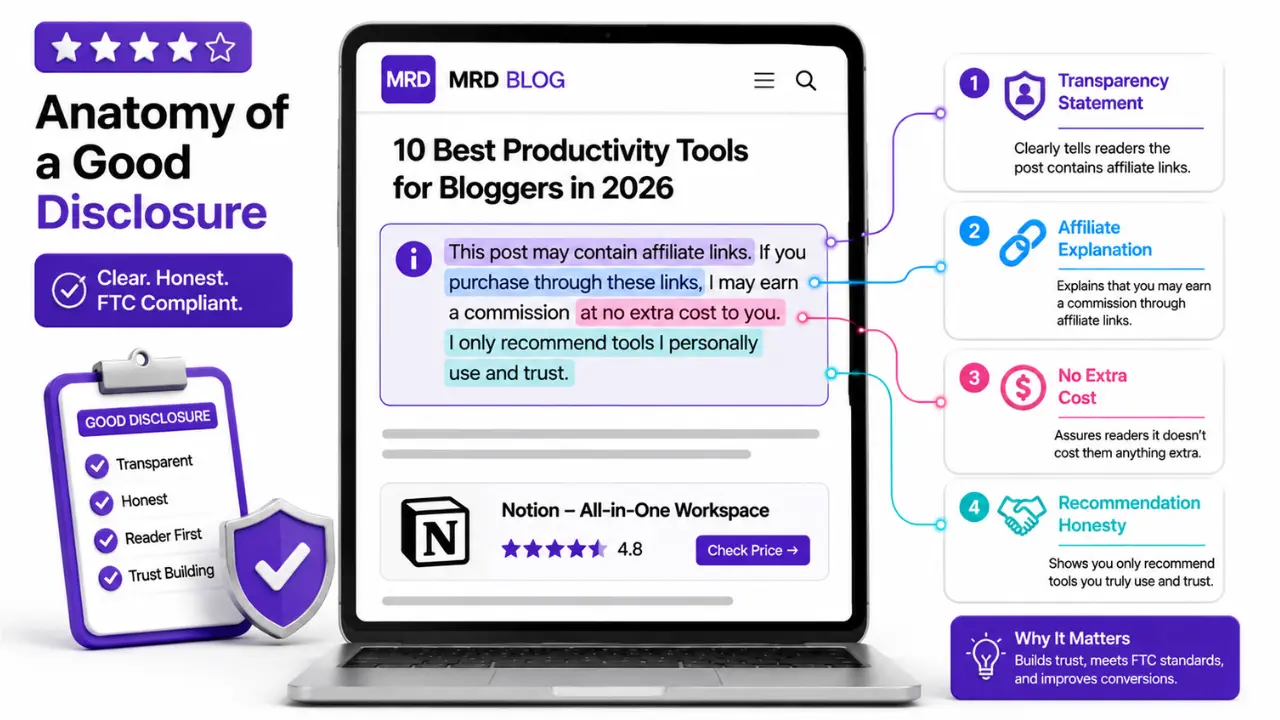
Effective conversational affiliate disclosure examples for beginners are short, honest, and written in the same tone as the rest of the post. They appear before the first affiliate link, avoid legal jargon entirely, and tell the reader specifically that the commission costs them nothing extra.
Most beginners write disclosures that sound like they were pulled from a legal contract.
That approach does two things badly simultaneously: it makes readers feel like they’ve stepped into a formal legal process before they’ve even started reading, and it signals that the blogger is uncomfortable with the disclosure rather than genuinely transparent about it.
Here are real examples, the weak version and the stronger replacement:
Weak (legal jargon, reader-unfriendly): This website contains affiliate links pursuant to FTC guidelines, and the site owner may receive monetary compensation from purchases made through said links."
Strong (conversational, trust-building): "Quick heads up - some links in this post are affiliate links, which means I earn a small commission if you buy through them. It costs you nothing extra, and I only recommend tools I've personally used."
Weak (buried, visually invisible): “[Affiliate disclosure: this post contains affiliate links]"* in small text, same color as body copy
Strong (visually distinct, immediately noticeable): A lightly shaded box at the top of the post, slightly different background, brief text: “This post contains affiliate links. If you click through and purchase, I may earn a commission at no additional cost to you."
Weak (vague and uncertain): "This post may or might contain some affiliate links."
Strong (specific and confident): “This post contains affiliate links. I earn a commission if you purchase through these links - it's one of the ways I keep this blog running while keeping everything free for you."
The best conversational affiliate disclosure examples for beginners share three characteristics: they confirm what an affiliate link is in plain terms, they make clear there’s no extra cost to the reader, and they give a genuine reason the blogger uses them.
The same honesty and directness that makes a great disclosure makes great affiliate content overall. How to promote affiliate products without being salesy covers exactly how to present recommendations in a way that readers trust rather than resist, which is the same skill that makes disclosures feel natural rather than defensive.
Where to put affiliate disclosure on blog post – The 3-zone disclosure system explained
Compliant affiliate disclosure on a blog post uses three zones simultaneously: a page-level disclosure at the top before the first affiliate link, inline disclosures near individual affiliate recommendations in longer posts, and a site-level disclosure in the footer and navigation as supplementary transparency.
I call this the 3-Zone Disclosure System and it’s the framework that removes all guesswork about whether your blog is covered.
Most beginners treat disclosure as a single action. It’s actually three overlapping layers working together.
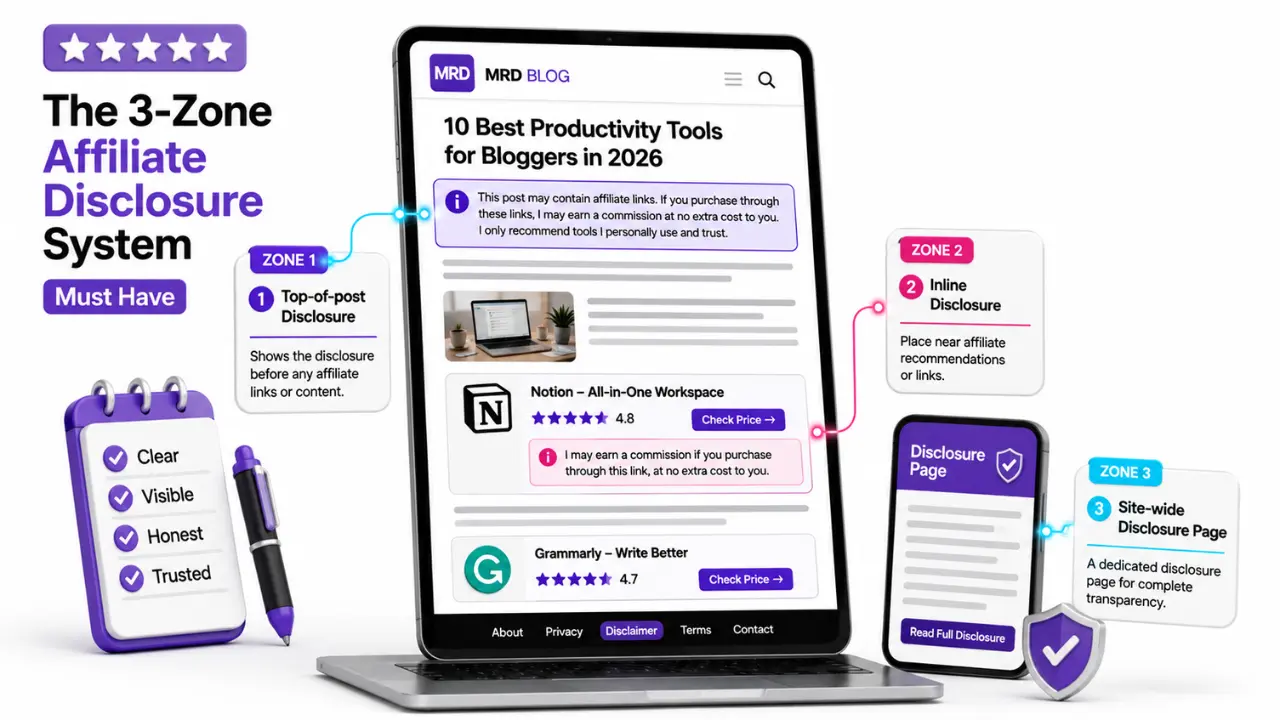
Zone 01 – Page-level disclosure (Non-negotiable)
Every post containing affiliate links needs a disclosure at the very top, above the fold if possible, and always before the first affiliate link. This is your primary compliance layer.
Format it as a visually distinct element: a shaded box, bold text, or a slightly larger font that stands apart from your regular paragraph text. It needs to be noticeable at an immediate glance.
Zone 02 – Inline disclosure (Best practice for long posts)
For posts over 1,000 words where affiliate links appear throughout multiple sections, brief inline notes near individual links reduce compliance risk significantly.
This doesn’t require repeating your full disclosure statement. Something as brief as “(affiliate link)” next to the link text, or a short note like “I earn a small commission if you buy through this link” directly after a specific product recommendation works well.
Zone 03 – Site-level disclosure (Supplementary)
A dedicated disclosure page linked from your footer, navigation, and about page. This is where readers can find your complete affiliate relationship disclosure if they want the full picture.
Zone 3 supplements Zones 1 and 2 – it does not replace them. It’s also where you satisfy most affiliate program requirements for site-wide disclosure.

The 3-Zone System matters most when you’re running high-ticket affiliate promotions where the commission and the recommendation both carry more weight. High-ticket vs low-ticket affiliate marketing for beginner bloggers covers how the disclosure requirements and reader expectations differ between a $10 product recommendation and a $500 one, a distinction most disclosure guides skip entirely.
And if you’re still in the early stages of building the blog that will carry these disclosures, getting the technical foundation right from the start makes every compliance setup easier. How to start a high quality blog on a budget covers exactly that, the setup decisions that affect everything from page speed to affiliate link functionality to legal compliance structure.
What most affiliate disclosure guides completely wrong – The mobile visibility problem
Here is the genuine competitor gap that every affiliate disclosure guide skips and it’s the one that catches the most technically-compliant bloggers completely off guard.
Your disclosure might be perfectly positioned on desktop and completely invisible on mobile.
Here is exactly what happens: you place your disclosure in a styled box between your post title and your first paragraph. On a 1440px desktop screen, that box is clearly visible before the first affiliate link. On a 390px iPhone screen, the same box is either below the fold before the reader begins scrolling, or it collapses into a barely-visible element between a large featured image and compressed paragraph text.
I tested this across three of my own posts after a blogging community discussion raised the issue. In all three cases, my disclosure was immediately visible on the desktop. On mobile:
- Post 1: Required a partial scroll to see before the first link
- Post 2: Appeared correctly above the fold on mobile
- Post 3: Was partially hidden behind the featured image on certain screen sizes
Two out of three posts were non-compliant on mobile despite appearing perfectly compliant in my desktop editor.
The mobile visibility check before every publish:
- Open the published post on an actual phone. not a browser simulation
- Do not scroll. Look at the screen as it loads
- Is your disclosure visible without any scrolling on this screen?
- Is it visually distinct enough to notice at a glance, not just technically present?
If the answer to either question is no, your placement needs adjustment before that post stays live.
This is the disclosure detail that sits above every other placement question, including where to put affiliate disclosure on blog post pages in general, because a disclosure that exists but cannot be seen does not satisfy the FTC standard.
Related questions on correct placement of affiliate disclosure on website
Does every blog post need an affiliate disclosure?
Yes, every individual post containing affiliate links needs its own disclosure, placed before the first affiliate link appears. A site-wide footer disclaimer or a single disclosure page does not cover individual posts under FTC guidelines.
Each post is evaluated independently. A reader who lands directly on a post from Google never sees your homepage disclosure or footer, they only see what’s on that specific page. I learned this the hard way after assuming my footer covered everything. It doesn’t. Every monetized post needs its own visible, top-of-post disclosure before a single affiliate link appears.
What happens if you don’t disclose affiliate links on your blog?
The FTC can issue fines of up to $51,744 per violation for undisclosed affiliate content. Each non-compliant post counts as a separate violation, meaning multiple unprotected posts multiply the financial exposure significantly.
Beyond the legal risk, the trust damage is harder to recover from than any fine. Readers who discover undisclosed affiliate links – especially through social media callouts, rarely return. The disclosure itself costs nothing and takes thirty seconds to add. The cost of skipping it, legally and reputationally, is disproportionately high for something so simple to fix.
Does affiliate disclosure nerd to be at the top of every post?
Yes, the FTC requires disclosures to appear before the reader encounters any affiliate content. Placing it at the bottom of the post or mid-article means readers have already engaged with your recommendations without being informed, which fails the compliance standard.
“Before” means before the first affiliate link, not before the conclusion. In practice, your disclosure should appear within the first two to three paragraphs, ideally in a visually distinct format like a shaded box or bold text that stands apart from your regular content. A disclosure the reader has to search for is a disclosure that isn’t working.
Is a one-sentence affiliate disclosure enough to be FTC compliant?
Yes, a single clear sentence is legally sufficient if it appears before your affiliate links, is visually noticeable, and is written in plain language a general reader immediately understands. Length is not the compliance factor. Visibility and placement are.
The FTC’s standard is “clear and conspicuous”, not lengthy. Something as simple as “This post contains affiliate links. I earn a small commission if you buy through them at no extra cost to you” satisfies the requirement completely. What makes a disclosure fail is not brevity – it’s being hidden in small text, buried below affiliate content, or written in language that obscures what an affiliate relationship actually means.
Can you use the same affiliate disclosure wording on every post?
Yes – reusing the same disclosure wording across every post is completely acceptable and actually recommended for consistency. The FTC does not require unique disclosure language per post. It requires that the disclosure is present, visible, and placed before affiliate content on every individual page.
Standardizing your disclosure wording saves time and ensures you never accidentally vary the language in a way that weakens its clarity. Create one compliant disclosure statement, save it as a reusable block in your WordPress editor, and insert it at the top of every affiliate post before publishing. Consistency here is both legally sound and operationally efficient for a growing blog.
One disclosure done right protects everything you’re building
Knowing where to put affiliate disclosure on blog post pages correctly takes fifteen minutes per post and protects your blog legally, ethically, and from a trust perspective simultaneously.
Zone 1 at the top of every post. Zone 2 inline for long-form content. Zone 3 site-wide as your transparency foundation.
The most common failure isn’t intentional dishonesty. It’s the same assumption I made, that a disclosure existing somewhere on the page is equivalent to a disclosure appearing where readers will actually see it. The FTC’s four-factor test makes clear these are not the same thing.
Readers Don’t Dislike Affiliate Disclosures—They Dislike Hidden Affiliate Relationships
One misconception keeps many beginner bloggers from writing clear affiliate disclosures: they worry that mentioning affiliate links will reduce clicks or make readers leave.
In reality, most readers don’t object to bloggers earning a commission. What damages trust is discovering the affiliate relationship after they’ve already clicked a recommendation. A simple, honest disclosure removes uncertainty and shows that you’re prioritizing transparency over short-term conversions.
The strongest affiliate blogs don’t earn trust by hiding disclosures—they earn it by making them clear, visible, and easy to understand before any affiliate recommendation appears.
Understanding where to put affiliate disclosure on blog post pages is one of the fastest and highest-value compliance fixes available to any beginner blogger. It reduces legal risk, builds reader trust, and signals the kind of genuine transparency that makes affiliate content convert better over the long term.
Can a First-Time Visitor Answer “Yes” to Every Question?
Before publishing an affiliate post, take one minute to audit your disclosure. If you can’t confidently check every box below, there’s probably room to improve transparency before your article goes live.
Is your current disclosure covering all three zones or are you relying on a single placement and hoping it handles everything?