

The month my Google traffic dropped by 34% overnight, I lost 68% of my income in the same week.
Same blog. Same posts. Same effort. One algorithm update and more than half my revenue disappeared because it all came from a single source.
That was the moment I stopped thinking about what is a balanced revenue mix for a new blog as a theoretical concept and started treating it as a survival strategy.
If you’re just stepping into monetization, how to monetize a blog for beginners is the essential starting point, it covers what each revenue stream actually is and how to access it. This post goes one level deeper: once you know your options, how do you split them to protect your income instead of accidentally building something fragile?
This post sits inside our complete high income blog monetization guide, your full roadmap for turning blog content into multiple, compounding income streams at any traffic level.
Here’s the part most monetization guides skip entirely: the ratio matters as much as the streams themselves. Choosing the wrong split is exactly what keeps beginner blogs stuck at inconsistent income for years.
Key takeaways : ideal blog revenue breakdown beginner guide
- Never let a single revenue stream become your entire business. One algorithm update, affiliate commission cut, or traffic decline should never be able to wipe out most of your income.
- Start building your email list from day one. Audience-owned assets become more valuable over time because they aren’t controlled by search engines, social platforms, or affiliate programs.
- Don’t chase display ads too early. Affiliate marketing and email monetization usually produce stronger returns for beginner bloggers long before ad revenue becomes meaningful.
- Treat digital products as a long-term income asset. Templates, guides, and other digital resources create scalable revenue that grows alongside your audience and authority.
- Think in terms of sequencing before diversification. Build one revenue stream well, then layer the next. A structured rollout consistently outperforms trying to launch everything at once.
- Use the 30-30-40 Revenue Blueprint as your destination, not your starting point. In the early months, your revenue mix will naturally look different. The goal is to steadily move toward a balanced, resilient income structure as your blog grows.
Can a blog make money with only one income stream?
Quick answer :
Yes, but it’s one of the highest-risk setups a blogger can build. A single income stream means one algorithm change, one affiliate program closure, or one traffic dip can wipe out your entire revenue. Most bloggers who fail financially didn’t fail because they lacked traffic. They failed because their income was structurally fragile.
This is the question nobody asks until it’s too late.
One of the most consistent findings across experienced blogging communities is that why most blogs fail before making money usually comes down to over-dependence on one traffic source, one monetization method, or one affiliate program. When any one of those pillars shifts, the whole income collapses.
Kit’s 2024 Creator Economy Report found that full-time creators average at least six income streams, and more than half maintain at least three simultaneously. That isn’t accidental, it’s structural protection.
This reinforces an important principle: sustainable blogging isn’t built by maximizing one income stream. It’s built by reducing dependence on any single one, which is exactly what a balanced revenue mix is designed to achieve.
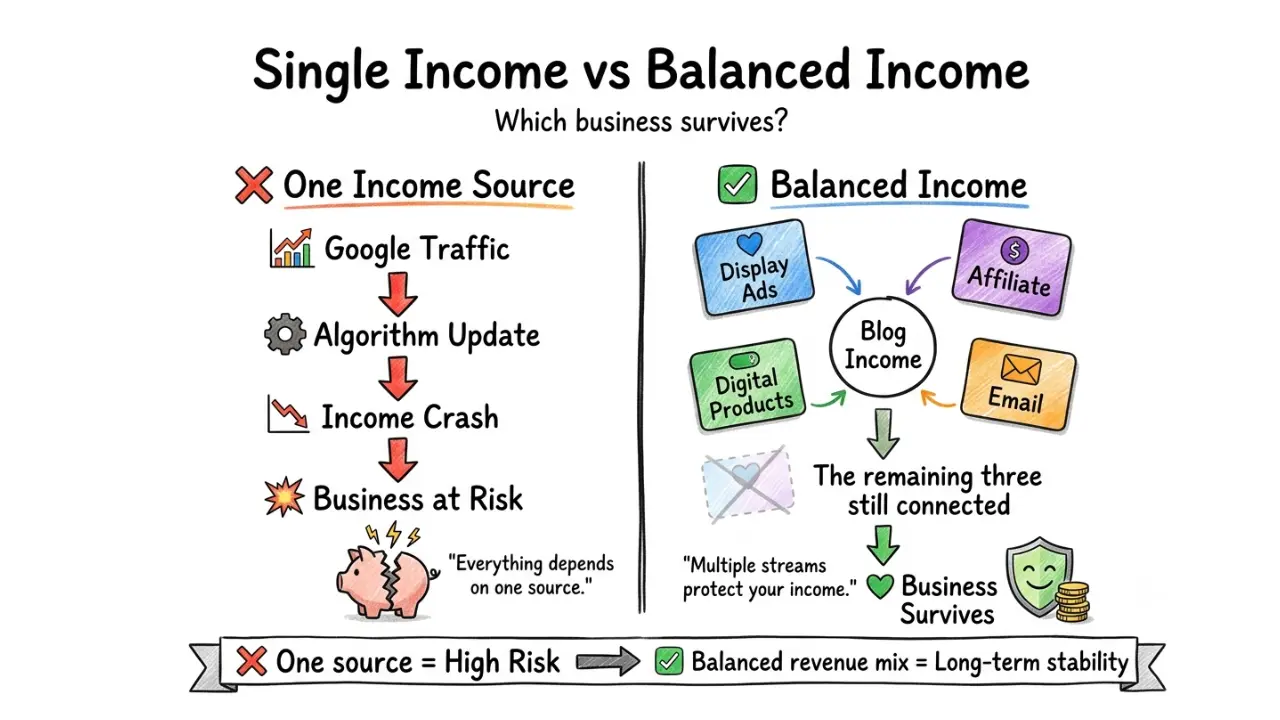
The beginner’s mistake is treating monetization like a single destination. “I’ll do affiliate marketing.” Full stop. That mindset works until the affiliate program cuts commission rates (which Amazon Associates has done multiple times), or until Google reshuffles your ranking for that post.
If you’re completely new to online revenue in general, understanding how to start making money online as a beginner gives you the foundational context before building out a multi-stream system, so you’re not layering complexity on top of confusion.
What is a balanced revenue mix for a new blog – The 30-30-40 rule explained
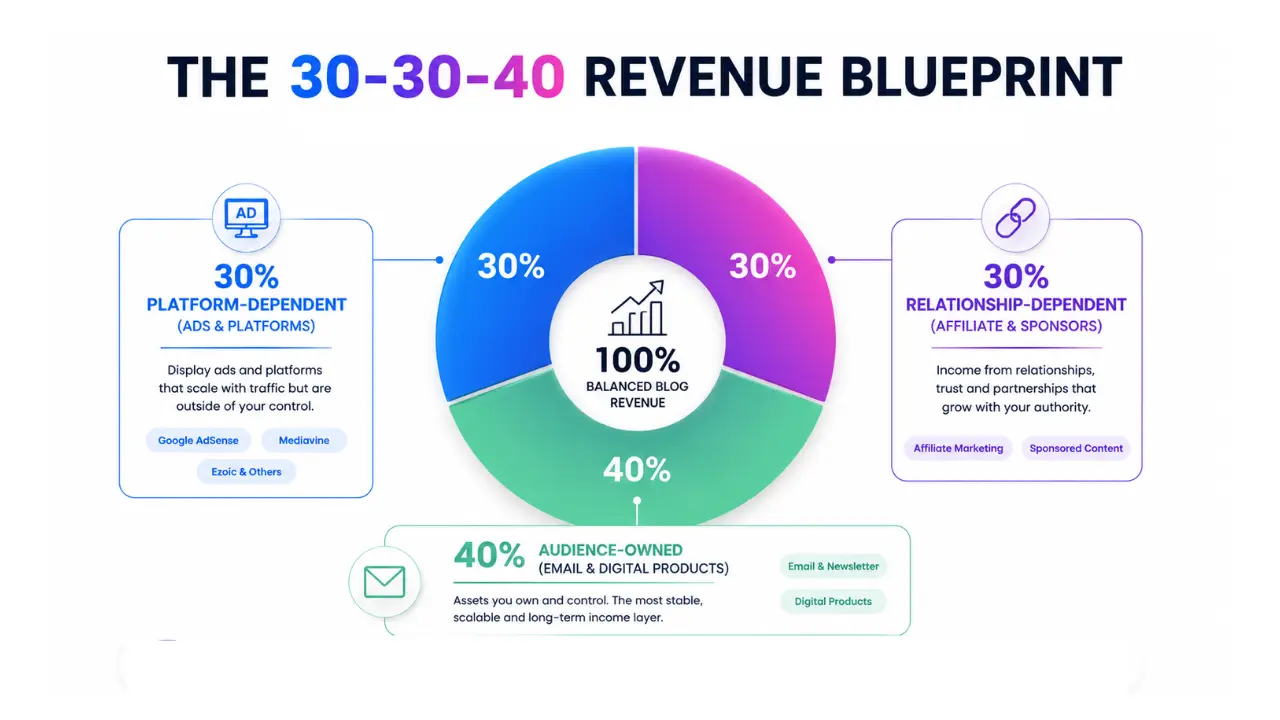
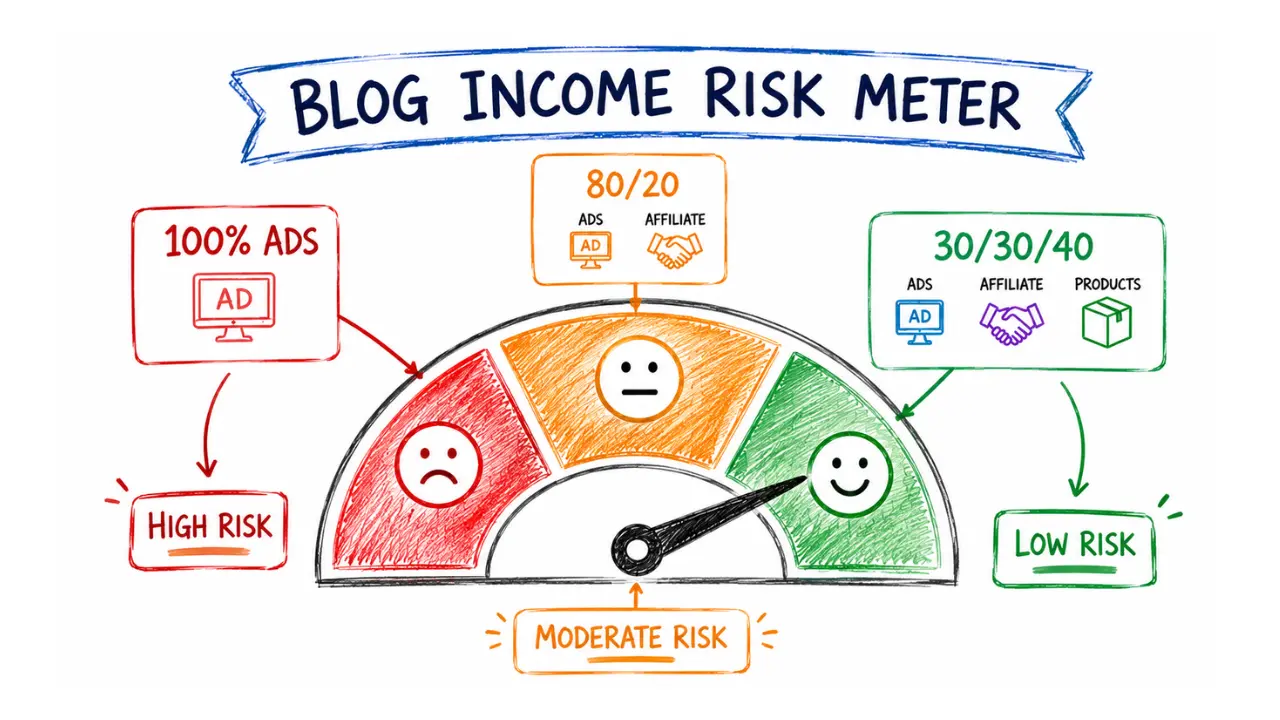
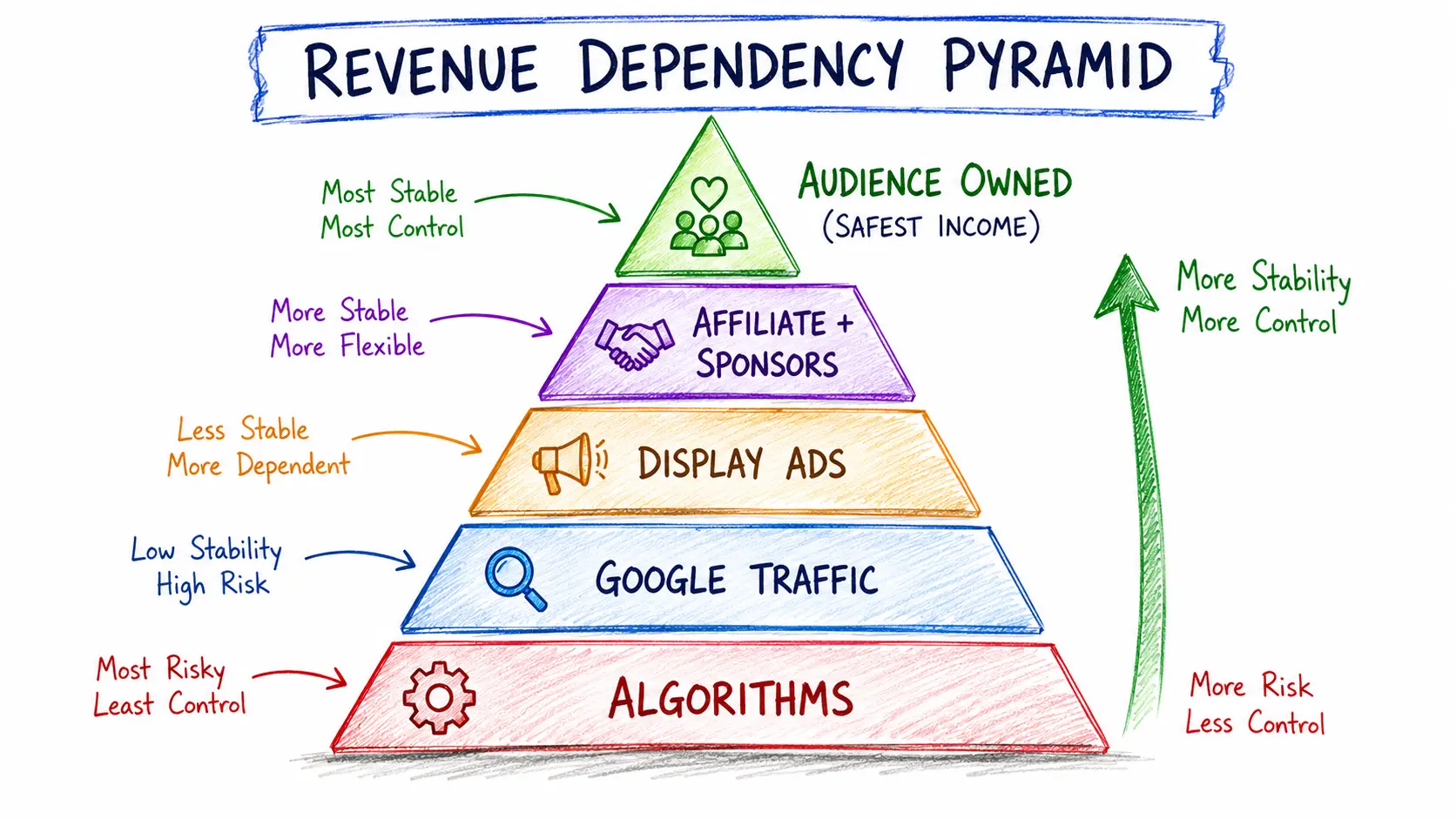
A balanced revenue mix for a new blog follows the 30-30-40 rule: 30% from platform-dependent streams (display ads), 30% from relationship-dependent streams (affiliate marketing, sponsored content), and 40% from audience-owned streams (email monetization, digital products). This split ensures no more than 60% of your income sits on platforms you don’t control.
I developed this framework after rebuilding my monetization strategy from scratch following that algorithm hit.
Every piece of advice I found said “diversify.” None of them said how. No specific ratios. No rationale behind the numbers. Just “don’t put all your eggs in one basket”, which is true but completely useless for a beginner trying to decide where to spend limited time.
Here is the 30-30-40 Blog Revenue Blueprint and why each percentage exists:
The psychology of building income layers is something most beginners underestimate entirely. Early income psychology for beginner bloggers covers the mindset side of this, because the hardest part of building a diversified revenue mix isn’t the technical setup. It’s staying patient while streams develop at different speeds.
The 30% – Platform- dependent revenue (Display advertising)
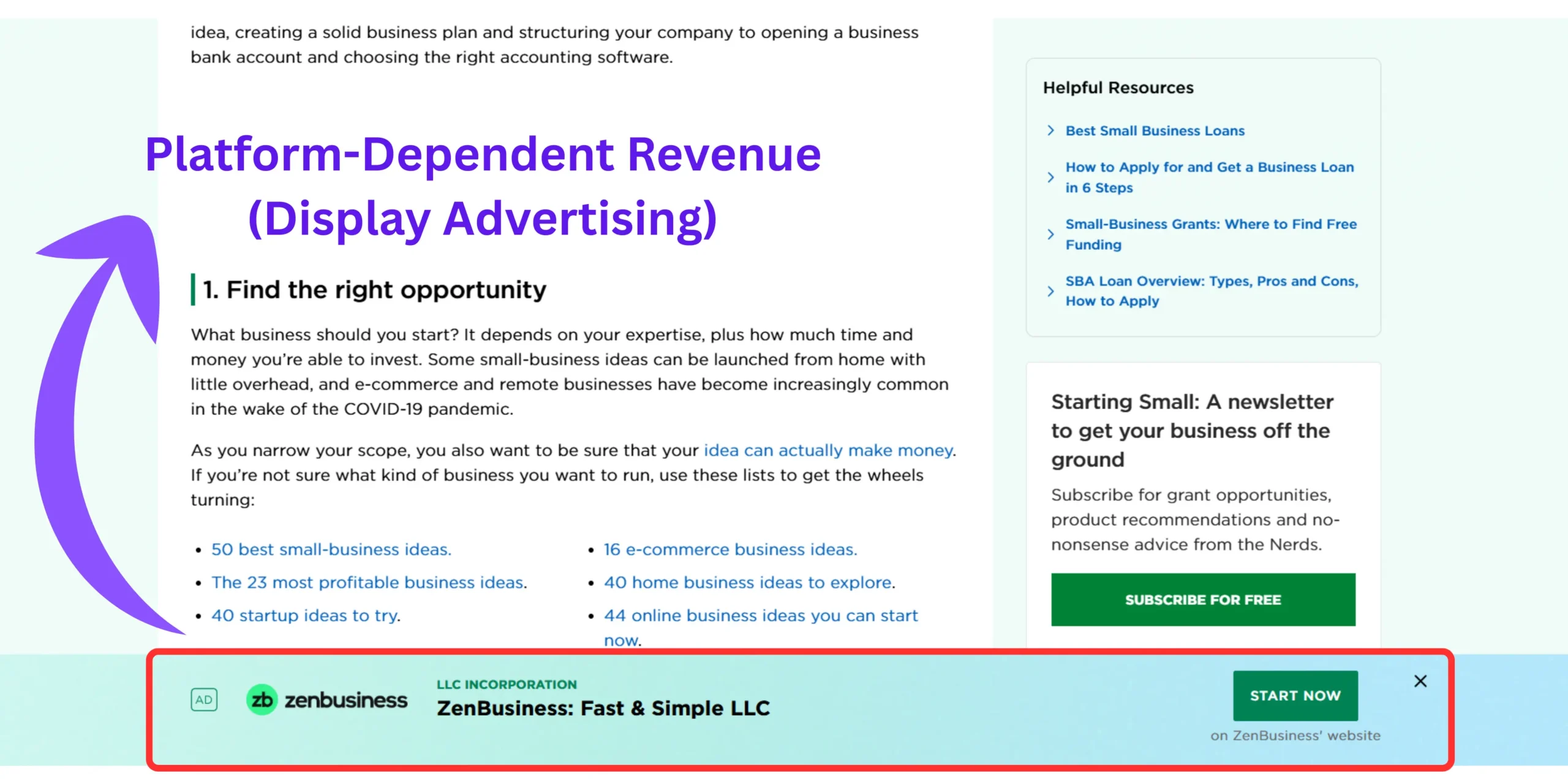
Display ads (Google AdSense, Ezoic, Mediavine, Raptive) fall into this category.
They are genuinely passive once set up, but they require a traffic minimum before becoming meaningful. Ezoic becomes viable around 10,000 monthly sessions. Mediavine requires 50,000. RPMs currently range from $5 to $30+ depending on your niche.
This is why display ads should represent no more than 30% of a beginner blog’s revenue target. Chasing ad income before reaching a traffic threshold means earning pennies while neglecting the streams that work with low traffic.
The 30% cap protects you from the biggest beginner mistake: building a blog where ad revenue grows with traffic, then traffic drops, and the income floor disappears with it.
For everything you need to know about monetizing below the ad network thresholds, how to monetize a blog with low traffic covers the exact approaches that work before the 50k monthly session milestone.
The 30% – Relationship dependent revenue (Affiliate + sponsored)
Affiliate marketing and sponsored content sit here.
Affiliate income is relationship-dependent because it relies on reader trust and consistent content pointing toward specific recommendations. That is the most preferred one of mine. Especially valued for the beginner bloggers who want quick monetization before Ads. Research shows the sweet spot is 5 to 10 affiliate programs per blog – enough to prevent a single program closure from collapsing your income, not so many that your content loses focus.
Sponsored content requires an engaged audience relationship with brands, which makes it largely inaccessible before month 12 for most beginner blogs.
The 30% target for this category reflects its medium-term accessibility. Affiliate income can start within months on a new blog. Sponsored income follows as authority builds. Together they form the relational layer, income that grows as trust grows.
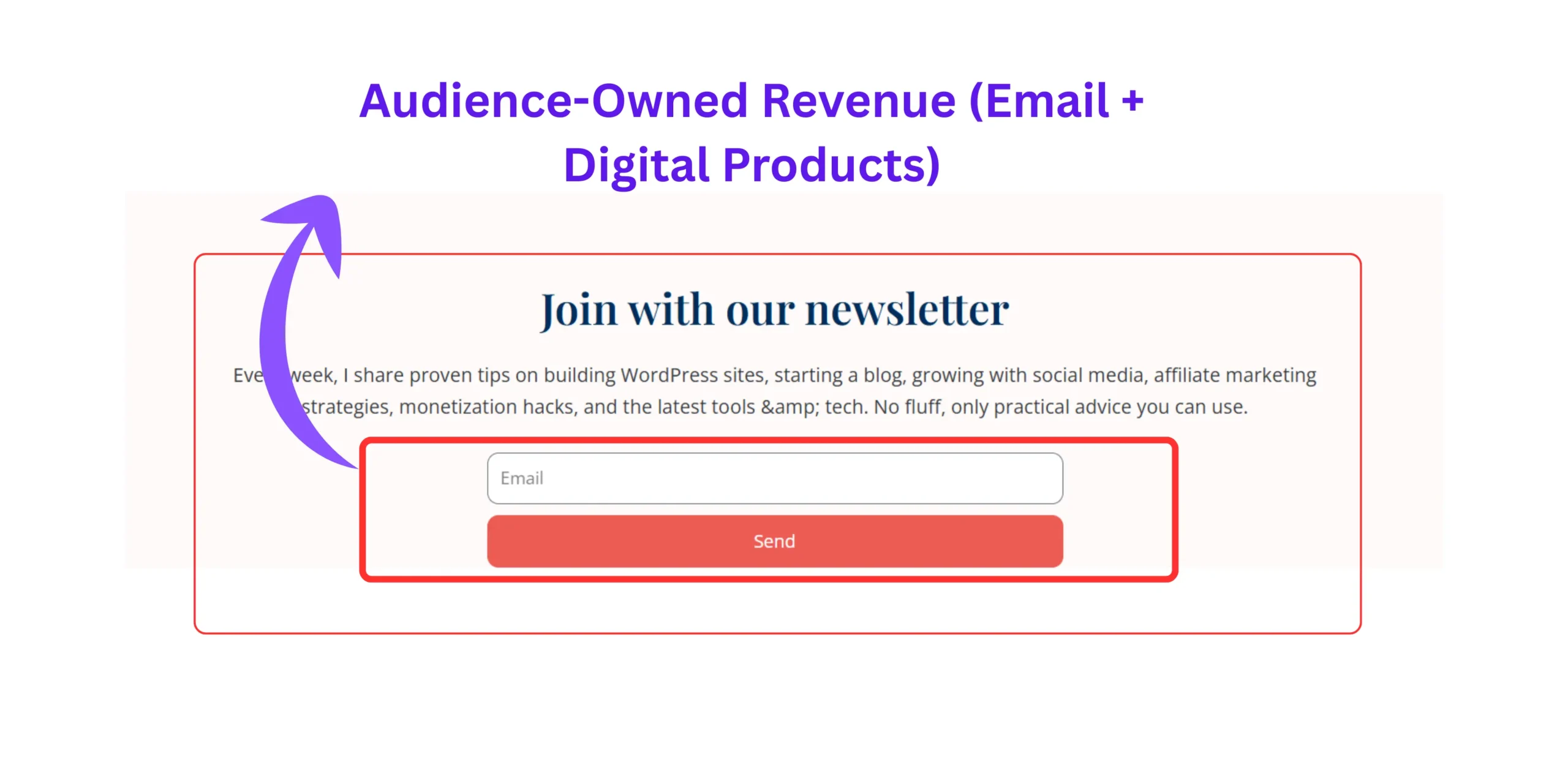
The 40% – Audience owned revenue (Email + digital products)
This is the most important category and the most neglected by beginners.
Audience-owned revenue includes income from your email list (affiliate promotions to subscribers, paid newsletters, product launches) and digital products (templates, ebooks, courses, guides).
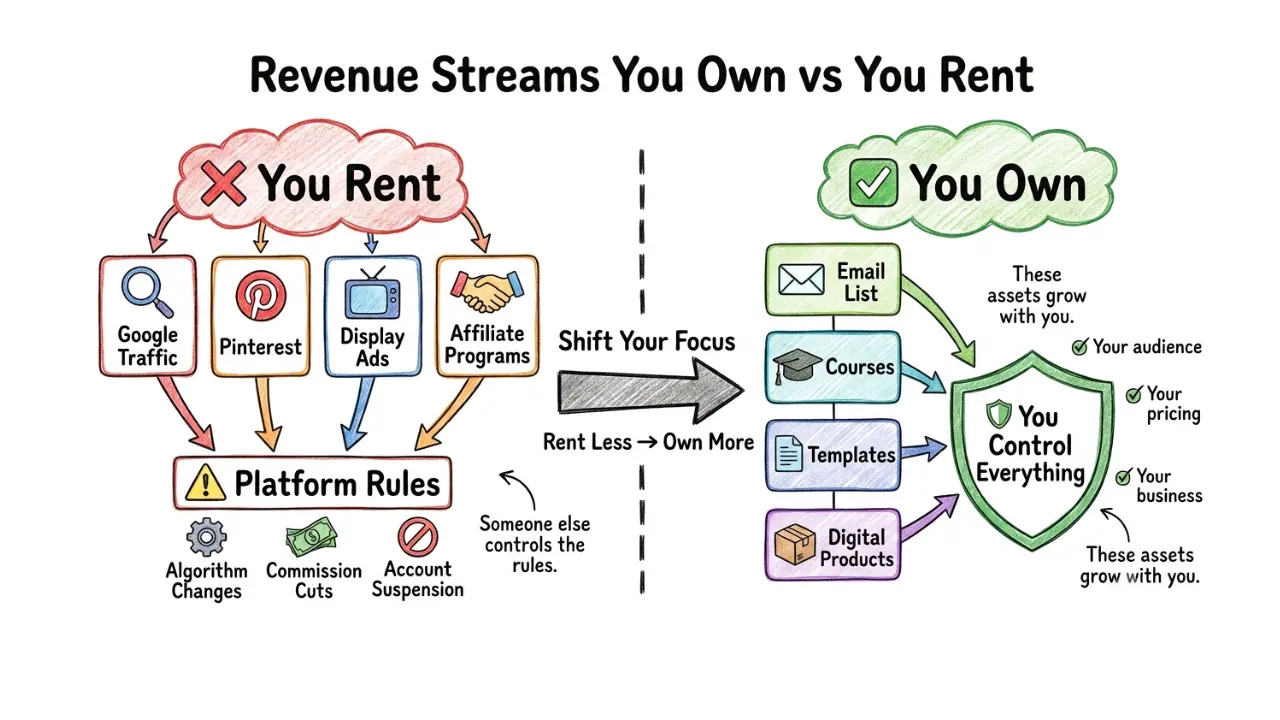
Why 40%? Because this is the only category that no platform can remove.
Google can demote your rankings. Pinterest can change its algorithm. An affiliate program can shut down. But your email list and your digital products exist independently of every platform you use. They are the only truly portable assets a blogger builds.
Research from a 2026 blogging income survey confirms that 45% of bloggers earning over $50,000 annually sell their own products or services. This suggests that audience-owned assets become increasingly important as blog income grows. While affiliate marketing often generates the first meaningful revenue, digital products are frequently what transform a blog from earning commissions into building long-term business equity. making owned products the single strongest predictor of high blogger income.
The 40% weighting isn’t arbitrary. It reflects the combination of stability and ceiling, audience-owned revenue has the highest long-term earning potential AND the lowest platform dependency. It should always hold the largest share.
The blog monetization revenue diversification matrix
The Blog Monetization Revenue Diversification Matrix maps each revenue stream against four key factors – traffic requirement, setup complexity, time to first income, and stability score. It gives bloggers a decision tool for which streams to build first, rather than trying to launch all streams simultaneously and executing all of them poorly.
Most beginners try to launch all monetization streams at once and spread themselves too thin to execute any of them well.
This matrix is the decision framework that solves that problem:
| Revenue Stream | Traffic Needed | Time to First Income | Stability Score | Priority for Beginners |
| Affiliate Marketing | 500+ sessions/monthly | 6-12 months | Medium | Start First |
| Email Monetization | Any | 9-18 months | Very High | Build Simultaneously |
| Digital Products | Any | 12-24 months | Very High | Build in Month 6+ |
| Display Ads | 10,000+ sessions/mo | 3-6 months (low RPM) | Low-Medium | Add When Qualified |
| Sponsored Content | 10,000+ sessions/mo | Variable | Low | Advanced Stage |
Avoid these revenue mix mistakes :
- Waiting for 50,000 monthly sessions before monetizing your blog
- Depending on display ads as your primary income source
- Joining too many affiliate programs instead of building reader trust
- Ignoring your email list while chasing more traffic
- Trying to launch every revenue stream at the same time instead of following a revenue sequence
The matrix confirms what the 30-30-40 rule prescribes: start with affiliate, build email simultaneously from day one, add display ads when traffic qualifies, introduce digital products in month six or later.
Avoiding the common errors around execution is just as important as choosing the right streams. Common mistakes beginners make when monetizing content covers the specific implementation errors that derail otherwise solid revenue strategies, including trying to build all five streams before any one of them is functioning properly.
And once your affiliate stream is running, the placement of your links inside posts matters far more than most beginners realize. Where to place affiliate links in blog posts breaks down the exact in-post positions that drive the highest click-through rates without creating a salesy reading experience.
What is a safe income split for new bloggers
A safe income split for new bloggers limits any single revenue stream to no more than 40% of total income. The 30-30-40 rule achieves this by distributing income across three distinct categories – platform-dependent, relationship-dependent, and audience-owned, so no single algorithm change or program closure can eliminate more than one-third of total revenue.
Three revenue streams is a magic number for beginner bloggers, especially for months 1-12. Five revenue streams is the target by month 18-24
What is the most stable revenue mix for a new website?
The most stable revenue mix combines one audience-owned stream, one relationship-dependent stream and one platform-dependent stream.
This three-pillar structure means no platform change eliminates your entire income. It also means your growth in each category reinforces the others. A growing email list improves affiliate conversion rates. Better affiliate content builds reader trust. Reader trust attracts sponsored content opportunities.
How do bloggers balance Ads and digital products safely?
The safe balance is to never let display ads exceed the income generated by your owned streams.
When ad revenue is higher than email or product revenue, you’ve built a blog that depends on traffic platforms for its financial health. The moment you reverse that ratio, owned streams earn more than ads. You’ve built something genuinely stable.
Understanding what your data is telling you about which streams are working is the analytical layer most beginners ignore entirely. How to use analytics to improve your monetization strategy breaks down exactly which metrics to track per revenue stream so your decisions are data-driven rather than guesswork.
And managing your timeline expectations matters enormously. How long it takes for a new blog to rank on Google explains the realistic organic traffic timeline, which directly determines when display ad income becomes meaningful as part of your 30% allocation.
What every blog monetization guide gets completely wrong about revenue diversification
Here is the information gap that cost me almost a year of suboptimal income decisions and that almost no published guide addresses.
Every monetization guide tells you to diversify your revenue streams. Almost none of them tell you to sequence them.
Diversification and sequencing are not the same concept.
Diversification means having multiple streams. Most advice stops here.
Revenue sequencing means building each stream in a specific order based on your current traffic level, trust level, and time investment capacity, then layering the next stream only when the previous one is functioning.
The distinction matters because a beginner who tries to build all five streams simultaneously at month two will execute all five of them at 20% quality. A beginner who builds affiliate at full focus for months one through four, then adds email systematically in month five, then introduces a digital product in month eight will execute each stream at 80-90% quality with compound results.
The 30-30-40 rule is not a starting ratio. It is a target ratio for months 12-18. In months one through six, the actual split looks more like 0-80-20 (almost entirely affiliate and early email building). In months six through twelve, it shifts toward 10-60-30. By month 18, with traffic growing and products launching, the 30-30-40 target becomes achievable.
One often-overlooked element in this sequencing: your existing content is a revenue asset you’ve already built. How to update old blog posts to get more clicks shows how refreshing underperforming posts can unlock monetization opportunities from content that’s already published and indexed.
And looking further ahead, the income landscape is shifting in ways that reward bloggers who develop new skills early. AI skills that will make you money in 2027 is worth reading now, because several of those skills directly impact how efficiently you can build and monetize your owned-audience category.
Related questions on what is a balanced revenue mixed for new blog
How many income streams should a new blogger have?
A new blogger should build three income streams simultaneously – affiliate marketing, email monetization, and one platform-dependent stream. More than three before month twelve spreads execution too thin for any stream to generate meaningful income.
Three gives you income protection without losing focus. When I tried running five streams at month three, none got the attention they needed. Narrowing to three and executing each properly was what actually moved the numbers. Once all three are consistently generating income, then you add a fourth, never before.
When should a blogger start monetizing their blog?
From day one, with the right stream for your current stage. Affiliate marketing works from your very first published post if the content matches buying intent. Waiting until you have “enough traffic” is one of the most expensive mistakes beginner bloggers make.
Traffic unlocks more streams, it doesn’t unlock the ability to start. A blog with 300 monthly visitors and one well-placed affiliate recommendation consistently earns more than a blog with 3,000 visitors and no monetization structure in place whatsoever.
Is display advertising worth focusing on as a new blogger?
No, display ads should be your last priority, not your first. Before 10,000 monthly sessions, RPMs are so low that focusing on ads actively pulls attention away from the streams that work at any traffic level.
A blog earning $4 per month from AdSense at 2,000 sessions could earn $40-120 in the same period from one relevant affiliate recommendation. Build affiliate and email first. Add display ads when your traffic genuinely qualifies for a premium network like Mediavine or Raptive.
Can affiliate marketing alone support a full time blogging income?
Technically yes, but it creates dangerous single-stream dependency. Affiliate commissions are controlled by third parties who can cut rates, change terms, or close programs without warning. Amazon Associates has done exactly this multiple times.
The 30-30-40 rule exists because affiliate is the best starting stream but the worst long-term foundation if it never gets balanced. Bloggers who documented losing 40-60% of their income overnight almost always had affiliate sitting above 70% of total revenue. Thirty percent is powerful. Ninety percent is a liability.
What is the fastest way to earn your first dollar from a new blog?
Affiliate marketing. It requires no product creation, no traffic minimum, and no audience size. A single post targeting a buying-intent keyword with a relevant affiliate link can generate a commission within the first month of publishing.
The key distinction is that speed to first dollar and long-term income stability need different strategies. Affiliate gets you to your first commission fastest. Email list building gets you to income that compounds regardless of what any platform does next. Start both simultaneously from month one.
Stop building one stream at a time- Your balanced revenue mix starts here
Understanding what is a balanced revenue mix for a new blog is the difference between building something that earns consistently and building something that earns well until one platform changes its rules.
The 30-30-40 Blog Revenue Blueprint gives you a specific target, not a vague instruction to “diversify.” Thirty percent platform-dependent. Thirty percent relationship-dependent. Forty percent audience-owned.
Start with affiliates. Build email simultaneously. Add ads when your traffic qualifies. Introduce digital products when your audience trusts you enough to buy.
What is a balanced revenue mix for a new blog? It’s an income structure where no single platform holds more than 40% of your financial outcome and where the streams you own grow larger than the streams you rent, every single month.
That’s not just a monetization strategy. That’s a business with a real floor.
Which of the three revenue categories – platform-dependent, relationship-dependent, or audience-owned – are you most underdeveloped in right now?