

If you’ve just started a blog, one question probably keeps coming back again and again , how long does it take for a new blog to rank on Google ? You publish your posts, wait a few days, check Google and see nothing. No traffic. No rankings. Just silence. This stage is frustrating, especially when you’re putting in real effort and wondering if you’re doing something wrong.
Most beginners ask the same related questions next , How long does it take a blog to rank on Google ?, How long does it take for Google to index a new site And maybe the most confusing one , how long does SEO take for new blogs to actually work ? The internet is full of unrealistic promises but very few honest explanations.
Choosing the right niche sets the foundation for all future rankings. Understanding how to choose the perfect blog niche for beginners helps you focus content around a topic Google can trust, making it easier to rank consistently over time.
Starting a new blog can feel overwhelming, especially when learning how Google ranks content. Beginners often wonder where to begin and how to start a WordPress blog for beginners that can provide clear step by step guidance. Understanding the basics from the start helps set realistic expectations for how long it takes a blog to rank on Google.
This guide is different. There’s no hype, no shortcuts and no “ rank in 30 days ” claims. Instead, you’ll get a clear, beginner friendly explanation of what really affects ranking timelines, what Google expects from new blogs and which best SEO practices for beginner bloggers actually help without overwhelming you.
Finally , you’ll know exactly what to expect, what to focus on and how to move forward with confidence.
Even with limited resources, it’s possible to launch effectively. Learning how to start a high quality blog on a budget ensures your site is properly structured, which contributes to faster indexing and better long term SEO performance. Smart planning early saves frustration while your blog gradually builds rankings.
Table of Contents on how long does it take for a new blog to rank on Google
What does “ranking on Google” actually mean?
Before understanding how long does it takes a blog to rank on Google , it’s important to know what ranking actually means. Many beginners assume that once a post is published, it should immediately appear in search results but that’s not how Google works.
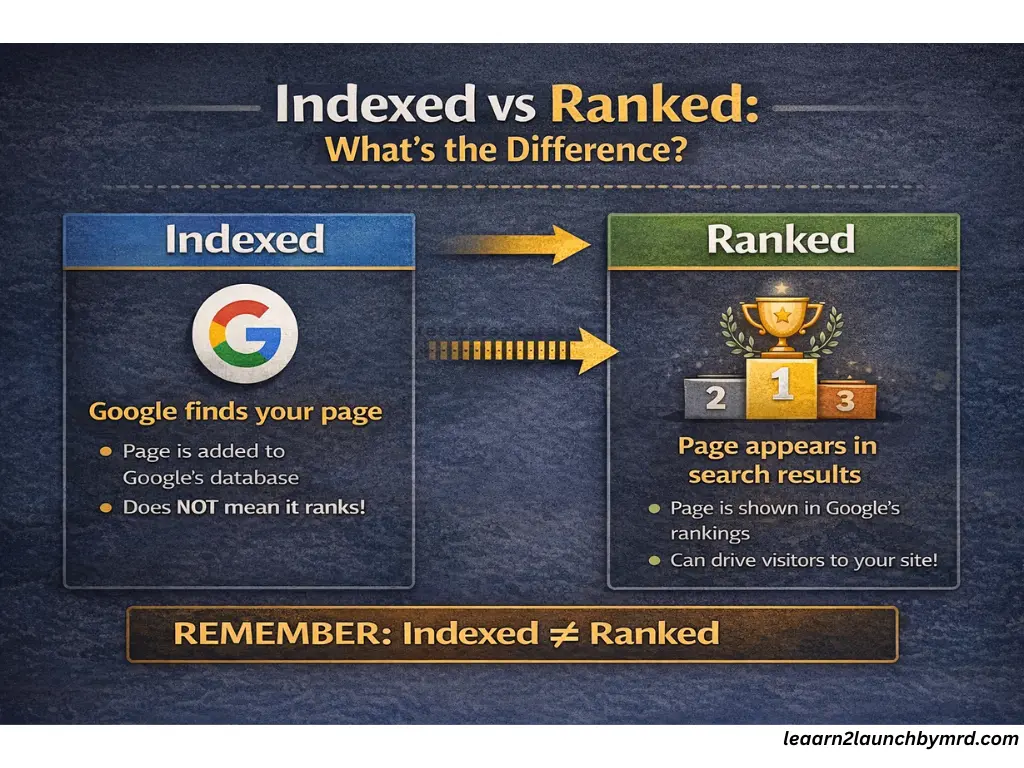
Indexed and ranked are not the same
These two terms are often confused,
- Indexed means Google has discovered your page and added it to its database.
- Ranked means your page is shown for a specific keyword and placed somewhere in search results.
A blog can be indexed and still not rank for anything meaningful. This is why many beginners search for How long does it take for Google to index a new site and feel confused when traffic doesn’t follow.
Many beginners confuse indexing with real ranking. One reason traffic remains low is why people do not engage with your content. Creating content that matches search intent and engages readers ensures Google notices meaningful user signals, which eventually helps your new blog rank.
The visibility stage of a new blog
Most new blogs go through these stages,
- Published – Your content goes live
- Indexed – Google finds and stores the page
- Test visibility – The page may appear briefly, then disappear
- Stable ranking – Google decides where it belongs long term
This process takes time, especially when Google is still learning whether your content deserves trust.
Why beginners confuse indexing with ranking
Beginners often check Google, see their page appear once and expect traffic immediately. When that doesn’t happen, they assume SEO isn’t working. In reality, this early phase is normal, especially when learning best SEO practices for beginner bloggers and understanding how long SEO takes for new blogs to show real results.
Knowing this difference prevents panic and unrealistic expectations.
How long does it take for a new blog to rank on Google?
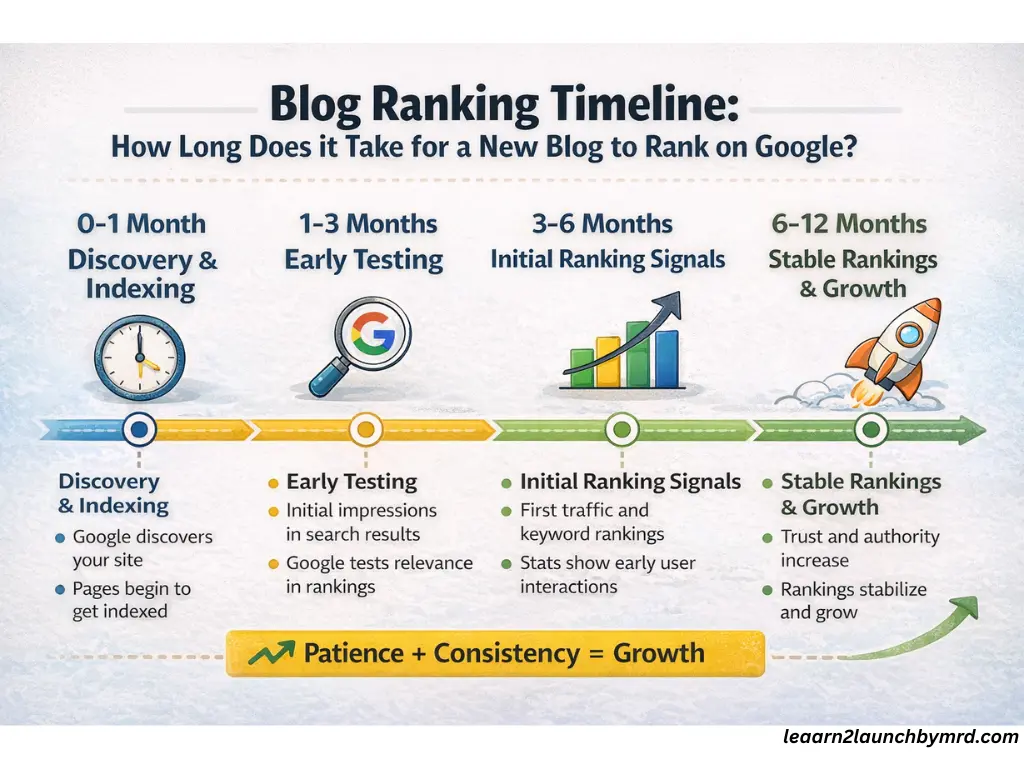
The honest answer to how long does it take a blog to rank on Google depends on one thing, what stage your blog is in . Google doesn’t rank new sites instantly. Instead, it observes, tests and slowly builds confidence in your content over time. Below is a realistic timeline most beginner blogs experience.
0 – 1 Months : Discovery and Indexing phase
In the first month, Google is simply trying to understand your site.
- Pages start getting indexed
- Rankings are unstable or nonexistent
- Traffic is usually very low or zero
At this stage, your blog may appear briefly for a keyword and then disappear. This doesn’t mean you’re failing , it means Google hasn’t gathered enough data yet.
While Google gradually tests your content, driving initial traffic matters. Learning how to get traffic to a new blog can speed up indexing and help posts reach the right audience sooner. Small efforts in promotion and sharing complement SEO during the first 0 – 3 months.
1 – 3 Months : Early testing phase
During months one to three, Google begins testing your content.
- Some posts may rank beyond page 5 – 10
- You might see impressions but very few clicks
- Rankings can move up and down frequently
This is when many beginners quit, assuming SEO isn’t working. In reality, this is when Google starts comparing your content against others.
Using social channels like Pinterest is a smart way to accelerate visibility. Understanding how to drive website traffic from Pinterest helps new blogs supplement early organic rankings with additional clicks, giving Google positive user behavior signals.
3 – 6 Months : Initial ranking signals
This is where progress becomes visible.
- Some posts may reach page 2 or low page 1
- Organic traffic starts appearing slowly
- Google begins trusting specific topics you cover
Blogs that follow best SEO practices for beginner bloggers and publish consistently often see their first real wins here.
6 – 12 Months : Stable ranking and growth phase
For most beginners, this is the realistic ranking range.
- Posts begin ranking consistently
- Traffic becomes predictable
- Older content improves without major changes
By this stage, Google understands your blog’s purpose, which is why many people finally see answers to how long does SEO take for new blogs only after several months of patience and consistency.
ranking is not instant, but it is predictable when you focus on quality, relevance and long term strategy.
How long does it take for Google to index a new site?
Before a blog can rank, it must first be indexed. This is why beginners often ask how long does it take for Google to index a new site and feel confused when their content doesn’t appear immediately. Indexing is simply Google’s way of discovering and storing your pages not ranking them.
What indexing actually means
Indexing happens when Google,
- Finds your page through links or a sitemap
- Reads and understands the content
- Stores it in its search database
If a page isn’t indexed, it cannot rank , no matter how good the content is. This is an important step many beginners overlook.
Typical indexing time for new blog
For most new websites, indexing follows this general pattern,
- A few days for individual pages (If Google finds them quickly)
- 1-2 weeks for most new blog posts
- Several weeks for brand new sites with no authority
This timeline varies but slow indexing is normal for new blogs with little content or few internal links.
Indexing is the first step, but using keywords correctly matters. Learning how to use keywords the right way ensures Google understands your topic and content intent, improving both indexing and early ranking potential without over optimization.
Why some sites get indexed faster than others
Not all blogs are indexed at the same speed. Google tends to index sites faster when,
- The site has a clear structure and sitemap
- Internal links connect pages properly
- Content is original and helpful
- The site publishes consistently
Beginners who follow best SEO practices for beginner bloggers often improve indexing speed naturally over time. However, faster indexing doesn’t mean faster ranking it simply means Google is aware of your content.
Understanding this difference helps set realistic expectations while learning how long SEO takes for new blogs to show results.
How long does SEO takes for new blogs
One of the most common beginner questions is how long does SEO take for new blogs and the honest answer is: SEO is not instant ,it’s cumulative. Every blog post, internal link and update adds small signals that grow stronger over time. Google doesn’t reward single actions; it rewards consistency.
SEO works by compounding over time
SEO is similar to building trust. Early on, your efforts may feel invisible but they are being recorded.
- Each published post strengthens topical relevance
- Internal links help Google understand your site structure
- Older content gains authority as it ages
This is why new blogs rarely see immediate results even when they are doing everything correctly.
Content trust signals matter more than speed
Google looks for signs that your content is worth ranking,
- Does your content answer search intent clearly?
- Is it original and genuinely helpful?
- Do visitors stay and read or leave quickly?
These trust signals take time to develop. That’s why simply publishing content faster doesn’t guarantee rankings. Blogs that follow best SEO practices for beginner bloggers and focus on clarity usually outperform rushed over-optimized sites.
Why beginners must think long term
Many beginners quit SEO too early because they expect quick wins. In reality, SEO rewards patience.
A blog that shows consistency for 6 – 12 months sends a powerful message to Google , this site is serious , rankings improve naturally even for older posts.
When beginners understand how long does SEO take for new blogs , they stop chasing shortcuts and start building real assets. That long-term mindset is what eventually turns a new blog into a reliable traffic source.
Even before significant rankings, beginners can focus on strategies like affiliate marketing. How to monetize a blog with low traffic explains ways to earn while building SEO, showing that early effort compounds into both traffic and revenue opportunities over time.
Early earnings teach important lessons about strategy and audience. Understanding how small blog earnings teach more than large earnings helps beginners stay patient while SEO results grow gradually over months, reinforcing the value of consistent effort.
Why new blogs take time to rank on Google
Because they are “bad,” new blogs don’t have problems with ranking. They struggle because Google takes time to establish credibility and understand authority, particularly in search results that are competitive. Almost all beginners experience this common delay.
Domain age and trust
A new domain has no history. Google doesn’t know if your site will exist long term or disappear in a few months.
- Older sites have proven consistency
- New blogs must earn trust gradually
- Time helps validate reliability
This doesn’t mean new blogs can’t rank , it means they need patience.
Content depth takes time to build
One or two blog posts are rarely enough. Google prefers sites that,
- Cover topics in depth
- Answer related questions clearly
- Show consistency within a niche
Until your blog builds enough content, it may struggle to compete with established sites that already have dozens of related posts.
Search intent mismatch
Many beginner blogs don’t rank because the content doesn’t fully match what users want.
FOR example ,
- Informational searches answered with vague content
- Long form topics explained too briefly
- Missing practical steps users expect
Google prioritizes content that best satisfies search intent, not just keyword usage.
Lack of topical authority
Topical authority means Google sees your blog as knowledgeable in a specific area. New blogs usually ,
- Cover too many topics
- Publish without internal linking
- Lack a clear focus
In competitive niches, authority wins. As your blog grows and content connects logically, Google becomes more confident ranking your pages higher.
What affects how fast a new blog ranks?
New blogs don’t all rank as quickly. Even though two blogs launch at the same time and post similar content, their outcomes can differ significantly. This is due to the fact that Google considers a number of signals when deciding how quickly a website deserves visibility.
Content quality comes first
Content quality is the strongest factor. Google favors content that,
- Clearly answers the search intent
- Explains topics in a helpful, structured way
- Feels written for humans not algorithms
Thin or generic posts may get indexed but they rarely rank well especially in competitive niches.
Keyword competition matters
Some keywords are simply harder to rank for.
- Broad keywords face heavy competition
- Beginner friendly, long tail keywords rank faster
- Clear intent keywords outperform vague ones
Choosing the right keywords often matters more than publishing more content.
Internal linking builds context
Internal links help Google understand,
- What your blog is about
- Which pages are most important
- How topics are connected
New blogs without internal links often struggle because Google lacks context. Even a simple linking structure can speed up ranking over time.
Consistency signals reliability
Once your content appears in search, user behavior matters. Google observes ,
- How long users stay on the page
- Whether they scroll or leave immediately
- If they explore other pages
Positive behavior signals tell Google your content is useful, helping it rank faster and more steadily.
Best SEO practices for bloggers
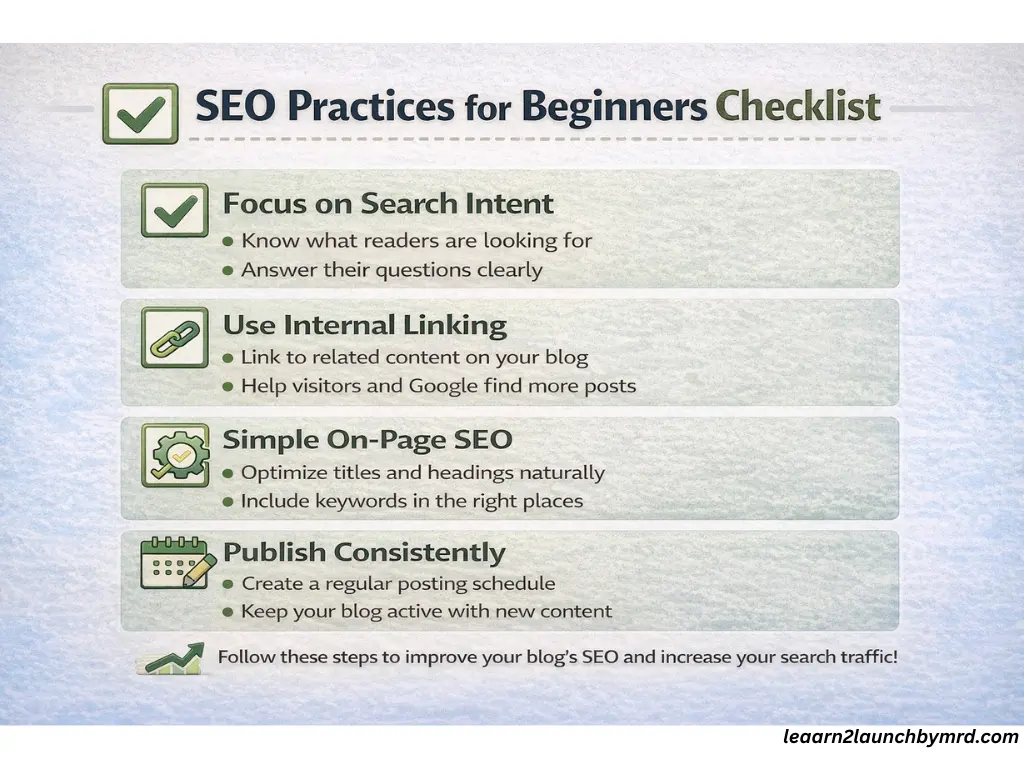
When beginners search for best SEO practices for beginner bloggers they often find complex advice that creates confusion instead of results. In reality, ranking faster comes from doing a few core things consistently without shortcuts or risky tactics.
Focus on search intent first
Search intent matters more than keywords alone. Before writing , ask ,
- What problem is the reader trying to solve?
- Are they looking for guidance, steps or explanations?
- What would a helpful answer look like?
Google ranks content that best matches intent, even if the site is new. Clear, focused answers often outperform longer but unfocused posts.
Foundational SEO starts with good content. Knowing how to write your first blog post correctly ensures proper structure, headings and keyword placement, making it easier for Google to index and rank your posts faster.
Use internal linking to build clarity
Internal links help Google understand your blog structure.
- Link related posts naturally
- Guide readers to supporting content
- Strengthen topic connections
For beginners, internal linking is one of the safest and most effective SEO practices and it improves both rankings and user experience.
Apply simple on page SEO
You don’t need advanced optimization. Focus on ,
- One main keyword per post
- Clear headings (H2 , H3)
- Short, readable paragraphs
- Natural keyword usage
Avoid keyword stuffing. Google prefers clarity over repetition, especially for new blogs.
Publish consistently , not constantly
Consistency signals commitment.
- Choose a realistic schedule ( weekly or by weekly )
- Stick to related topics
- Avoid long gaps between posts
Consistent blogging encourages trust more quickly than random posting. Over time, this consistency increases ranking stability and helps Google in understanding the purpose of your website.
One post can work harder through repurposing. Learning how to repurpose one blog post into multiple content formats helps maintain consistent publishing and internal linking, which strengthens your blog’s topical authority and accelerates ranking.
Beyond SEO, repurposing content allows you to reach new audiences. Understanding what is content repurposing and how does it work complements consistent publishing and internal linking, ensuring each blog post continues contributing to ranking growth over time.
Sustainable growth results from the slow compounding of these easy-to-use SEO techniques.
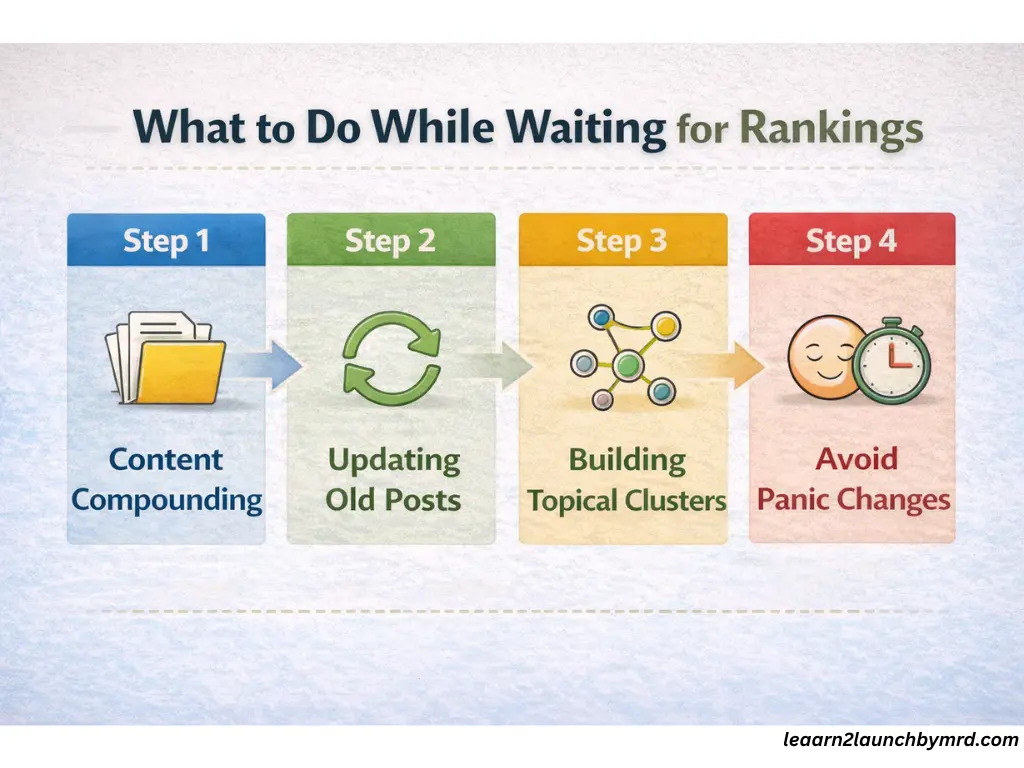
What beginners should do while waiting for ranking
It’s easy to feel impatient when your blog isn’t ranking immediately . The truth is, most new blogs take time and successful beginners focus on strategic actions rather than waiting idly or panicking.
Content compounding
Every post you publish adds value to your blog over time.
- Older posts gain authority as you add new related content
- Each new post strengthens your overall site relevance
- Traffic often increases gradually as Google recognizes your blog as a resource
Updating old posts
Don’t forget the content you’ve already published.
- Refresh outdated information
- Add new examples or steps
- Optimize with internal links to newer posts
Updating old posts signals to Google that your blog is active and trustworthy.
Building topical clusters
Grouping related content helps both Google and readers.
- Link posts around a single topic to create a cluster
- Establish authority in a specific niche
- Make your blog easier to navigate and index
Avoid panic changes
Many beginners make rapid changes when they see slow progress.
- Avoid deleting posts or changing URLs unnecessarily
- Stick to your content plan and consistent SEO practices
- Trust the cumulative effect of your efforts
By focusing on these strategies instead of rushing for instant results, you set your blog up for long term success and steady growth in search rankings.
Patience prevents premature failure. Learning why most blogs fail before making money reminds beginners that SEO takes time and consistent effort, and early setbacks don’t indicate a poorly performing blog they’re part of the process.
Common beginner SEO mistakes that delay rankings
Beginners often make mistakes that slow their blog’s ranking progress, even with the best of intentions. You can avoid frustration and wasted effort by being aware of these mistakes.
01 . Publish randomly
Posting inconsistently confuses both readers and Google.
- Irregular publishing signals unreliability
- Pages take longer to index and gain trust
- A steady schedule builds authority and momentum
02 . Chasing tools instead of strategy
Many beginners rely too much on SEO tools without a clear plan.
- Tools are helpful but won’t replace strategy
- Over focusing on metrics distracts from content quality
- Google prioritizes relevance, originality and user experience
03 . Keyword stuffing
Stuffing posts with keywords may have worked in the past but not anymore.
- Overusing keywords can hurt readability
- Google can penalize unnatural content
- Focus on naturally including your main and secondary keywords
04 . Expecting fast results
The biggest mistake is expecting instant rankings.
- SEO is cumulative and long term
- Most blogs take 6 – 12 months to see meaningful results
- Patience and consistency are key
Avoiding these common errors allows beginners to focus on what truly matters: creating quality content, following best SEO practices for beginner bloggers and building long term trust and authority with Google
Frequently asked questions on how long does it take for a new blog to rank on Google?
How long does it take new blog to rank on Google?
The ranking timeline for a new blog varies, but most beginners see measurable results between 6 – 12 months. Factors like domain age, content quality, and internal linking affect rankings. Following best SEO practices for beginner bloggers can help speed up progress.
How long des it take a blog to appear on Google search
Typically, it takes 1 – 2 weeks for Google to index a new blog post. However, ranking in search results takes longer because Google evaluates trust, authority and relevance over time. Using proper on-page SEO and publishing consistently can improve indexing and early visibility.
How long does it take for Google to index a new site?
Google usually indexes new sites within a few days to a few weeks. Sites with clear sitemaps, internal linking and regular content updates tend to get indexed faster. Indexing is only the first step; ranking for keywords may take several months.
How long does SEO take for new blogs to show results?
SEO is cumulative, so most new blogs see noticeable traffic after 3 – 6 months, with significant rankings often appearing around 6 – 12 months. Consistently publishing quality content and following best SEO practices for beginner bloggers accelerates results.
What ar ehte best SEO practices for beginner bloggers to rank faster?
Key practices include,
- Focusing on search intent first
- Using internal linking to connect content
- Optimizing headings and paragraphs for clarity ( On page SEO )
- Publishing consistently
The honest truth about blog ranking timelines
Social media signals support rankings indirectly. Learning how to use social media to grow your online business helps you share content effectively, increasing engagement and traffic while Google observes positive user signals for ranking evaluation.
So , how long does it take for a new blog to rank on Google? The answer isn’t instant, but it’s predictable if you follow the right approach. Most beginners wonder how long does it take a blog to rank on Google or how long does it take for google to index a new site and feel frustrated when results don’t appear immediately. It’s normal Google evaluates trust, authority and content quality over time, and SEO is cumulative.
The key is to focus on what you can control: following best SEO practices for beginner bloggers publishing consistently, creating helpful content, and building internal links. Remember, how long does SEO take for new blogs varies by niche and competition but persistence always pays off
You can cultivate a long-term mindset, reduce unnecessary stress, and gradually increase your authority in your niche by understanding the realistic timeline and avoiding short cuts. Every little step adds up to make your new blog a reliable, useful resource that Google and your readers will value.