
TL;DR: How to identify seasonal blog niches requires checking three signals simultaneously – Google Trends annual spike patterns, SERP freshness signals showing annual content updates, and content calendar patterns in search results. Any niche where monthly search interest falls below 20 on Google Trends for more than six consecutive months is a seasonal niche that will deliver traffic for 6–8 weeks per year regardless of how much content you publish.
You can spend six months building a blog only to discover that your “high-volume niche” has demand for six weeks. Search volume alone doesn’t reveal seasonality.
This guide shows you how to detect it before publishing. You’ll use the 3-Signal Seasonality Detection Method. Then you’ll learn how to score the niche, identify seasonal traps, and pivot seasonal ideas into evergreen opportunities.
How to identify seasonal blog niches before committing to one is the exact knowledge gap that separates bloggers who build consistent traffic from those who experience a two-month surge followed by nine months of silence.
This post is part of the Profitable Blogging Niche Validation & Market Research Frameworks system, the complete niche research guide for beginner bloggers building long-term digital assets.
The full business architecture around niche selection sits inside How to Start a Business Blog: Blueprint for Building a Real Digital Asset in 2026, which covers how niche decisions compound into revenue decisions over a 2–3 year timeline.
By the end of this guide, you’ll have three named frameworks, a scored list of 15 seasonal niches to avoid, and the exact pivot process for converting a seasonal blog into an evergreen income asset.
To identify seasonal blog niches, check whether search demand repeatedly rises and falls during the same period each year. Validate the pattern using Google Trends, seasonal SERP changes, and calendar-dependent content language before deciding whether the niche is evergreen, mixed, or seasonal.
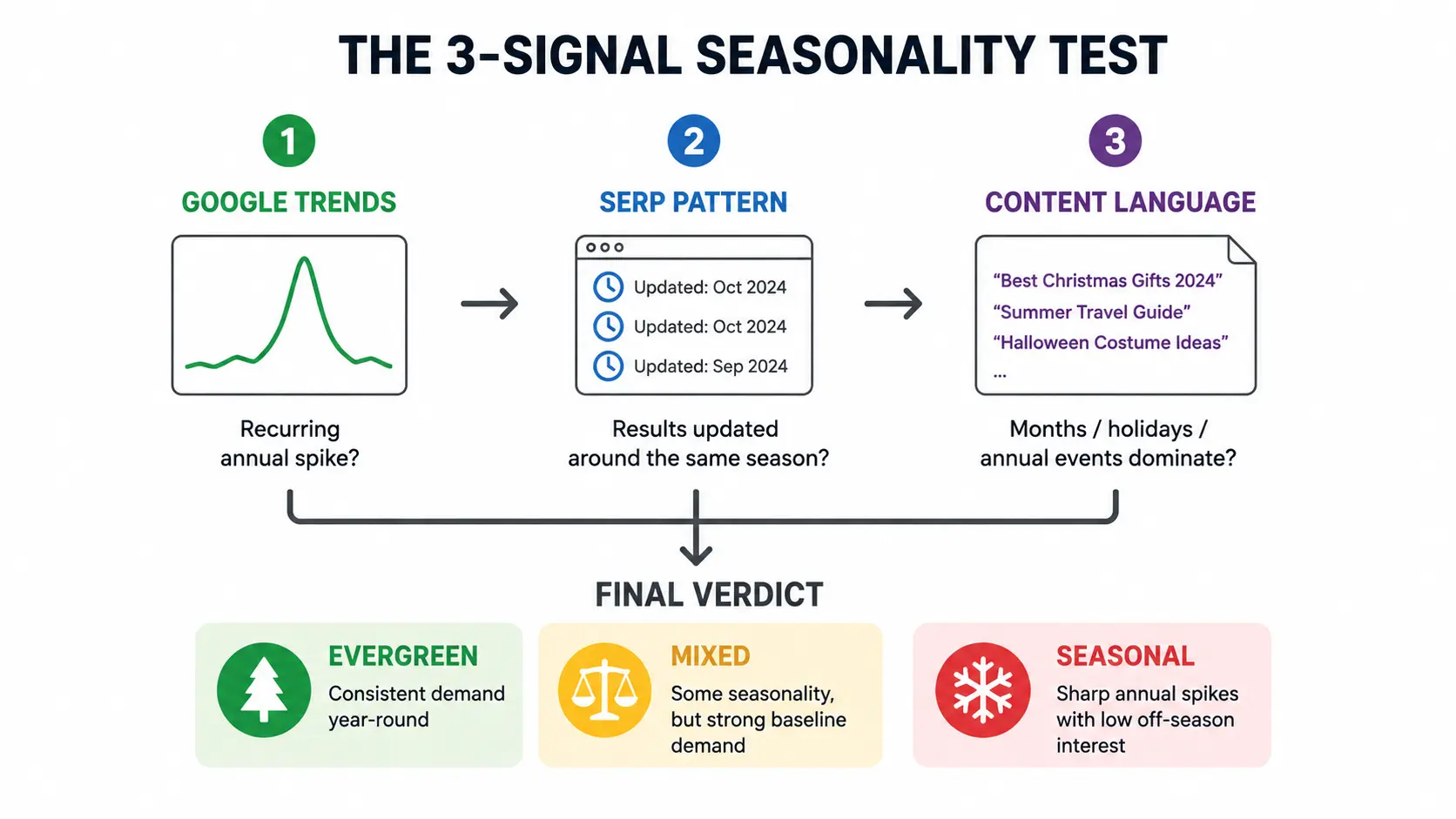
THE 3-SIGNAL SEASONALITY TEST
Important: A single traffic spike does not prove seasonality. A recurring pattern supported by multiple signals is much stronger evidence.
Key Takeaways on how to identify seasonal blog niches
Before choosing a blog niche, check whether its search demand is truly evergreen or concentrated around a predictable seasonal window.
Seasonality can create a traffic ceiling. A niche that depends heavily on a short recurring demand window can produce strong peaks followed by long periods of weak interest.
Use three signals before committing to a niche. Check Google Trends for recurring demand patterns, the SERP for seasonal update patterns, and search-result language for months, holidays, or annual events.
Google Trends shows the shape of demand. Use it to identify recurring spikes and valleys, then combine the pattern with SERP and keyword evidence before making your final niche decision.
Seasonal does not always mean unusable. A seasonal topic can become more durable when its underlying audience problem is transformed into a broader, year-round content angle.
The Seasonal-to-Evergreen Pivot Protocol provides the transformation path. Identify the core interest, remove the calendar qualifier, add a specific audience qualifier, and validate the new niche with year-round content opportunities.
Validate seasonality before publishing post one. A short pre-registration check can reveal whether your niche has year-round demand or depends on a predictable seasonal cycle.
MRD Insight: The goal is not to eliminate every seasonal topic. The goal is to understand the demand pattern before investing months of content effort into a niche that may depend on a narrow traffic window.
Evergreen vs seasonal blog niches for beginners – The difference that determines your entire traffic ceiling
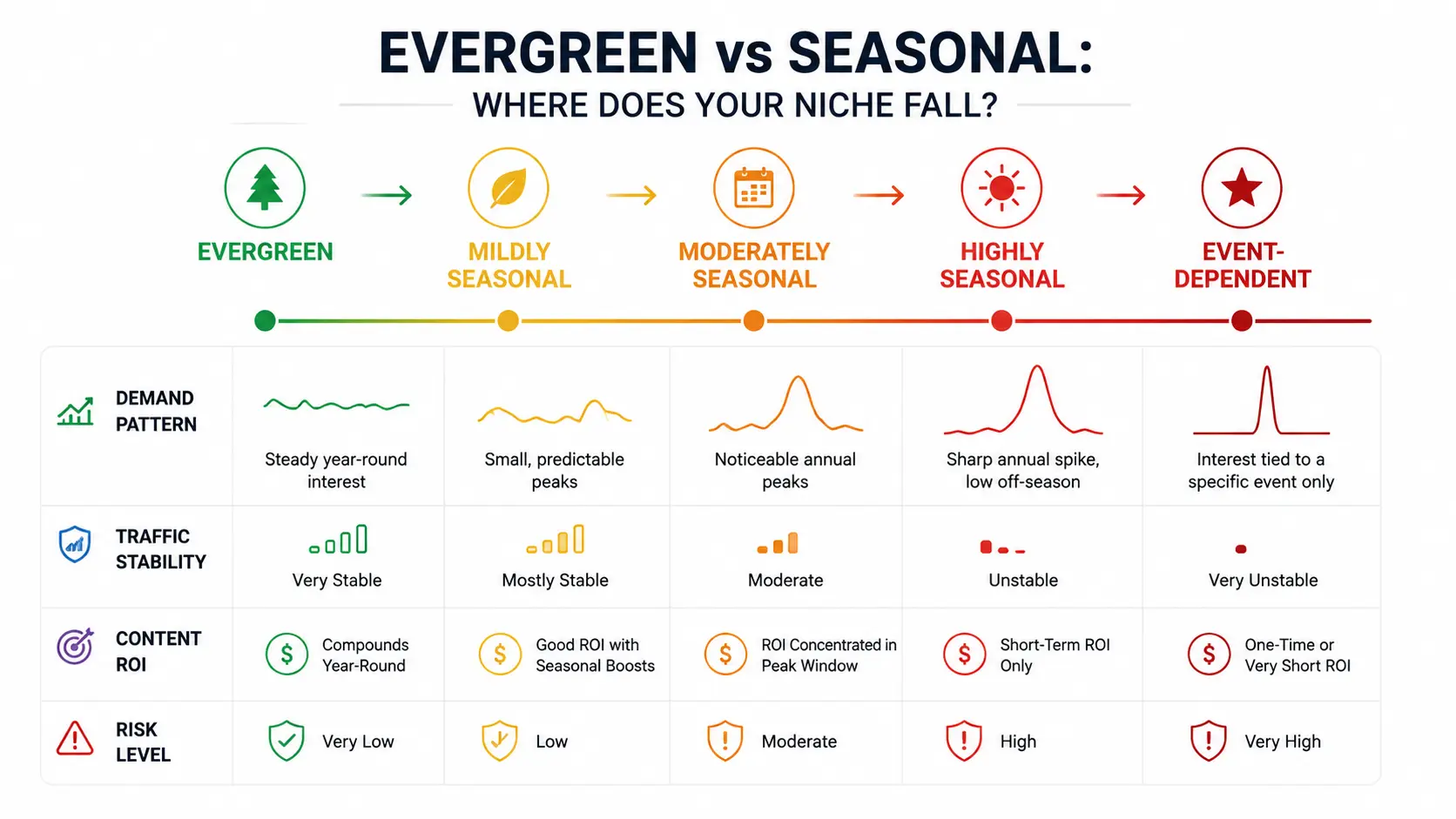
An evergreen blog niche is a topic category that maintains consistent search demand across all 12 months of the year. A seasonal blog niche is a topic that generates the majority of its annual search volume during a specific 4–8 week window – producing traffic spikes followed by prolonged low-traffic periods that no SEO strategy can reverse.
Evergreen vs seasonal blog niches for beginners is the most important niche evaluation dimension that most beginner guides skip entirely.
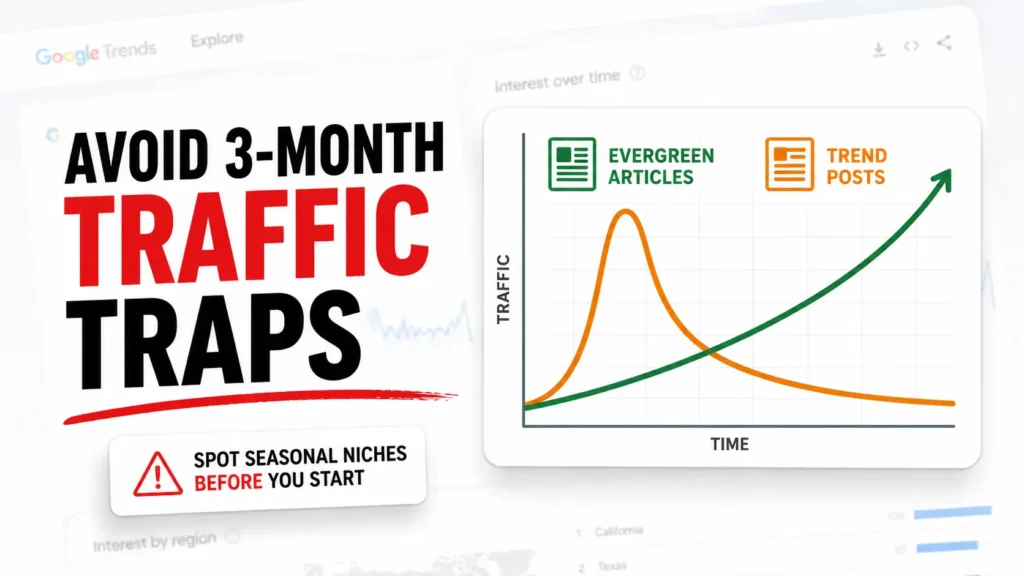
If the entire niche depends on trend cycles, you’re building on sand. Flat demand equals good. Upward trend equals excellent. Spikes and crashes – avoid.
Here is the structural difference in practical terms:
The biggest difference between evergreen and seasonal niches is how consistently their traffic, content, and monetization opportunities remain active throughout the year.
| Factor | 01 Evergreen Niche | 02 Seasonal Niche |
|---|---|---|
| Monthly traffic consistency | Year-round | 6–8 weeks per year |
| Google Trends pattern | Flat or upward line | Annual spike → crash |
| Email list building pace | Steady monthly growth | Rapid spike → stagnant |
| Affiliate commission timing | Year-round | Compressed to spike window |
| Content publishing ROI | Compounds over time | 6–8 weeks → dormant |
| Recovery from traffic dip | No seasonal dip | 9-month wait for next season |
A blogger publishing 50 posts in a purely seasonal niche accumulates approximately 75–100 weeks of active ranking time over three years. A blogger publishing 50 posts in an evergreen niche accumulates 156 weeks – a 56% higher earning window from identical publishing efforts.
Evergreen vs seasonal blog niches for beginners comes down to one question: do you want content that earns 52 weeks per year or content that earns 6?
15 best low competition high income blog niches for beginners documents the highest-BNVS evergreen niches that avoid the seasonal trap entirely with scoring across all five dimensions including Evergreen Demand.
How to identify seasonal blog niches – The 3 signal detection method
Identifying seasonal blog niches requires checking three simultaneous signals: a Google Trends annual spike pattern (above 80 in peak month, below 20 in off-peak months), a SERP freshness pattern showing annually-updated top results, and a content calendar pattern where first-page titles reference specific months, holidays, or annual events. Any niche triggering all three signals is confirmed seasonal.
The 3-Signal Seasonality Detection Method is the framework I use to screen every niche idea in under 10 minutes before committing any content effort.
Signal 1 – Google Trends Annual Spike Check
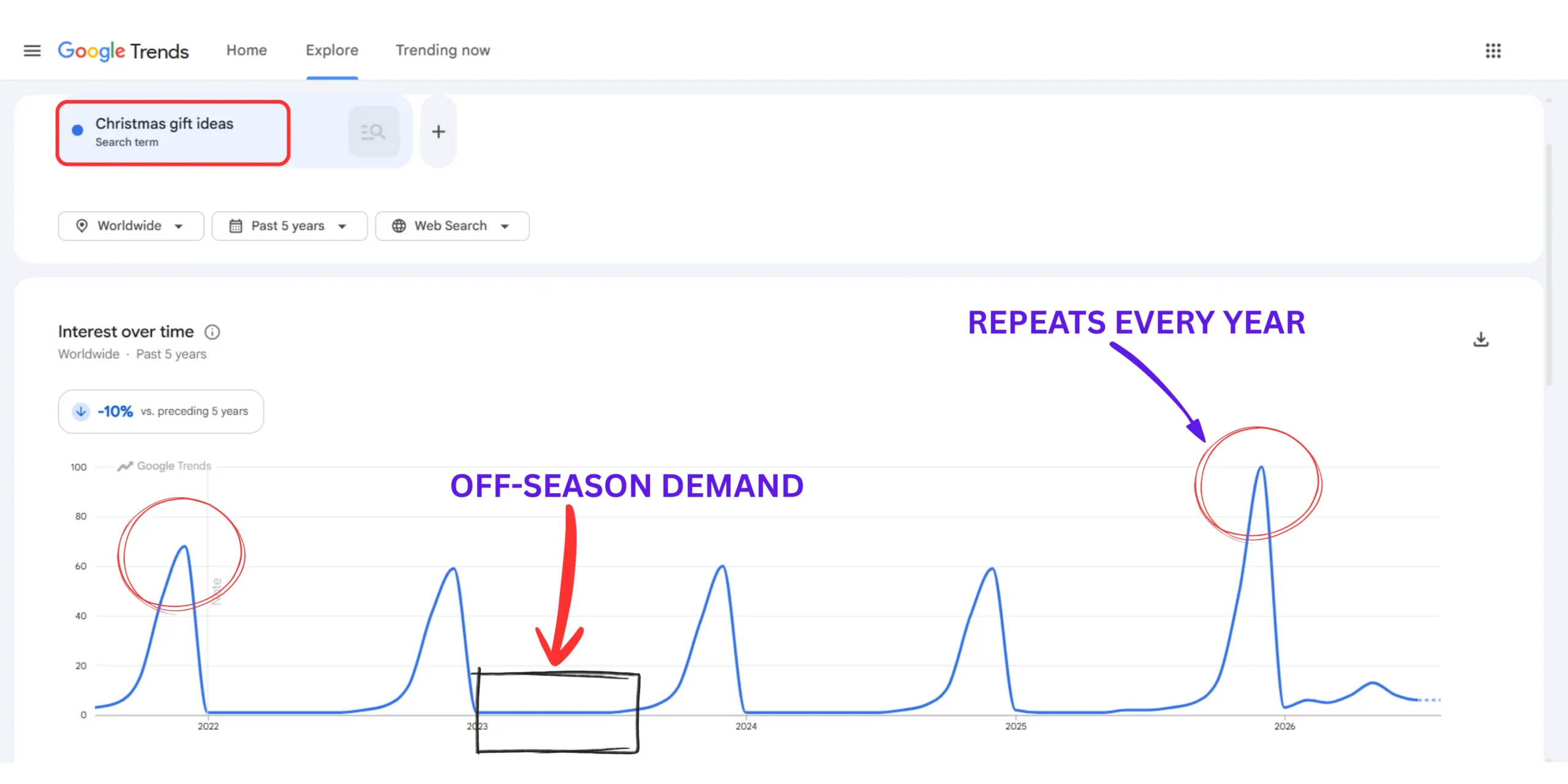
Google Trends tells you the shape of demand, not the actual number of searches.
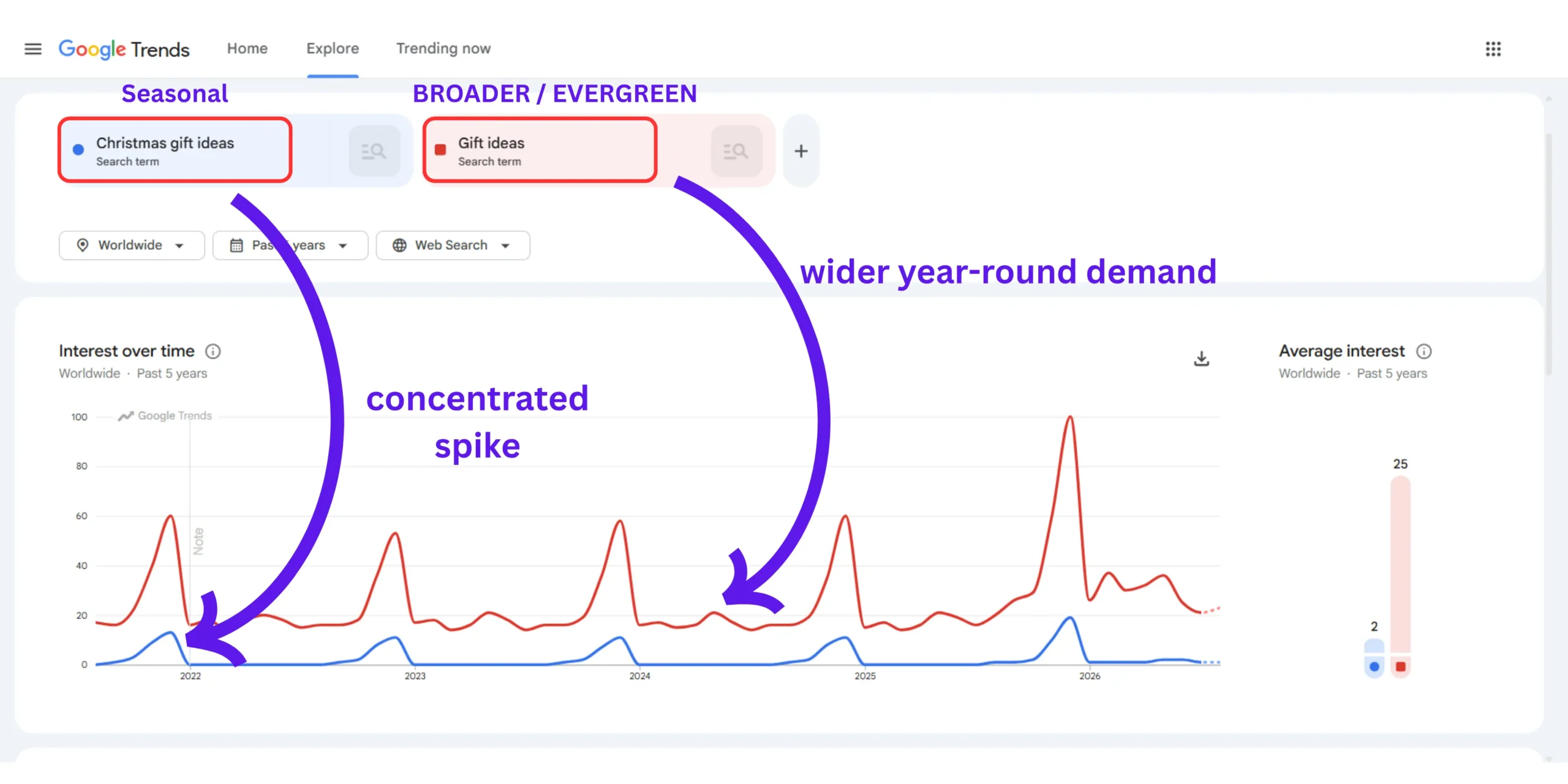
Enter your niche keyword at Google Trends. Set the time range to “Past 5 years.” If the graph shows a recurring annual spike to 80-100 followed by valleys A recurring pattern of very low off-season interest and sharp annual peaks is a strong seasonality signal. Use the SERP and content-calendar checks to confirm whether the pattern is actually niche-wide. That niche is seasonal. Flat or gently rising lines indicate evergreen demand.
Signal 2 – SERP Freshness Pattern
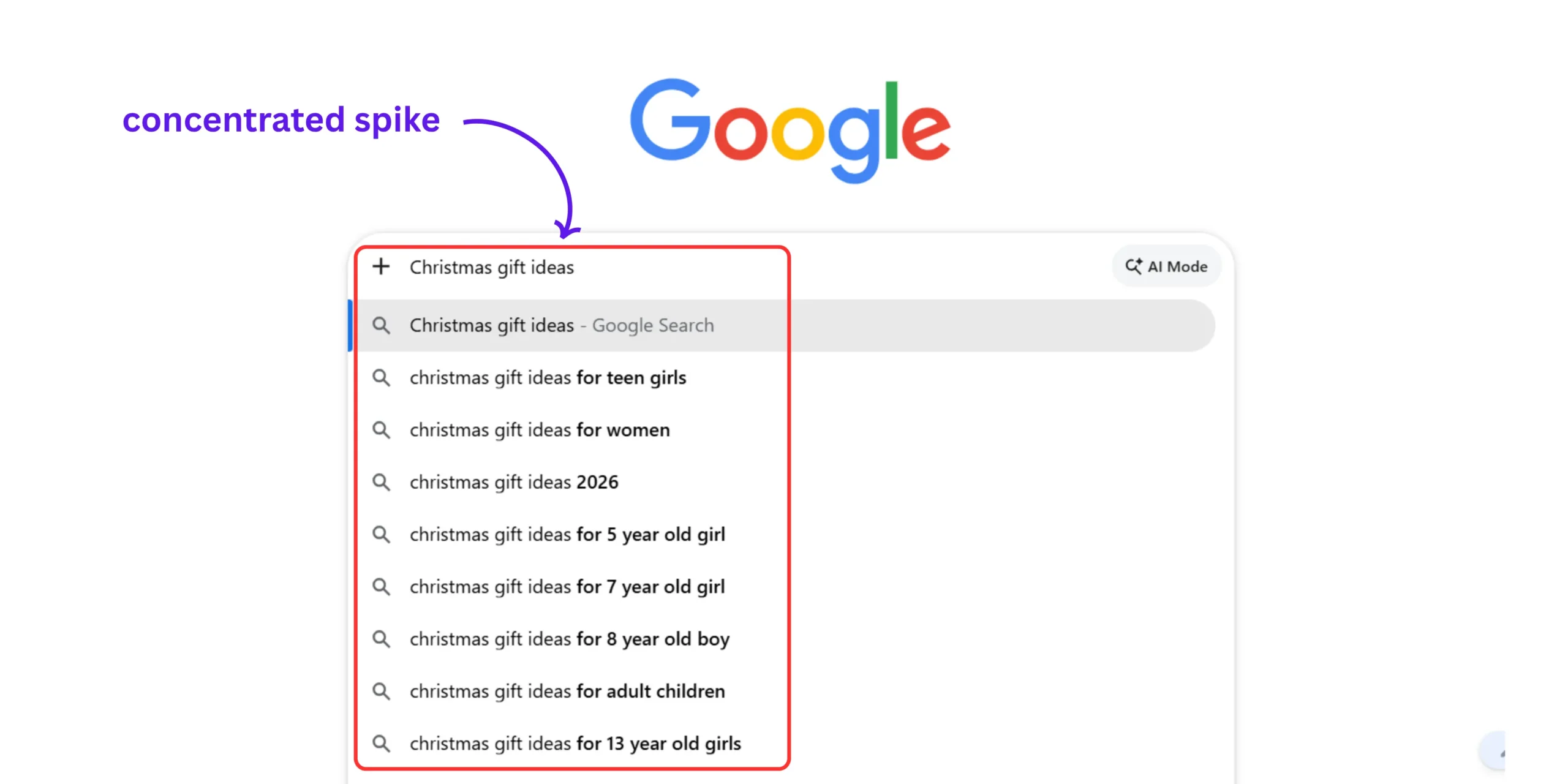
Search your core niche keyword in Google incognito. If the majority of top-ranking articles display publication dates of October, November, or December (or whichever peak season applies) and show annual update patterns, the niche requires calendar-timed content that loses relevance immediately after the peak.
Seasonal queries can become more time-sensitive during their peak period, which can increase the relative competitiveness of newer or recently updated pages.
Signal 3 – Content Calendar Language
Search “[niche] + ideas” or “[niche] + guide.” If the first-page results reference specific years (“2025 Christmas Gift Ideas”), holidays (“Valentine’s Day Recipes”), or seasonal qualifiers (“Spring Wedding Checklist”) – the niche is inherently time-bound.
A niche triggering all three signals is a confirmed seasonal trap. A niche triggering one signal warrants deeper investigation. Zero signals = evergreen.
Best tools to check blog niche seasonality – Ranked by beginner accessibility
The best free tools to check blog niche seasonality are Google Trends (primary, shows annual demand patterns), AlsoAsked (reveals whether PAA questions are time-specific), and Google Keyword Planner (confirms whether monthly search volume is consistent or spike-based). These three tools together provide a complete seasonality verdict in under 15 minutes.
Best tools to check blog niche seasonality by beginner accessibility and accuracy:
Use these tools together to compare demand patterns, keyword behavior, question trends, and seasonal concentration before choosing a niche.
| Tool | Cost | What It Shows | Seasonality Signal |
|---|---|---|---|
| Google Trends | Free | Relative interest over time | Spikes = seasonal |
| Google Keyword Planner |
Free
Ads account | Monthly volume ranges | Off-season volume collapse |
| AlsoAsked.com |
Limited free
3/day | PAA question patterns | Holiday-specific questions |
| Ubersuggest Chrome Ext. |
Free
Unlimited | Keyword difficulty + volume | Volume concentration |
| AnswerThePublic | Limited free | Question volume by month | Seasonal questions dominate |
MRD Insight: No single tool should determine your niche decision. Compare demand patterns with keyword data, SERP behavior, and seasonal search language before making the final call.
How to use Google Trends correctly for seasonality detection:
Google Trends measures relative interest direction, not absolute search volume. A score of 100 means peak interest. A score of 10 means 10% of peak interest.
For evergreen validation, look for a line that never drops below 30 across any 12-month period. For seasonal detection, look for any pattern showing months below 15 followed by months above 75.
How to interpret the best tools to check blog niche seasonality together: run all three for any niche candidate. If Google Trends shows spikes AND AlsoAsked returns holiday-specific questions AND Keyword Planner shows near-zero volume in off-months – do not register a domain in this niche.
How to test if a blog niche is profitable covers the complete 4-Point Niche Validation Matrix that incorporates seasonality as a core evaluation dimension – alongside affiliate potential, competition level, and defensibility.
15 seasonal blog niches to avoid – Each scored and mapped to an evergreen alternative
The 15 most common seasonal blog niches beginners enter score below 75/100 on the BNVS framework primarily due to Evergreen Demand scores of 3-8 out of 20. Every seasonal niche has a validated evergreen alternative that preserves the audience and monetization angle while removing the calendar dependency.
How to identify seasonal blog niches becomes immediately practical when applied to real examples. Every niche below has been scored on the five-factor BNVS system.
15 Seasonal Blog Niches and Their Evergreen Alternatives
These examples show how seasonal niches compare by BNVS, evergreen demand, and peak window, while revealing a broader evergreen alternative that can support more consistent year-round content opportunities.
| # | Seasonal Niche | BNVS |
Evergreen Demand |
Peak Window | Evergreen Alternative | Alt. BNVS |
|---|---|---|---|---|---|---|
| 1 | Christmas Gift Ideas | 69/100 | 4/20 | Nov–Dec | Unique Gifts for People Who Have Everything | 85/100 |
| 2 | Halloween Costumes | 67/100 | 3/20 | Sep–Oct | DIY Costume Ideas for Adults | 82/100 |
| 3 | Valentine’s Day Gifts | 67/100 | 4/20 | Jan–Feb | Romantic Gift Ideas for Long-Distance Couples | 83/100 |
| 4 | Black Friday Deals | 68/100 | 3/20 | Nov | Shopping Hacks to Save Money Year-Round | 84/100 |
| 5 | New Year’s Resolution Fitness | 66/100 | 6/20 | Dec–Jan | Home Workout Routines for Beginners With No Equipment | 88/100 |
| 6 | Tax Season Finance Tips | 70/100 | 7/20 | Jan–Apr | Personal Finance for Freelancers | 90/100 |
| 7 | Summer Travel Planning | 69/100 | 8/20 | Apr–Jun | Budget Travel Tips for First-Time Travelers | 84/100 |
| 8 | Easter Recipes | 56/100 | 4/20 | Mar–Apr | Easy Recipes for Seniors With Dietary Restrictions | 84/100 |
| 9 | Mother’s Day Gift Guides | 68/100 | 4/20 | Apr–May | Thoughtful Gifts for Moms Who Say They Want Nothing | 83/100 |
| 10 | Spring Wedding Planning | 72/100 | 9/20 | Feb–May | Wedding Planning for Couples on a Tight Budget | 84/100 |
| 11 | Thanksgiving Recipes | 54/100 | 4/20 | Oct–Nov | Comfort Food Recipes for Families of 4 Under $20 | 83/100 |
| 12 | Spring Cleaning Tips | 65/100 | 7/20 | Mar–Apr | Home Organization Systems That Work Year-Round | 85/100 |
| 13 | Super Bowl Party Ideas | 58/100 | 3/20 | Jan | Game Night Snack Recipes for Groups of 10+ | 81/100 |
| 14 | Graduation Gift Ideas | 67/100 | 5/20 | Apr–Jun | Career Starter Gifts for Young Professionals | 82/100 |
| 15 | Back-to-School Shopping | 67/100 | 6/20 | Jul–Aug | Budget-Friendly School Supplies for Parents | 83/100 |
Key insight: The strongest evergreen alternatives in this comparison generally have higher BNVS scores and broader year-round demand than the seasonal topics they replace, making them stronger candidates for a durable content strategy.
Every alternative niche preserves the core audience and monetization angle while removing the calendar dependency that limits earning time to 6–8 weeks per year.
What is a micro niche blog for beginners examples covers the 3-Sub-Level mapping system used to generate the evergreen alternatives in the table above.
Why seasonal blog traffic drops and how to fix it – The structural reality
Seasonal blog traffic drops because Google’s ranking systems evaluate content freshness and search intent simultaneously. When a seasonal keyword’s demand collapses after its peak window, Google progressively deprioritizes the ranking of content targeting that keyword, not because the content quality dropped, but because the search signal driving rankings temporarily vanished.
Why seasonal blog traffic drops is a structural problem, not an SEO execution problem. Most beginner bloggers who experience this spend months trying to fix something unfixable with their current niche choice.
Trending topics can generate fast traffic. However, relying only on trends can be risky. This creates short-term traffic without long-term growth opportunities.
The four primary causes of seasonal traffic collapse:
- Demand disappearance – The search volume that drove rankings disappears. Google’s ranking confidence in your page drops proportionally.
- Freshness penalty – Last year’s “Christmas Gift Ideas 2024” post actively loses rankings to the new “Christmas Gift Ideas 2025” competitor content appearing each October.
- Click signal decay – When search volume drops, click signals to your page reduce. Google interprets reduced clicks as declining relevance.
- Affiliate link rot – Seasonal products go out of stock in off-seasons. Broken affiliate links compound the ranking signal deterioration.
How to fix seasonal blog traffic drops when you’re already in a seasonal niche:
- Identify the evergreen angle within your existing content using the Seasonal-to-Evergreen Pivot Protocol below
- Update top-performing posts to remove explicit seasonal references from titles and meta descriptions
- Add year-round subtopics to existing posts that extend their relevance beyond the peak window
- Redirect publishing effort toward evergreen cluster posts within the same audience interest area
Why your blog is not getting traffic after 6 months addresses the combined effect of niche seasonality and technical SEO issues – which frequently compound together in beginner blogs that chose seasonal niches before understanding the structural consequences.
How to turn a seasonal blog into an evergreen niche – The seasonal to evergreen pivot protocol
Turning a seasonal blog into an evergreen niche follows a four-step protocol: identify the core audience interest beneath the seasonal trigger, remove the time or calendar qualifier from the niche definition, add an audience or problem qualifier instead, then verify the transformed niche passes the 15-Article Viability Test. The entire pivot preserves existing content value while unlocking year-round traffic potential.
The Seasonal-to-Evergreen Pivot Protocol is the structured transformation process I apply to any blog that has already been built in a seasonal niche and needs to expand its traffic window without abandoning its existing audience.
The Four-Step Pivot Protocol:
- Identify the core interest – What is the underlying audience need that drives the seasonal traffic? “Christmas Gift Ideas” = people seeking gift recommendations for difficult-to-shop-for recipients.
- Remove the calendar qualifier – Strip the holiday, month, or seasonal event from the niche definition. “Christmas Gift Ideas” becomes “Gift Ideas.”
- Add an audience qualifier – Replace the seasonal qualifier with a specific audience definition. “Gift Ideas” becomes “Unique Gift Ideas for People Who Have Everything.”
- Verify with the 15-Article Test – Confirm the transformed niche generates 15+ distinct long-tail questions in Google Autocomplete without returning seasonal-specific suggestions.
Practical pivot examples:
- “New Year’s Resolution Fitness Blog” → “Sustainable Fitness for Beginners Who’ve Quit Before”
- “Tax Season Finance Tips” → “Personal Finance Systems for Self-Employed Freelancers”
- “Spring Cleaning Organization” → “Minimalist Home Organization Systems for Small Apartments”
How to turn a seasonal blog into an evergreen niche does not require deleting existing content. It requires reframing the site’s editorial focus so that seasonal posts become supporting content within a broader evergreen architecture, rather than the entire foundation.
How specific should a blog niche be covers the exact niche specificity level that balances content depth with audience breadth – the same balance required when executing a seasonal-to-evergreen pivot.
101 content ideas for beginners provides an immediately actionable content library for every pivoted evergreen niche, reducing the content planning effort required during the transition period.
What every seasonal niche guide gets completely wrong – The seasonal debt concept
Most guides on avoiding seasonal niches tell you to “check Google Trends” and move on. That is advice that addresses one symptom while ignoring the structural debt seasonal content accumulates.
I call this Seasonal Debt, the compounding opportunity cost of publishing content that earns actively for only 6–8 weeks per year.
Here is the exact calculation:
Seasonal blog (50 posts, 3 years):
- Each post earns active ranking time for 8 weeks per year
- Over 3 years: 50 posts × 8 weeks × 3 years = 1,200 weeks of post-earning time total
- Distributed across 156 weeks: average of 7.7 posts earning at any given week
Evergreen blog (50 posts, 3 years):
- Each post earns active ranking time for 52 weeks per year
- Over 3 years: 50 posts × 52 weeks × 3 years = 7,800 weeks of post-earning time total
- Distributed across 156 weeks: average of 50 posts earning at any given week
The evergreen blog generates 6.5x more concurrent earning opportunities from identical publishing output over the same three-year period.
Seasonal Debt grows with every post you add to a calendar-dependent niche. The interest compounds in the wrong direction – against you.
Passion vs Profit: How to find a blogging topic you won’t quit writing about in 3 months addresses the emotional side of this pivot decision, specifically why many bloggers resist leaving seasonal niches even after understanding the structural disadvantage they create.
How to write your first blog post for beginners covers the content structure that maximizes evergreen ranking signals from the very first post, the structural foundation that prevents Seasonal Debt from accumulating in a new blog.
Frequently asked questions on how to identify seasonal blog niches
What is a seasonal blog niche?
A seasonal blog niche is a topic category that generates the majority of its annual search volume during a 4–8 week window, then collapses to near-zero demand for the remaining months.
Christmas gift guides, Halloween costumes, and New Year’s fitness content are classic examples, they spike predictably then disappear regardless of content quality or SEO execution.
How do I know if my blog niche is seasonal?
Search your core niche keyword on Google Trends set to “Past 5 years.” Any niche showing months below 15 and months above 80 in the same annual cycle is confirmed seasonal.
The 3-Signal Detection Method adds two additional checks – SERP freshness patterns and content calendar language – to eliminate false positives that Trends alone sometimes misses.
Can a seasonal blog still make money?
Yes – but only during its 6–8 week peak window. A seasonal blog cannot generate year-round income regardless of content volume because the search demand that drives rankings disappears after the peak.
The solution is the Seasonal-to-Evergreen Pivot Protocol: remove the calendar qualifier, add an audience qualifier, and verify the transformed niche passes the 15-Article Viability Test.
What is the difference between a seasonal niche and an evergreen niche?
An evergreen niche maintains consistent search demand across all 12 months. A seasonal niche concentrates 80–90% of its annual search volume into a single 4–8 week period each year.
Evergreen blogs generate 6.5x more concurrent earning opportunities than seasonal blogs publishing identical content volume, because every post earns actively for 52 weeks instead of 6.
Which blog niches are most commonly seasonal traps for beginners?
The most common seasonal traps are Christmas gift guides, Halloween costumes, Valentine’s Day content, Black Friday deal blogs, and New Year’s resolution fitness, all scoring under 75/100 on the BNVS Evergreen Demand dimension.
Each of these niches has a validated evergreen alternative preserving the same audience and monetization angle without the 9-month traffic drought between annual peaks.
How do I convert a seasonal blog into an evergreen niche?
Remove the holiday or calendar qualifier from your niche definition, add an audience or problem qualifier instead, then verify the transformed niche generates 15+ distinct article ideas in Google Autocomplete year-round.
Example: “Christmas Gift Ideas” becomes “Unique Gifts for People Who Have Everything”, same audience, same affiliate products, zero calendar dependency, year-round search demand.
Can I build a profitable blog in a seasonal niche if I publish enough content?
No – publishing volume cannot overcome seasonal demand collapse. A blog in a purely seasonal niche cannot generate year-round traffic regardless of content quantity, because the underlying search demand disappears for 9+ months per year.
The solution is pivoting to the evergreen alternative that preserves your audience and monetization angle while removing the calendar dependency.
How do I check if my existing niche is seasonal using Google Trends?
Search your core niche keyword on Google Trends set to “Past 5 years.” If any 12-month period shows months below 15 and months above 80 in the same cycle, your niche has confirmed seasonal dependency.
A score that never drops below 30 across any 12-month period indicates evergreen demand. The 3-Signal Seasonality Detection Method provides two additional confirmation signals beyond Trends alone.
Is it possible to turn a seasonal blog into an evergreen site without losing existing rankings?
Yes – the Seasonal-to-Evergreen Pivot Protocol transforms a seasonal blog without deleting existing content or losing accumulated ranking signals.
The protocol reframes the site’s editorial direction by adding an audience qualifier and removing the calendar qualifier from the niche definition, then builds new evergreen content clusters that extend the site’s relevance across all 12 months.
Validate the seasonality before you publish post one – not after post fifty
Knowing how to identify seasonal blog niches before committing to one is the validation step that protects every hour of content work you’ll ever invest.
The 3-Signal Detection Method takes 10 minutes. The BNVS Evergreen Demand score takes 5 minutes to calculate. The Google Trends check takes 2 minutes. Combined, that is 17 minutes of pre-registration research that prevents building a blog with a structural 6-week earning ceiling.
How to identify seasonal blog niches correctly means checking demand patterns, not just demand existence. A niche can have massive search volume in one month and essentially zero volume for the other eleven. Both numbers matter equally.
Run the three signals on your current niche idea today. If all three trigger, pivot before you publish.
Has your current niche idea passed all three seasonality signals or did the Google Trends check reveal a spike-and-crash pattern you hadn’t noticed?