

It can be difficult to monetize your content. Your income isn’t corresponding with the hours you’ve spent producing blog posts, videos or social media content. The same difficulties are faced by many creators ,
- Unsure which content drives actual income
- Struggling to convert traffic into sales or clicks
- Confused about which metrics truly matter
This is where analytics becomes a game changer. How to use analytics to improve monetization strategy isn’t just a technical question, it’s the key to transforming your content into a reliable revenue source. By understanding your data, you can make informed decisions, double down on what works and fix what doesn’t.
Analytics isn’t limited to just one platform. It matters across,
- Blog – Track pageviews, session duration and affiliate clicks
- YouTube – Monitor watch time, click through rates and ad performance
- Social media – Analyze engagement, link clicks and audience behavior
- Email newsletter – Track open rates, click throughs and conversions
When you learn to read and act on these insights, you gain ,
- Data driven decisions that maximize revenue
- Optimized affiliate strategies for higher commissions
- A deeper understanding of your audience to create content they love
In this guide, we’ll break down exactly how you can use analytics to unlock your content’s earning potential, from beginner friendly tips to advanced strategies. By the end, you’ll have a clear roadmap to turn your content into a profitable , sustainable income stream
Table of Contents – How to use analytics to improve monetization strategy
Why content monetization analytics is crucial for growth ?
If you’re creating content without tracking its performance, you’re leaving money on the table. Content monetization analytics is the process of measuring and analyzing data from your content to understand what works , what doesn’t and how to maximize revenue .
By monitoring key metrics, you gain a clear picture of which pieces of content are driving income and where there’s room for improvement. This isn’t just about numbers . it’s about making informed decisions that grow your business.
Tracking performance helps you ,
- increase ad revenue – Identify pages or videos that generate the highest ad impressions and optimize placement.
- Boost affiliate income – See which links convert best and focus on high performing products.
- Sell digital products effectively – Discover which content drives purchases and replicate its success.
Key metrics you should focus on include,
- CTR ( Click Through Rate ) – Shows how many visitors click on your ads, affiliate links or CTAs.
- Conversion rate – Measures how many visitors complete a desired action, like buying a product or subscribing.
- Session duration – Indicates how engaged your audience is with your content.
- Revenue per user – Reveals how much each visitor contributes to your income.
By analyzing these metrics regularly, you can optimize every aspect of your monetization strategy . cut wasted effort, and scale your revenue faster. Successful content creators don’t guess, they let the data guide every decision.
Low engagement metrics often confuse beginners, but analytics provide clues. If users scroll but don’t interact, understanding why people do not engage with your content helps diagnose messaging, structure, or relevance problems that prevent clicks, conversions and monetization growth.
Without traffic, analytics can’t provide meaningful insights. Understanding how to get traffic to a new blog helps generate the initial data needed to analyze performance, optimize content and implement monetization strategies effectively from the start.
What analytics beginners should focus on maximize revenue
If you’re just starting out, it’s easy to get overwhelmed by the sheer amount of data available. The key is knowing what analytics beginners should focus on? By tracking the right metrics, you can make informed decisions that directly impact your monetization strategy.
Here are the essential metrics every beginner should monitor,
- Pageviews and traffic sources –
- Shows which content attracts the most visitors and where they come from search engines, social media or referral links.
- Focus on sources that bring engaged traffic likely to click your affiliate links or ads.
- Conversion rates –
- Measures how many visitors take a desired action, such as signing up for a newsletter or purchasing a product.
- Identify pages with low conversion rates and experiment with CTAs, layouts or headlines to improve them.
- Bounce rates and session duration –
- Bounce rate tells you how many visitors leave without interacting, while session duration measures engagement.
- Low session duration or high bounce rates may indicate your content isn’t meeting audience expectations, update or restructure it for better engagement.
- Affiliate link clicks –
- Tracks which links are generating interest and revenue.
- Place links strategically within high value content and monitor which products perform best.
How to read and interpret data ,
- Look for patterns over time rather than daily fluctuations.
- Compare performance across different pieces of content to identify winners.
- Focus on actionable insights, if a metric is low, implement a specific change and monitor the result.
- Use dashboards or reports to visualize trends and make quick decisions.
By concentrating on these key metrics, beginners can prioritize efforts that directly increase revenue , avoid guesswork and start building a data driven monetization strategy that scales.
How to use Google analytics for monetization , step by step
Many creators wonder how to use Google analytics for monetization? The truth is, this powerful tool is essential for understanding your audience, tracking performance and uncovering opportunities to increase revenue from your content. By following a step by step approach, even beginners can turn data into actionable insights.
Step 01 . Create an account and link to your website
- Sign up for Google Analytics and add your website or blog.
- Verify ownership through your CMS (WordPress , Wix , etc.) or by adding the tracking code manually.
- Linking ensures all traffic and conversion data is accurately tracked from day one.
Step 02 . Set up goals and events
- Goals track specific actions like newsletter sign ups, purchases or clicks on affiliate links.
- Events allow you to monitor interactions such as button clicks, video plays or downloads.
- Start with 3 – 5 key goals that directly impact your revenue to avoid overwhelming data.
Step 03 . Track conversions and affiliate clicks
- Use conversion tracking to see which pages or content drive actual income.
- Monitor affiliate links with UTM parameters or Google Tag Manager for precise insights.
- Identify high performing content and replicate strategies that work.
Step 04 . Analyze dashboard metrics
- Google Analytics provides metrics like ,
- Users and sessions – Who is visiting your content
- Acquisition sources – Where your traffic comes from (organic, social, referral)
- Behavior flow – How users navigate your site
- Conversions and revenue – Which content generates income
Step 05 . Use insights to optimize content
- Identify pages with high traffic but low conversions and optimize CTAs or affiliate placement.
- Focus on sources that bring engaged visitors to maximize revenue.
- Regularly review data to refine your monetization strategy and scale your earnings
By mastering how to use Google analytics for monetization , creators gain a data driven approach to improve ad revenue, affiliate performance and digital product sales. The result is smarter decisions, higher earnings and sustainable growth.
How to optimize affiliate revenue with analytics for maximum profit
Many creators struggle to earn consistently from affiliate marketing because they don’t know how to optimize affiliate revenue with analytics? The key is using data to understand what works, which content drives sales and how to improve underperforming links. By tracking the right metrics, you can turn affiliate marketing into a reliable income stream.
Step 01 . Track affiliate performance
- Use analytics tools or affiliate dashboards to monitor clicks, conversions and revenue.
- Set up tracking in Google Analytics using UTM parameters for precise insights.
- Focus on actionable data rather than vanity metrics like total clicks, look for clicks that actually lead to sales.
Step 02 . Monitor key metrics
- Click Through Rate ( CTR ) – Percentage of visitors clicking your affiliate links.
- Conversion rate – Percentage of clicks that result in a purchase or action.
- Top performing content – Identify blog posts, videos or social media posts generating the most affiliate revenue.
- Compare metrics across different platforms to find the most profitable traffic sources.
Step 03 . Improve underperforming links
- Update or replace links that aren’t converting well.
- Test different product recommendations and wording to increase relevance.
- Don’t hesitate to remove links that consistently underperform, they can dilute your earnings.
Step 04 . Experiment with placement and CTAs
- Test different locations for links – within content, at the end of posts or in pop-ups.
- Experiment with CTA text, buttons and banners to see what drives clicks and conversions.
- Small changes in placement or wording can significantly impact affiliate revenue.
Step 05 . Analyze and repeat
- Regularly review affiliate performance and make incremental improvements.
- Double down on high performing content and scale successful strategies.
- By consistently using analytics, you can maximize affiliate revenue, reduce wasted effort and create a data driven , profitable affiliate system .
Analytics can highlight a common issue: people click but don’t convert. Often, this signals a trust gap. Understanding how to build trust on social media as a beginner for free helps improve engagement metrics, session duration and conversions , key signals that directly impact monetization performance.
How analytics can boost your ad revenue
Understanding how analytics can boost your ad revenue is essential for creators who rely on ads as a key income source. Many beginners place ads without strategy, missing out on potential earnings. By using analytics, you can identify which content performs best and optimize ad placements for maximum profit.
Step 01 . Understanding ad revenue metrics
- CPM ( Cost Per Mile ) – Earnings per 1000 ad impressions.
- CPC ( Cost Per Click ) – Revenue earned per click on an ad.
- RPM ( Revenue Per Mile ) – Total revenue earned per 1000 pageviews, combining all ad types.
Monitor these metrics regularly to identify which content generates the most income.
Analytics often reveal that even good ideas fail because of poor execution. If your data shows low engagement or weak conversions, the issue may be how content is created, not what you monetize. That’s where content creation tools and strategies for beginners help streamline workflows, improve quality and create content that actually converts.
Step 02 . Identify high traffic content
- Use analytics to find pages, videos or posts with the highest traffic.
- Focus on content that keeps users engaged longer, as longer sessions often increase ad impressions and clicks.
- Place ads on pages where users are already highly engaged to maximize revenue potential.
Step 03 . Test ad placement , formats and networks
- Experiment with different ad positions ( top, middle, sidebar, in-content ) to find what converts best.
- Test ad formats like banners, native ads or video ads.
- Consider multiple ad networks if one isn’t performing optimally.
- Track each test in analytics to see which combination drives the highest RPM and CTR.
By regularly analyzing performance and testing strategies, you can turn analytics insights into higher ad revenue , making every piece of content work harder for you.
Analytics frequently reveal a gap between followers and revenue. Understanding how to turn social media followers into customers helps align content, CTAs and funnels so engagement metrics translate into real monetization instead of vanity numbers.
Using analytics to monetize social media and YouTube channels
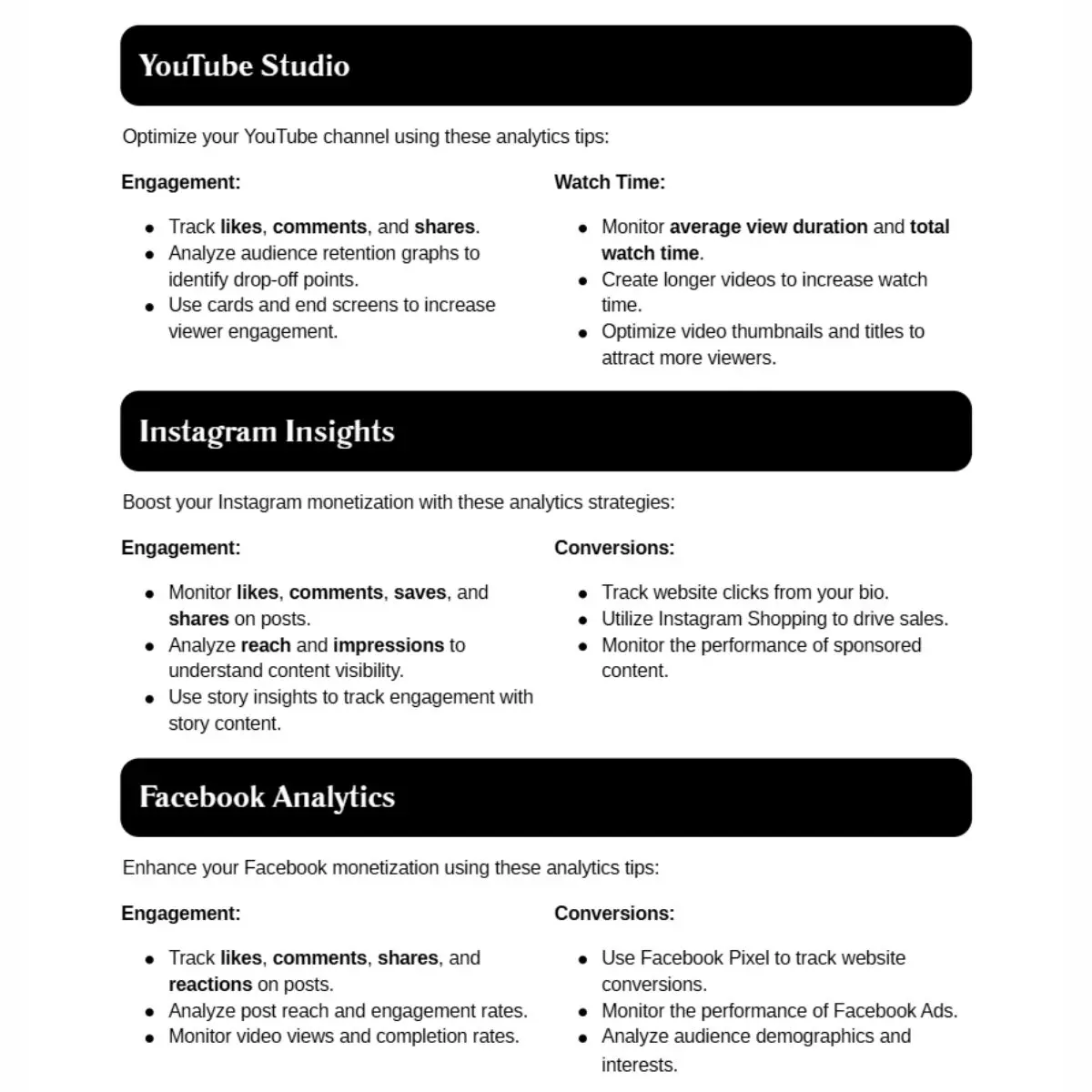
The only way to effectively monetize social media and video content is to use analytics to monitor performance. You can learn a lot about your audience, engagement and revenue opportunities from social media sites like Facebook, Instagram and YouTube.
Step 01 . Use platform specific analytics
- YouTube studio – Monitor watch time, audience retention, CTR on thumbnails and revenue per video.
- Facebook insights – Track post engagement, reach, click-throughs and link clicks.
- Instagram analytics – Measure impressions, story views, swipe-ups and engagement rate.
For example – A creator might notice that tutorials on YouTube get higher watch time and CTR than vlogs, indicating a focus area for monetization.
If analytics show strong professional traffic but low conversions, LinkedIn may be underutilized. Learning how to post on LinkedIn for online business beginners helps align content with audience intent, improve click-through rates, and turn profile views into traffic that supports your monetization strategy.
If analytics show long term traffic potential but slow growth, Pinterest may be the missing channel. Learning how to drive website traffic from Pinterest helps generate evergreen, high intent visitors that improve ad revenue, affiliate clicks and content monetization performance over time.
Step 02 . Track key metrics
- Engagement rate – Likes, shares, comments and saves indicate content resonance.
- Watch time and retention – Longer watch times increase ad revenue and algorithm visibility.
- Click throughs and conversions – Measures how many users take the next action, such as clicking affiliate links or signing up for newsletters.
Example – On Instagram, tracking swipe-up conversions from stories can show which product links generate the most sales.
Early analytics data usually reflects small audiences. Learning how to get your first 1000 followers as beginner for free helps improve reach, engagement signals and algorithm trust, creating the foundation needed for monetization strategies to work effectively.
Step 03 . Optimize monetization using analytics
- Focus on content formats and topics that generate high engagement and conversions.
- Experiment with posting times, captions and CTA placement to increase clicks and revenue.
- Repurpose top – performing content across multiple platforms to maximize earnings.
By consistently tracking and analyzing social media and video metrics, you can make date driven decisions that grow revenue , improve audience engagement and ensure your content monetization strategy is highly effective.
Advanced tips to use analytics for maximum monetization
It’s time to advance your monetization strategy after you’ve understood the fundamentals. By maximizing revenue, optimizing content placement and forecasting future trends, advanced analytics techniques help you make sure your content consistently performs at its peak.
Analytics often show one piece of content outperforming others. Instead of guessing, learning what is content repurposing and how does it work allows you to multiply results across platforms, improve reach and maximize monetization without creating content from scratch.
01 . Segment your audience for targeted monetization
- Divide your audience by demographics, behavior and engagement levels.
- Example – Identify high spending visitors who consistently click affiliate links and tailor content specifically for them.
- Personalized content increases conversions and revenue.
02 . Use heatmaps and click tracking
- Tools like Hotjar or Crazy Egg show where users click, scroll or spend the most time.
- Example – Discover which sections of a blog post drive clicks on affiliate links or ads.
- Place CTAs, affiliate links, or ad units in high activity areas to boost performance.
03 . A/B testing headlines , CTA buttons and content formats
- Experiment with variations of headlines, call to action buttons and content layouts.
- Example – Test two versions of a product CTA , one text link, one button, to see which converts better.
- Even small improvements can significantly increase affiliate and ad revenue.
04 . Use predictive analytics or AI tools
- Predict which content topics will perform well based on past trends.
- Tools like ChatGPT or AI analytics platforms can forecast high converting content ideas.
- Combine predictive insights with audience segmentation to prioritize high-potential posts.
05 . Optimize content funnels using analytics insights
- Map user journeys from discovery to conversion.
- Example – Track how blog visitors move from reading a tutorial to clicking an affiliate link or purchasing a digital product.
- Identify drop off points and optimize funnels for smoother, higher converting paths.
By applying these advanced strategies, you can scale monetization effectively , make smarter decisions and consistently increase revenue across blogs, YouTube and social media. Analytics becomes not just a tracking tool, but a Powerful driver of growth and profitability .
Analytics often show social traffic without revenue. This is where how to use lead magnets with social media traffic becomes powerful. Lead magnets bridge the gap between attention and monetization by capturing emails, increasing conversions and creating long term income opportunities.
Best analytics tools for monetizing your content
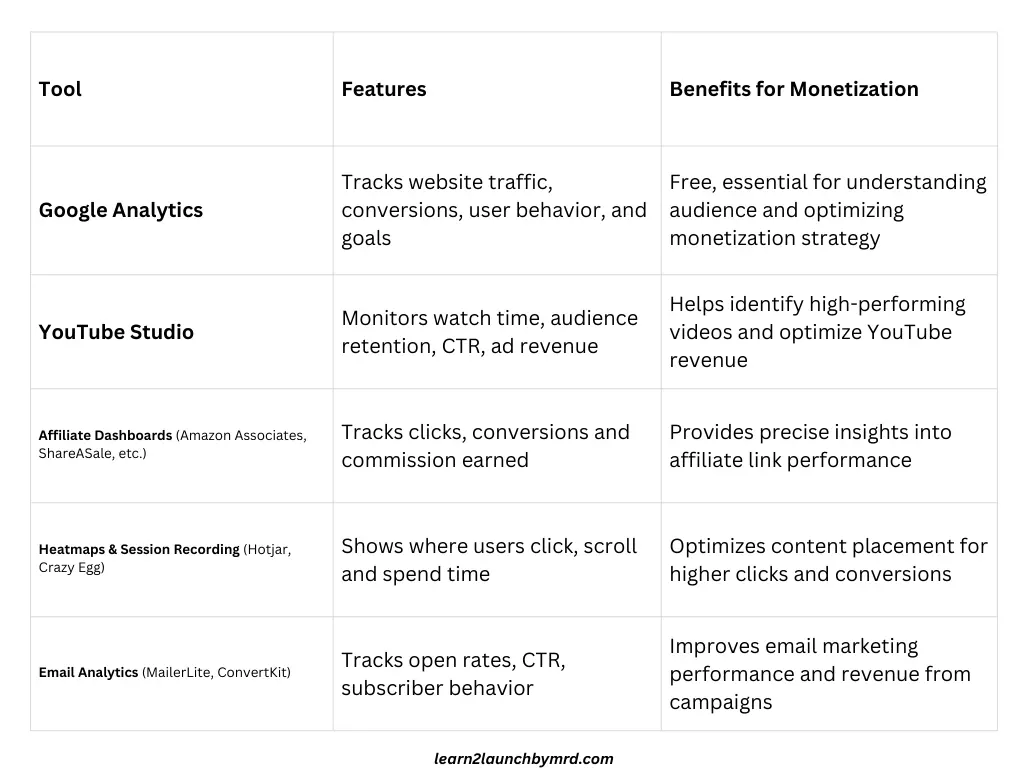
Using the appropriate analytics tools is just as important to maximizing revenue as monitoring metrics. Through blogs, social media and YouTube, these platforms offer insights into audience behavior, content performance and revenue potential.
The best resources for content monetization analytics are as follows,
Analytics consistently show that email traffic converts better than social media. Learning how to build an email list for beginners allows you to capture high intent users, improve revenue per visitor and build a monetization channel you fully control.
Tips for using these tools effectively
- Combine data from multiple tools to get a complete picture of content performance.
- Focus on actionable insights rather than every available metric.
- Regularly review reports to refine strategies, update underperforming content and double down on high performing content.
Using these analytics tools allows creators to make informed decisions , optimize affiliate and ad revenue and scale monetization effectively. The right tools transform raw data into actionable insights that directly impact your income.
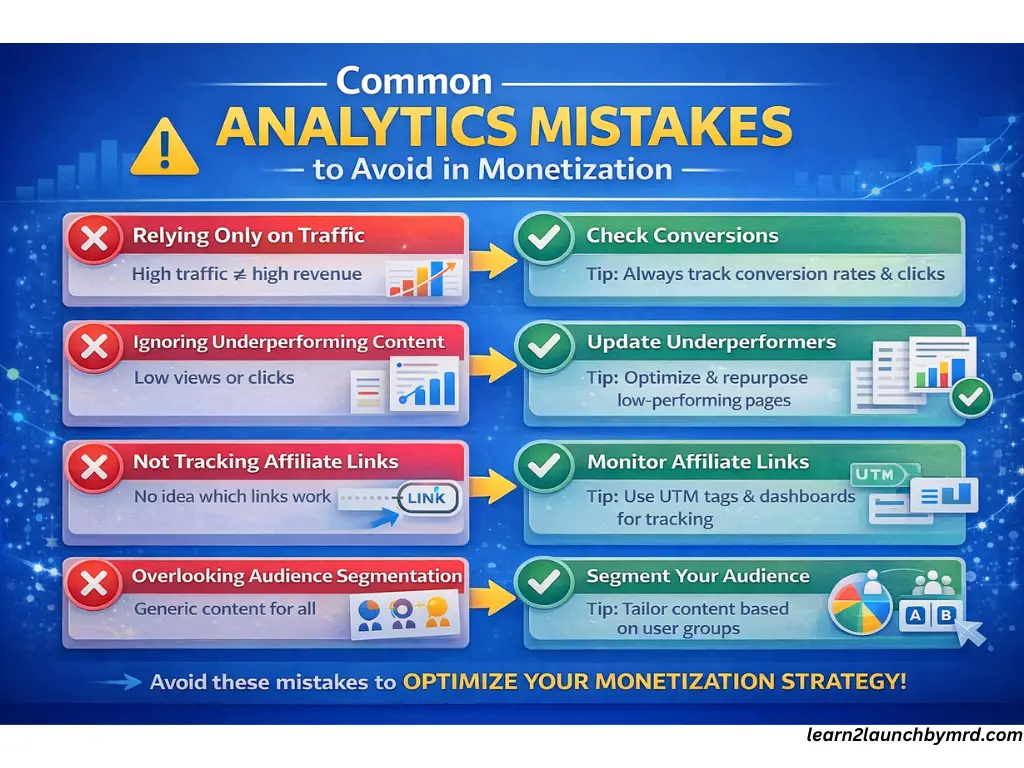
Common analytics mistakes that can hurt your monetization
Even with powerful analytics tools, many creators make mistakes that limit revenue potential . Avoiding these common pitfalls is crucial for turning data into profitable decisions.
01 . Relying only on traffic without checking conversions
- High traffic doesn’t always equal high revenue.
- Always track conversion rates alongside traffic to understand true performance.
02 . Ignoring under performing content
- Failing to update or remove low-performing posts or videos wastes potential revenue.
- Use analytics to identify underperformers and optimize or repurpose them.
03 . Not tracking affiliate links properly
- Without proper tracking, you can’t tell which links generate income.
- Use UTM parameters or affiliate dashboards to monitor every link’s performance.
04 . Overlooking audience segmentation
- Treating all visitors the same misses opportunities for targeted monetization.
- Segment your audience by behavior, demographics and engagement to tailor offers and CTAs.
05 . Failing to test and optimize
- Not experimenting with CTAs, placements or content formats can limit growth.
- A/B test changes and measure impact to continuously improve revenue.
By avoiding these mistakes, creators can make smarter , data driven decisions , maximize ad and , affiliate revenue and create a sustainable monetization strategy that grows over time .
When analytics show declining engagement or high bounce rates from social platforms, mistakes are usually the cause. Learning social media mistakes beginners must avoid helps fix issues that silently hurt reach, credibility and monetization, before they damage long-term growth.
Frequently asked on how to use analytics to improve monetization strategy
How can I use analytics to improve monetization strategy for my blog or YouTube channel ?
Using analytics to improve monetization strategy involves tracking key metrics like CTR, conversion rate, watch time and revenue per user. By analyzing content monetization analytics, you can identify high-performing posts or videos, optimize underperforming content, and scale your ad and affiliate revenue effectively.
What analytics tools should beginners use for content monetization?
Beginners should start with Google Analytics, YouTube Studio analytics, affiliate dashboards (Amazon Associates, ShareASale) and email analytics tools like MailerLite or ConvertKit. These platforms provide essential insights for tracking clicks, conversions and engagement, perfect for implementing analytics to improve monetization strategy.
Which metrics are most important for beginners to track for monetization ?
If you’re wondering what analytics beginners should focus on? Key metrics include pageviews, traffic sources, conversion rates, bounce rate, session duration and affiliate link clicks. Monitoring these metrics helps you make data-driven decisions that boost revenue and optimize your monetization strategy.
How can I optimize affiliate revenue using analytics ?
By monitoring CTR, conversion rates and top-performing content, you can maximize affiliate revenue. Utilize analytics tools to test various placements, update underperforming links, track affiliate link performance and enhance calls to action. This guarantees that your content makes the most money possible.
How does Google analytics help improve monetization?
Google Analytics for monetization allows you to track traffic, user behavior and conversions. By setting goals and events, you can see which content drives revenue, optimize ad placement and focus on high-performing posts. Using this data helps implement a data-driven monetization strategy across blogs, social media and YouTube.
Start using analytics to boost your monetization strategy today
Knowing how to use analytics to enhance your monetization strategy is a game changer if you’ve been having trouble turning your content into steady income. You can solve the common issue of speculating about what works by tracking the appropriate metrics and analyzing data to determine precisely which content generates clicks, conversions and revenue.
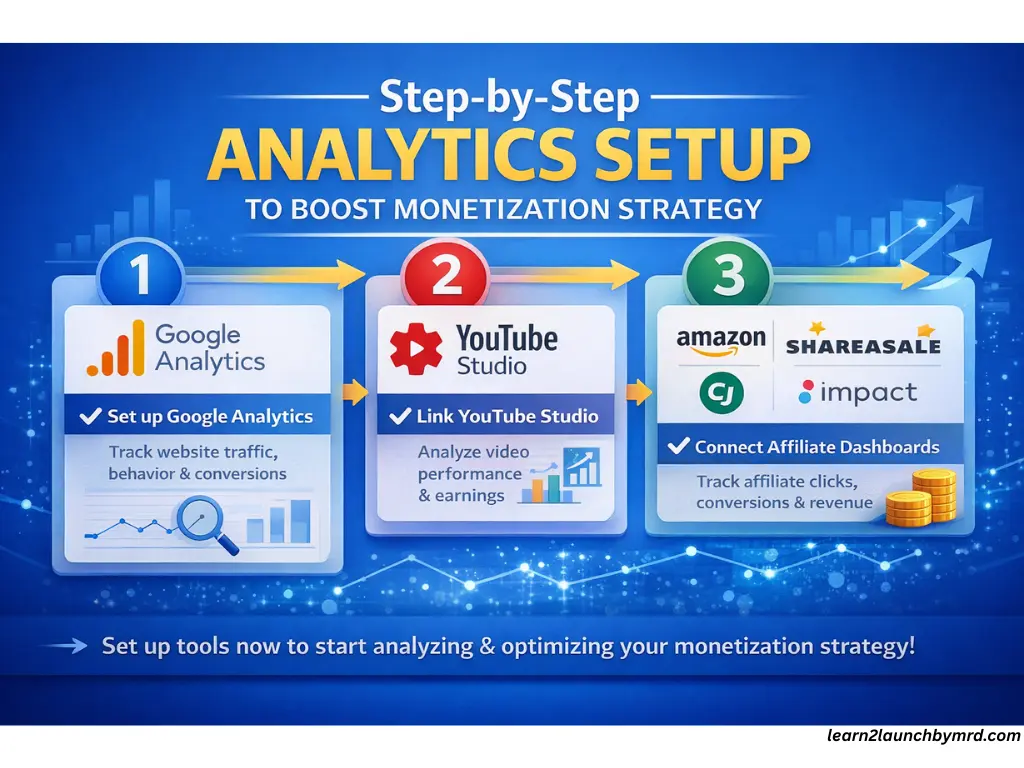
Here is the step by step action plan to get started,
- Set up analytics tools – Install Google Analytics for your website, connect YouTube Studio for video insights and monitor affiliate dashboards to track performance.
- Track your metrics for your content – Focus on content monetization analytics , including CTR, conversion rates, watch time and revenue per user.
- Optimize content based on data – Use insights to improve underperforming posts, update affiliate links and test CTA placements.
- Social monetization strategies gradually – Double down on high performing content, experiment with advanced analytics tools and explore social media and email campaigns to increase revenue.
By following this approach, even beginners can make data driven decisions that maximize ad revenue, affiliate performance and overall monetization. Don’t wait, start applying these insights today and turn your content into a profitable , sustainable income stream .