
How to monetize a blog for beginners
The high income blog monetization framework : How to scale a one person digital asset to $10k/ month
Building a profitable blog is no longer just about generating traffic. Sustainable growth comes from implementing effective high income blog monetization strategies that turn content, audience trust, and expertise into multiple revenue streams. This category explores practical blog monetization frameworks for beginners, covering everything from affiliate marketing and digital products to premium advertising, sponsorships, conversion optimization, analytics, and audience monetization systems.
Whether you’re learning how to make money blogging with low traffic, how to sell digital products on a blog, or how to build a scalable monetization system around your content, you’ll find actionable guides designed to help you create long-term income from your blog. The focus is not on quick-win tactics or short-lived trends, but on building diversified revenue assets that increase profitability, stability, and business growth over time.

By MRD- Malaka
Last verified : june 21, 2026
Read time – 13 minutes
- Revenue Diversification: Combine multiple income streams to build a more stable blogging business.
- Low-Traffic Monetization: Learn how to earn from a focused audience without massive traffic.
- Digital Products: Turn your knowledge into scalable assets that generate recurring income.
- Monetization Systems: Use simple tools and automation to grow your blog revenue efficiently.
The modern practitioner's guide to engineering premium, diversified revenue streams from a lean organic audience.
When I first started trying to make money online, I followed the same path many new bloggers take. I spent weeks building a website, published content consistently, and added display ads as soon as possible. I assumed traffic would eventually turn into meaningful income.
It didn’t. Even after generating a few thousand monthly pageviews, the revenue was barely noticeable. The problem wasn’t the traffic. The problem was the monetization model.
That realization completely changed how I approached blogging.
Most beginners believe they need massive traffic before they can earn serious money. In reality, many blogs struggle financially because they rely on a single income source and never build a complete monetization system. It’s one of the major reasons discussed in Why most blogs fail before making money.
High-Income Blog Monetization
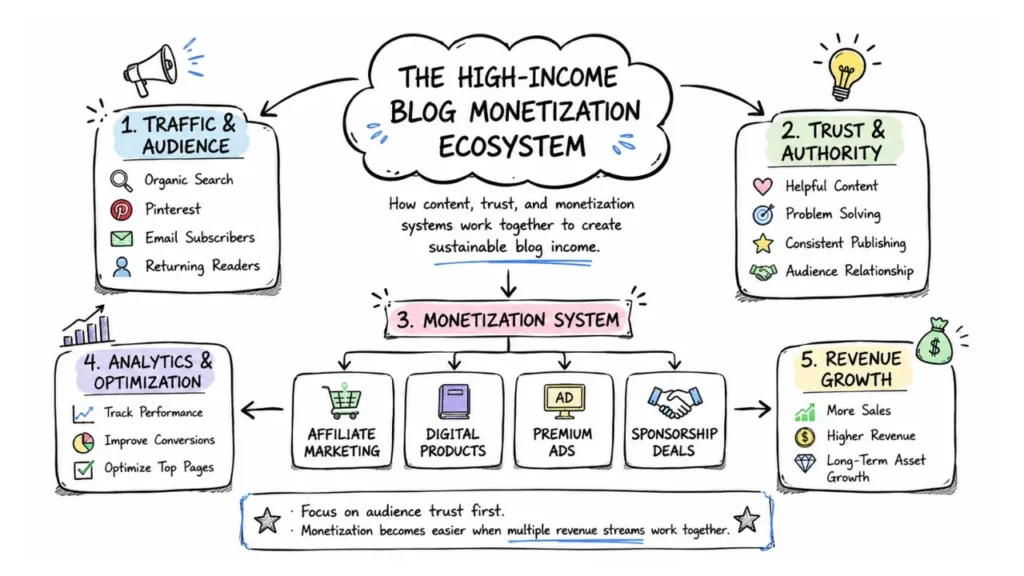
“High income blog monetization strategies are methods used to generate scalable and sustainable income from a blog by combining multiple revenue streams such as affiliate marketing, digital products, premium advertising, and sponsorships.
Instead of relying on traffic alone, successful bloggers focus on audience intent, content quality, and strategic monetization systems. Even blogs with low traffic can earn income by targeting high-intent readers and offering valuable solutions.
A simple blog monetization stack for beginners, combined with tools like email marketing and analytics, helps create an automated system that grows revenue over time.”
— MRDToday, successful independent creators use a different approach. Instead of chasing pageviews alone, they build multiple revenue layers around a highly relevant audience. They focus on high income blog monetization strategies that prioritize audience trust, offer-market fit, and long-term asset creation.
Once you understand how to make money blogging with low traffic, everything changes.
You stop measuring success purely by visitor counts and start focusing on revenue per visitor. A blog with 5,000 highly targeted monthly readers can often outperform a blog with 100,000 untargeted visitors when the monetization framework is designed correctly.
This shift also opens the door to higher-value opportunities. Instead of relying exclusively on display advertising, you can learn how to sell digital products on a blog, recommend carefully selected affiliate offers, attract sponsorship opportunities, and create service-based income streams that scale alongside your content.
Before you start building your blog income system, understand this clearly: high income blog monetization strategies are not about chasing every trend or adding random ways to make money. It’s about building a simple system where your content, audience, and income streams work together in a smart way.
-
Revenue Diversification
Learn how to use different income methods like affiliate marketing, digital products, ads, and sponsorships together. This helps you avoid depending on just one income source. -
Making Money with Small Traffic
You don’t need huge traffic to earn. By focusing on the right topics and solving real problems, even a small audience can generate real income. -
Digital Products Growth
Turn your knowledge into simple digital products like templates, guides, or tools that you can sell again and again without extra work. -
Premium Monetization Opportunities
Understand how to prepare your blog for premium ad networks for bloggers and brand deals by building strong content and a focused niche audience. -
Simple Monetization Setup
A basic blog monetization stack for beginners (payments, email list, analytics) helps you run everything smoothly and grow your income step by step.
A sustainable monetization strategy should also be diversified from the beginning. That means positioning your site for acceptance into premium ad networks for bloggers while simultaneously developing revenue channels that are not dependent on ad rates, algorithm updates, or seasonal traffic fluctuations.
The goal is not to build dozens of complicated systems.
The goal is to create a simple, scalable blog monetization stack for beginners that combines:
- Strategic affiliate marketing
- Digital products
- Premium advertising
- Sponsorship opportunities
- High-value service offers
- Automated sales systems
Working together, these income layers create a stronger and more resilient business than any single monetization method can provide on its own.
In this guide, you’ll learn how to build that framework step by step. We’ll break down the monetization systems used by profitable content businesses, show you where each revenue stream fits into the customer journey, and explain how to turn a content-focused website into a scalable digital asset that generates income around the clock.
Whether you’re starting from zero or already publishing content, this framework will help you build a monetization system designed for long-term growth rather than short-term traffic spikes.
The High-Income Monetization Stack
Stop drowning in tool choices. To match the exact speed, tracking precision, and conversion performance of this guide, this is the lean, high-yield infrastructure stack I run. No bloated extras.
Mailerlite
LAYOUT ENGINE • PAGE BUILDERThe primary distribution engine for routing native content pieces, deploying automated pitch funnels, and maintaining a direct connection with high-intent readers.
Gumroad
CHECKOUT HUB • DIGITAL PRODUCTSA friction-free checkout infrastructure used to host templates, frameworks, and guides. Instantly accept payments without complex custom script configurations.
Google Analytics
INTENT TRACKING • CONVERSION DATAEssential data engine to measure traffic behavior, pinpoint high-converting articles, and accurately verify which search keywords are generating your revenue.
Impact Affiliate
PARTNERSHIP MATRIX • REVENUE BRANDINGA premium affiliate network platform that connects your targeted content to top-tier brand partnerships, high-payout SaaS platforms, and tracking systems.
Is This Monetization Blueprint For You?
Before you commit to this deep-dive strategy blueprint, let's verify you're in the right room. This monetization implementation engine is hyper-optimized for two distinct pathways:
The Solo Creator & Beginner
For those building from complete absolute zero scratch or aiming to clear their first financial milestones cleanly.
-
✓Zero Code Barriers: Skip complex custom payment scripts. Every step uses visual drag-and-drop checkout integrations.
-
✓High-Intent Focus: Learn to identify and capture buyers actively searching for solutions, eliminating the need for massive pageview metrics.
-
✓Lean Tech Stacks: Deploy simple, beginner-friendly tools for automated email captures and fast-loading affiliate funnels.
The Solopreneur & Business Owner
For those scaling high-value content assets, digital product ecosystems, and recurring optimization loops long-term.
-
✓100% Platform Ownership: Completely avoid closed ecosystem builders or relying strictly on volatile third-party marketplace rules.
-
✓Scalable Asset Engines: Turn specialized knowledge into standalone tools, downloadable matrices, and automated premium sales loops.
-
✓Premium Network Readiness: Optimize content layout architectures to match tracking demands for top-tier premium ad placements.
Shifting to high-yield assets : How to make money blogging with low traffic
The biggest obstacle for most beginner bloggers is not a lack of writing ability, technical skills, or website design. It is a misunderstanding of how online businesses actually generate revenue.
Many creators build their blogs around traffic alone. They publish more content, chase higher pageview numbers, and rely heavily on low-paying display ads. The assumption is simple: more traffic will eventually lead to more income.
Unfortunately, that approach often creates a difficult cycle. As revenue becomes dependent on pageviews, bloggers feel pressured to publish more content, target broader keywords, and compete for increasingly competitive search terms just to maintain growth.
This pattern explains much of Why most blogs fail before making money. The issue is rarely effort. The issue is strategy.
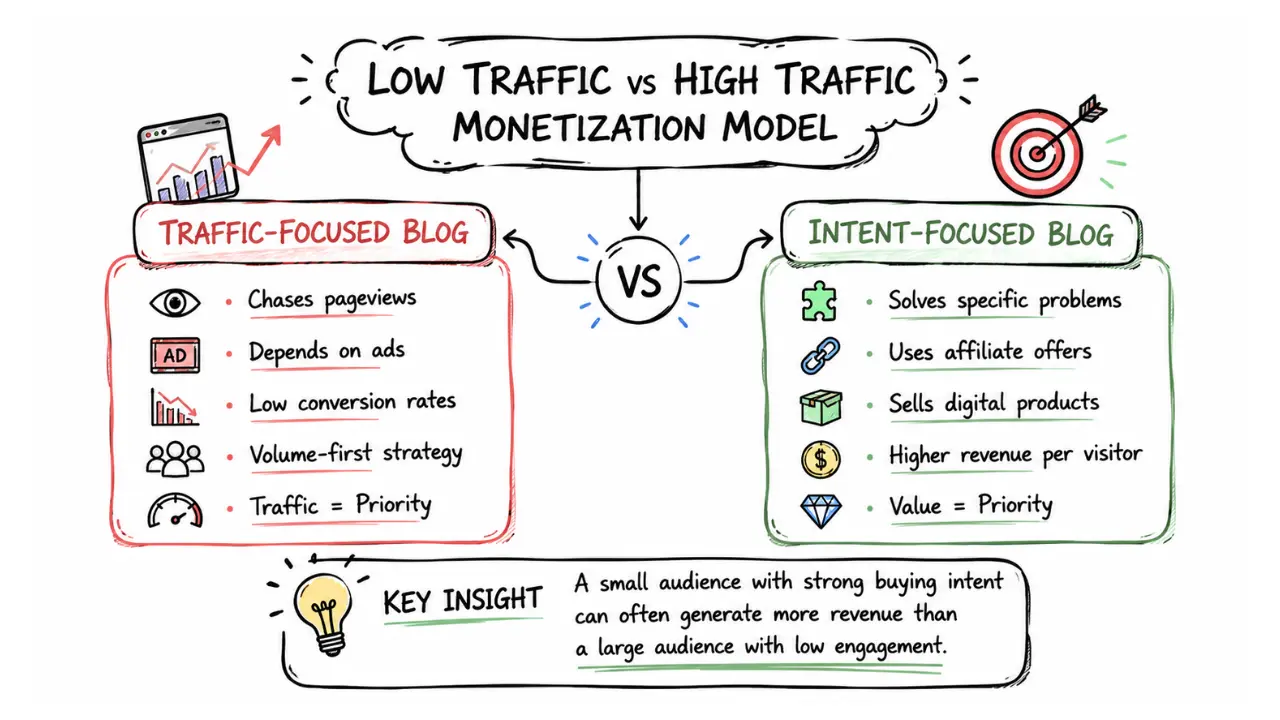
Many struggling blogs focus on vanity metrics instead of business metrics. They celebrate traffic increases while ignoring revenue per visitor, conversion rates, audience trust, and commercial intent. As a result, they attract visitors but fail to build a monetization system that turns attention into income.
Breaking out of this cycle starts with mastering the early income psychology for beginner bloggers. Successful creators understand that visitors are not simply numbers in an analytics dashboard. They are real people actively searching for solutions to specific problems. When you begin viewing your audience through that lens, monetization becomes far more effective because your content, recommendations, and offers become aligned with genuine user needs.
This shift changes how you build your blog. Instead of chasing the largest possible audience, you focus on attracting the right audience.
Instead of optimizing only for traffic, you optimize for value. Instead of measuring success by pageviews, you measure success by outcomes. That is the foundation of understanding how to make money blogging with low traffic.
A smaller audience with strong intent often generates more revenue than a much larger audience with weak engagement. Readers who trust your content are more likely to subscribe to your email list, purchase digital products, click relevant affiliate recommendations, and become long-term customers.
This is why many profitable blogs prioritize audience quality over audience size.
A focused group of highly engaged readers can become a valuable digital asset that compounds over time. By consistently solving meaningful problems and building trust, you create a business that relies less on traffic volume and more on the strength of the relationship between your content and your audience.
The diversification matrix : The four pillars of high income blog monetization strategies
Sustainable blog income is rarely built on a single traffic source, monetization method, or product. Long-term stability comes from diversification.
If one income stream slows down because of seasonality, changing advertising rates, or market conditions, the others continue generating revenue. This reduces risk, creates more predictable cash flow, and allows your business to grow without becoming dependent on a single platform or monetization model.
That is why successful creators build their businesses around diversified high income blog monetization strategies rather than relying on one source of income.
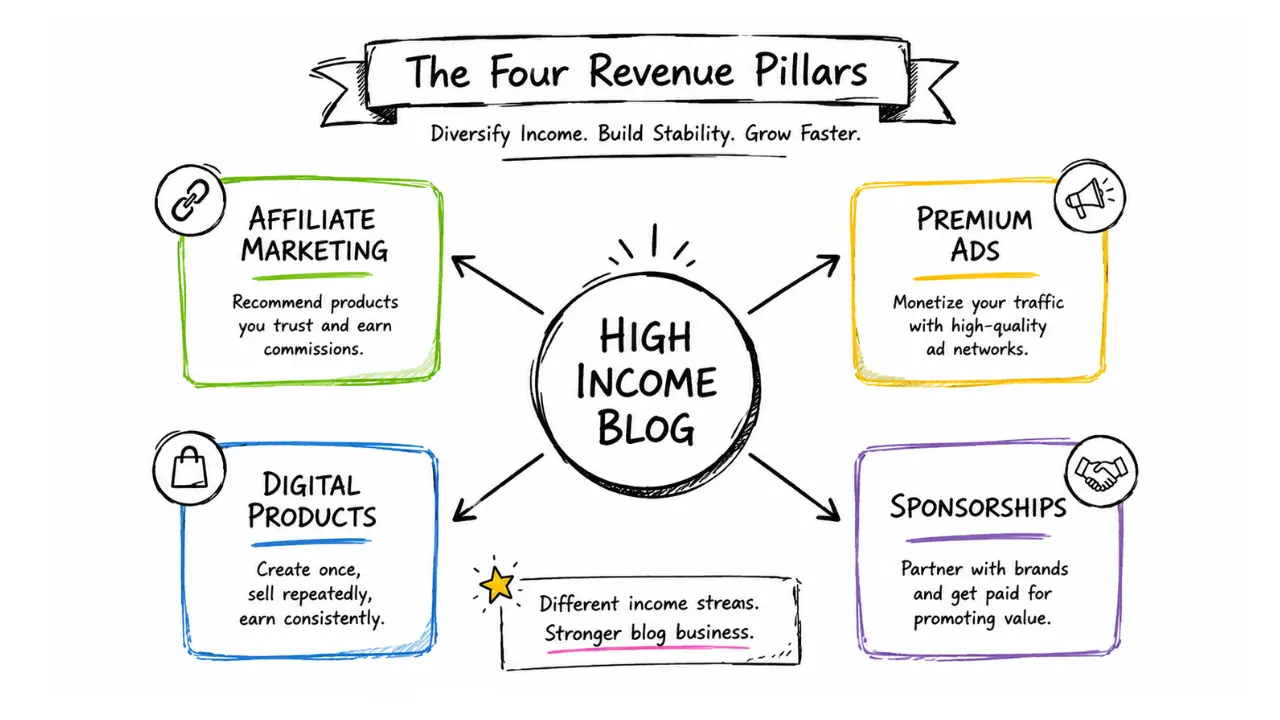
Think of your blog as a digital asset portfolio. Instead of depending on one revenue stream, you build several complementary systems that work together:
- Strategic affiliate recommendations
- Premium display advertising
- Digital products
- High-ticket services and sponsorships
Each pillar serves a different purpose. Together, they create a stronger and more resilient monetization framework.
Once you understand how these systems connect, learning How to start making money online as a beginner becomes far more predictable because you are building a complete business rather than chasing a single monetization tactic.
I will explain the four pillars that support a high-income blogging model.
Bypassing the technical friction
Want to make sure you don’t skip a critical step while executing the framework below? Secure your interactive copy of the roadmap companion tracker to audit your system live:
FREE RESOURCE
The no-code WordPress launch checklist
Don’t miss a critical setting. Skip the technical friction with this step-by-step checklist to launch a secure, lightning-fast WordPress site on your own terms.
🔒 Zero Spam. Unsubscribe with 1-click anytime.
01 . The premium display advertising (the passive floor)
Display advertising is often the first monetization method bloggers encounter, but not all advertising platforms operate the same way.
Entry-level ad networks typically generate modest earnings and can negatively affect user experience when implemented aggressively. Premium networks, on the other hand, focus on higher-quality advertisers and stronger audience targeting.
As your blog grows, premium advertising can provide a consistent baseline revenue stream that helps cover operating expenses and generates passive income from existing content.
The goal of this pillar is not to maximize earnings from every pageview. The goal is to create a stable income foundation that works alongside your other monetization channels.
02 . Strategic affiliate recommendations (The intent accelerator)
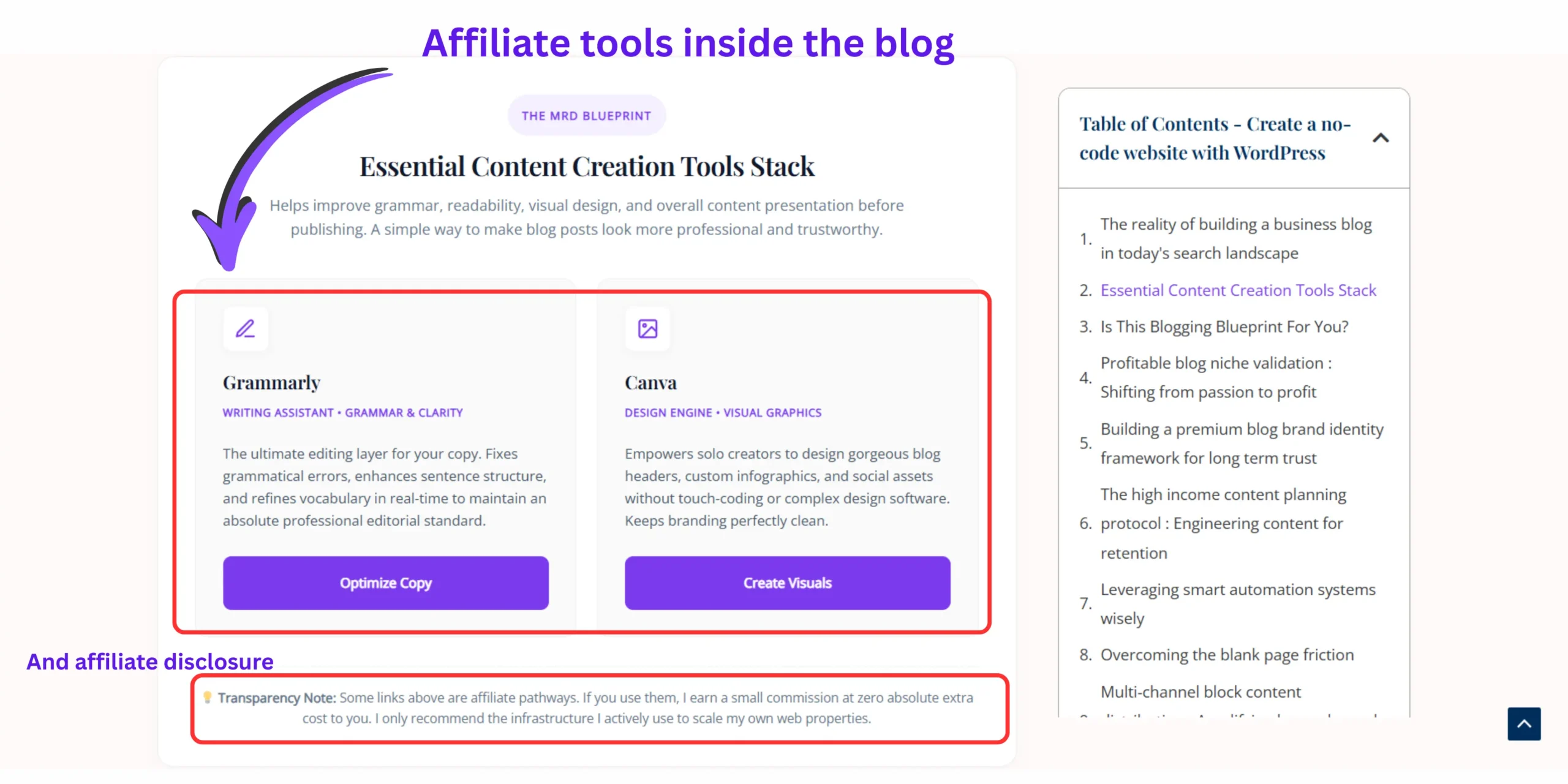
Affiliate marketing becomes significantly more effective when recommendations are aligned with the reader’s goals and challenges.
Rather than promoting large numbers of unrelated products, successful bloggers focus on carefully selected tools, software platforms, courses, and services that solve specific problems for their audience.
Because these recommendations appear at moments of high purchase intent, affiliate revenue often becomes one of the most scalable components of a blog monetization system.
When trust, relevance, and timing work together, affiliate marketing can generate recurring revenue without requiring you to create your own products.
- We explore the deep execution mechanics of this specific pillar inside our comprehensive Affiliate Marketing Category Guide.
03 . Digital products engine (the aximum margin driver)
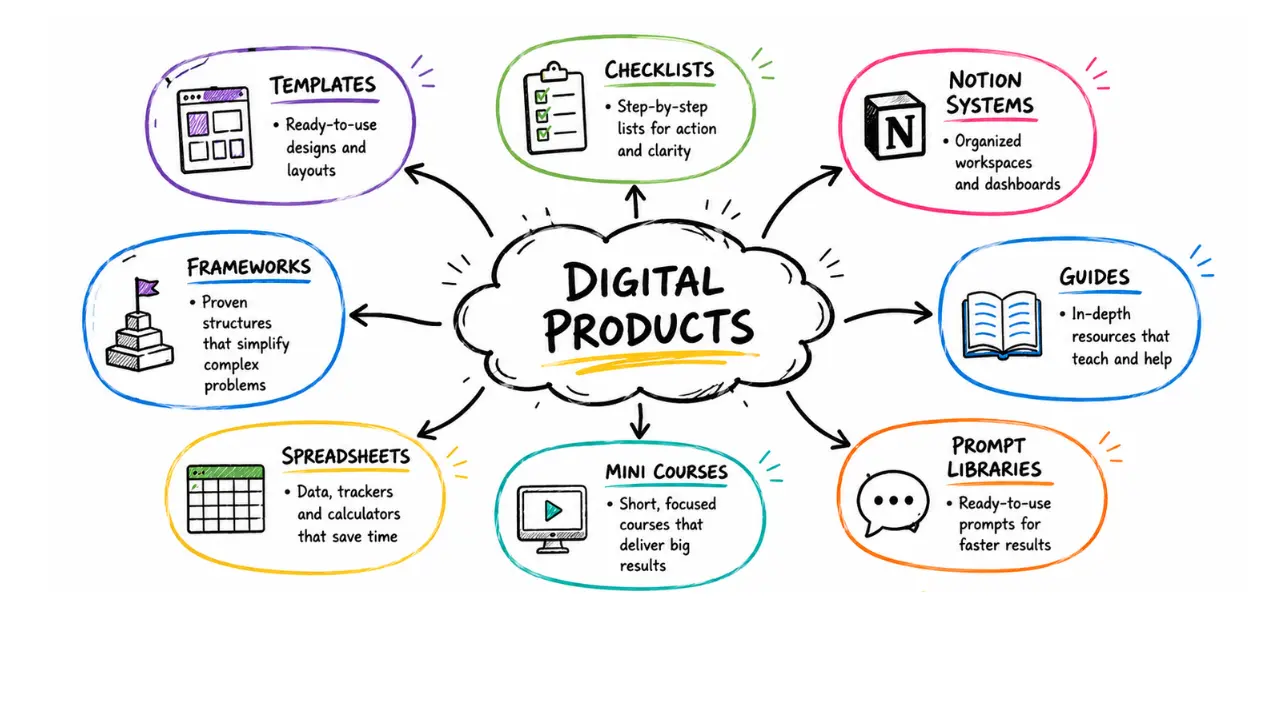
Digital products are often where blogging businesses achieve their highest profit margins. Templates, frameworks, guides, spreadsheets, checklists, mini-courses, and other digital resources can be created once and sold repeatedly without inventory, shipping, or ongoing production costs.
This allows creators to transform their expertise into scalable assets that continue generating revenue long after the original work is completed.
For many bloggers, learning how to package knowledge into valuable solutions becomes a major step toward building a more independent and profitable business model.
04 . High-ticket services and direct corporate sponsorships (the cash flow multiplier)
Services and sponsorships are often overlooked by beginner bloggers, yet they can become powerful revenue drivers long before a website reaches large traffic numbers.
As your authority grows within a niche, opportunities may emerge for consulting, coaching, implementation services, workshops, corporate training, or direct sponsorship agreements with relevant brands.
These opportunities allow you to monetize expertise rather than traffic alone.
A single client engagement or sponsorship partnership can often generate more revenue than months of display advertising, while your content assets continue attracting new readers and prospects in the background.
The strongest blogging businesses do not rely on any one of these pillars alone.
They combine all four into a balanced monetization system where each revenue stream supports and strengthens the others. This creates greater stability, better cash flow, and a more scalable path toward long-term growth.
Productizing your expertise : How to sell digital products on a blog
One of the biggest turning points in blogging happens when you stop thinking only like a content creator and start thinking like an asset builder.
Many bloggers spend years relying entirely on advertising revenue or affiliate commissions. While those monetization methods can be effective, they are ultimately tied to external platforms, commission structures, and market conditions.
Digital products are different.
When you learn how to sell digital products on a blog, you create assets that you own, control, and can improve over time. Unlike physical products, digital products require no inventory, no shipping, and very little ongoing maintenance after creation. Once the system is in place, your content can continuously attract potential customers while automated delivery handles fulfillment.
This makes digital products one of the highest-margin monetization opportunities available to bloggers.
Identifying profitable digital products for bloggers
The most successful digital products solve a specific problem for a specific audience.
Rather than creating broad resources that attempt to serve everyone, focus on helping readers achieve a particular outcome faster, easier, or with fewer mistakes. Common digital product formats include:
- Templates
- Checklists
- Spreadsheets
- Canva design packs
- Notion systems
- Figma resources
- Workflow frameworks
- Mini courses
- Implementation guides
- Productivity systems
- Prompt libraries
A simple product validation framework is:
- Identify recurring audience questions.
- Look for problems readers repeatedly struggle to solve.
- Create a shortcut, framework, or tool that simplifies the process.
- Package the solution into a digital product.
- Improve and expand based on customer feedback.
The strongest products are often created from systems you already use in your own work.
As the creator economy continues evolving, new opportunities are emerging around automation, artificial intelligence, and workflow optimization. For example, developing the practical AI skills that will make you money in 2027 can help you create templates, prompt systems, automation workflows, and implementation frameworks that save users significant amounts of time and effort.
This approach transforms knowledge into a scalable asset. Instead of exchanging hours for income, you build a resource once and allow your content ecosystem to market it continuously to future readers.
The monetization architecture : Trap vs high-ticket engines
| Entry-Level Monetization Traps | High-Ticket Creator Frameworks |
|---|---|
| Low-priced products that compete primarily on cost and offer limited differentiation. | Specialized templates, frameworks, systems, and implementation resources that solve valuable problems quickly. |
| Monetization strategies that depend entirely on third-party platforms and external policies. | Owned intellectual property assets that you control, improve, and sell directly to your audience. |
| Generic content designed to attract the widest possible audience. | Targeted content created for readers with specific goals, challenges, and purchase intent. |
| Revenue models that require constant increases in traffic volume to maintain growth. | Revenue models that increase earnings by improving value, conversion rates, and customer outcomes. |
The highest-income blogging businesses rarely rely on traffic alone. They combine content, audience trust, and owned digital assets into a monetization system that becomes more valuable over time.
When digital products are aligned with genuine audience needs, every blog post becomes more than content—it becomes an entry point into a scalable ecosystem of solutions that can generate revenue long after the content is published.
Unlocking premium ad networks for bloggers and high-ticket partnerships
Many bloggers begin monetizing with whichever advertising platform is easiest to join. While that approach can generate some early revenue, it often leads to a poor balance between earnings, user experience, and website performance.
As your blog grows, the goal should not be to display more advertisements. The goal should be to improve the quality of your monetization system.
This is where premium ad networks for bloggers become valuable.
Unlike many entry-level advertising platforms, premium networks focus on higher-quality advertisers, stronger audience targeting, and optimized ad placements. The result is often a better balance between revenue generation and user experience.
Understanding premium Ad networks for bloggers
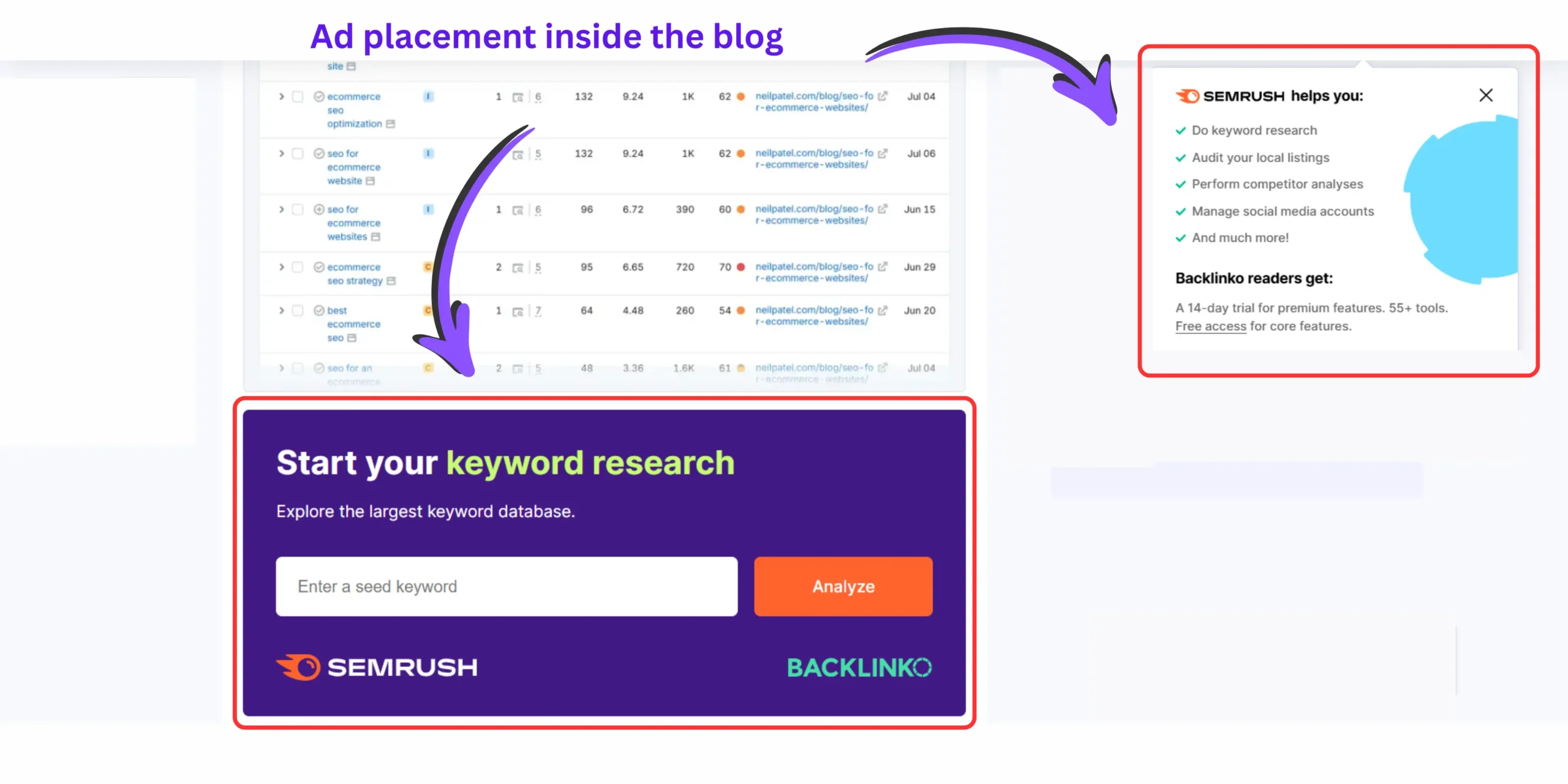
Premium advertising works best when supported by:
- High-quality content
- Consistent traffic growth
- Strong audience engagement
- A positive user experience
- Clear niche positioning
As your blog develops, premium advertising can provide a reliable baseline income stream while allowing you to focus on creating content and building additional revenue channels.
Some well-known options include:
01 . Raptive
Raptive has significantly lowered its entry requirements compared to previous years, making premium advertising opportunities accessible to a larger number of growing niche publishers.
02 . Journey by Mediavine
Journey provides an entry point for smaller websites that want access to professional ad infrastructure without waiting until they reach very large traffic levels.
The key lesson is not which network you choose.
The key lesson is that premium advertising should support your content strategy rather than disrupt it. A clean user experience, strong content quality, and audience trust often create more long-term value than maximizing ad placements on every page.
How to get blog sponsorships without a massive audience
One of the biggest misconceptions in blogging is that sponsorships are reserved for creators with huge audiences.
In reality, many brands are more interested in relevance than reach. A website that attracts highly targeted readers can sometimes provide more value than a much larger publication with a broad, less engaged audience.
This is especially true in specialized niches where readers arrive with clear goals, strong purchase intent, and a specific problem they want solved.
That is why learning How to monetize a blog with low traffic can become a significant advantage. Instead of competing on traffic volume alone, you can compete on audience quality.
Brands typically look for several signals when evaluating sponsorship opportunities:
- Audience relevance
- Topic expertise
- Reader trust
- Content quality
- Search intent alignment
- Conversional potential
When these factors are present, a blog with modest traffic can still become an attractive partnership opportunity.
Building a sponsorship ready media kit
Many bloggers focus exclusively on traffic numbers when creating a media kit. While traffic matters, brands are increasingly interested in understanding the quality of your audience and the context in which their products will appear.
A strong media kit may include:
- Your niche and positioning
- Audience demographics
- Top-performing content
- Email subscriber data
- Engagement metrics
- Relevant case studies
- Previous partnerships
- Testimonials or results
Search data can be particularly valuable because it demonstrates intent.
For example, if your content consistently ranks for commercially relevant topics, brands can see that readers are actively searching for solutions related to their products or services.
This shifts the conversation away from pageviews alone and toward business outcomes. The most successful sponsorship opportunities are not built on audience size alone. They are built on trust, relevance, and the ability to connect the right solution with the right audience at the right moment.
When premium advertising and strategic partnerships work together, they become powerful components of a diversified blog monetization system that continues growing as your authority expands.
The on-page conversation blueprint : Where to embed monetization hooks
Creating profitable monetization assets is only part of the equation.
Even the most valuable digital products, affiliate recommendations, and sponsorship opportunities can underperform if readers never encounter them at the right moment.
Effective monetization is not about placing more offers throughout your content. It is about placing the right offer in the right context at the right time.
The highest-converting blogs understand a simple principle:
Readers are most likely to take action when a recommendation naturally supports the information they are already consuming.
This is why avoiding the Common mistakes beginners make when monetizing content often comes down to understanding user behavior rather than adding more monetization tools.
Instead of interrupting the reading experience with aggressive tactics, focus on creating clear pathways that help readers discover relevant resources, products, and next steps when they are most likely to benefit from them.
The goal is simple:
- Reduce friction
- Increase visibility
- Maintain trust
- Improve relevance
When these elements work together, conversion rates often improve without sacrificing user experience.
The high-converting on-page placement checklist
To maximize the effectiveness of your monetization system, consider integrating offers at key points throughout your content journey.
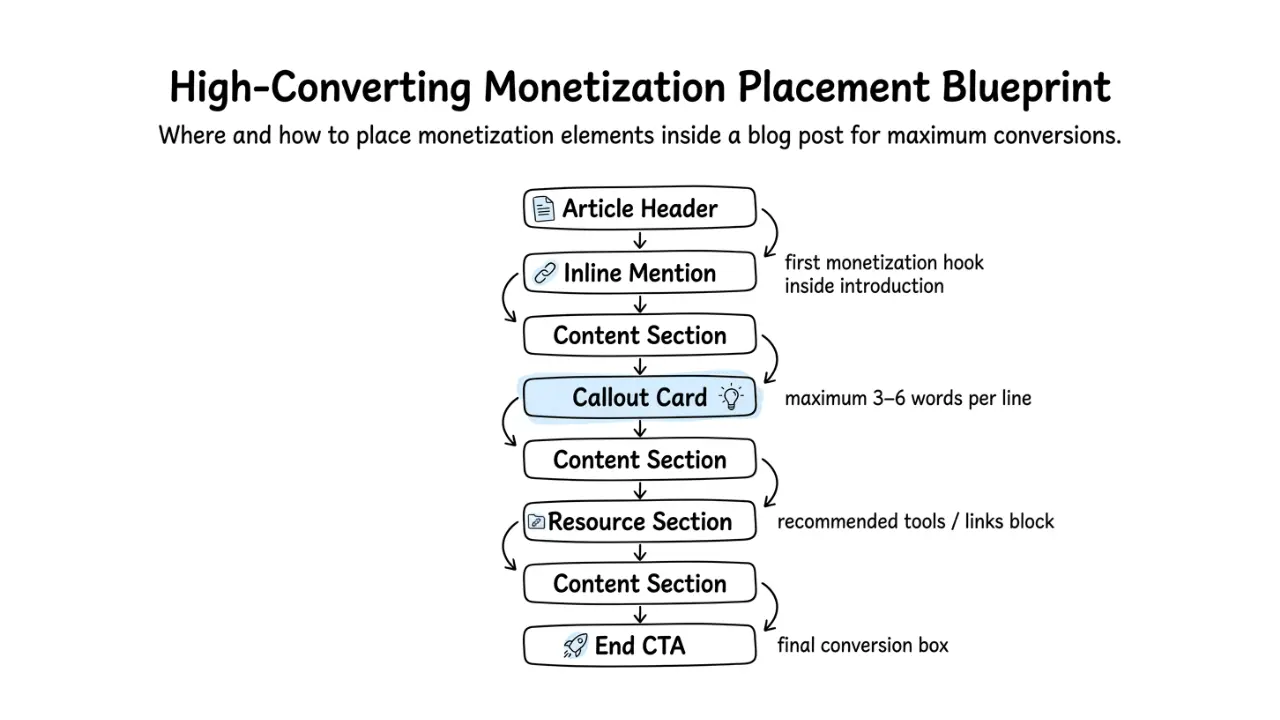
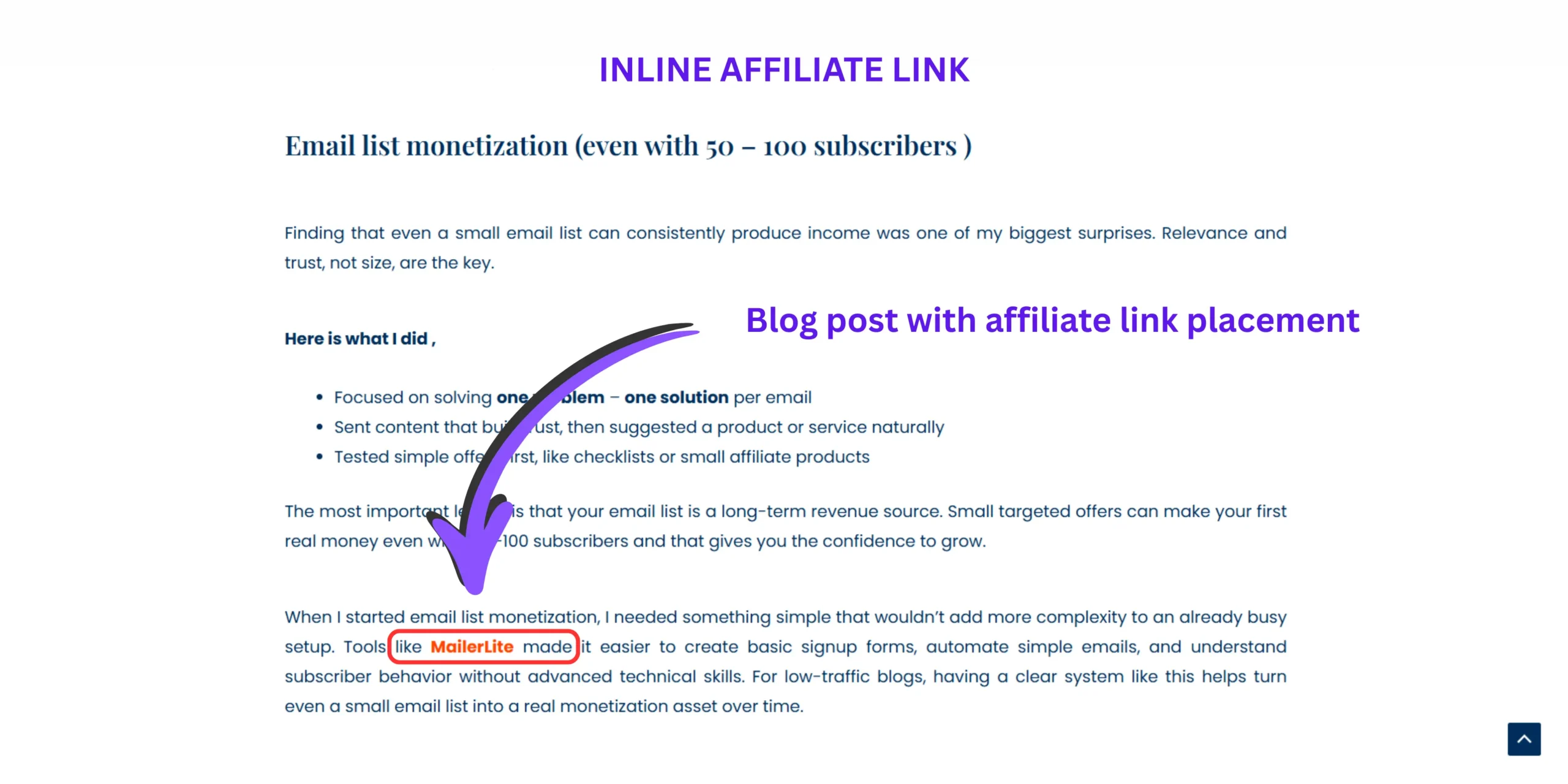
01 . The inline native mention (top 15%)
Place a natural recommendation within the opening section of your article before the first major heading. This works particularly well for:
- Digital products
- Lead magnets
- Affiliate resources
- Helpful tools
Readers who already know what they need often skim introductions. Early visibility allows them to take action without searching through the entire article.
02 . The contextual callout card
Break up long sections of content with visually distinct resource blocks. A simple callout card can include:
- A clear headline
- A short description
- A single call to action
- Clean visual spacing
These cards work best when they directly support the topic being discussed rather than introducing unrelated offers.
03 . The strategic resource section
Whether your site uses a sidebar, full-width layout, or mobile-first design, dedicate a consistent area for high-value resources.
Instead of cluttering your layout with unnecessary widgets, focus attention on:
- Recommended tools
- Premium resources
- Email subscriptions
- Core offers
The objective is clarity, not quantity.
04 . The mid content pivot
One of the most effective placement opportunities occurs immediately after a major insight, framework, or breakthrough section.
At this point, readers have already received value and often want additional guidance or implementation support. A well-placed recommendation can naturally bridge the gap between learning and action.
05 The end of article next step
Many bloggers treat the end of an article as a stopping point. High-performing blogs treat it as a transition point.
After delivering value, provide readers with a clear next action, such as:
- A related guide
- A digital product
- A consultation offer
- An email newsletter
- A recommended tool
This helps maintain momentum and encourages deeper engagement with your content ecosystem.
06 . The optional exit intent gateway
For blogs that use email marketing, a carefully designed exit-intent offer can provide an additional opportunity to capture interested visitors before they leave. If used, it should:
- Be highly relevant
- Offer genuine value
- Appear sparingly
- Avoid disrupting the reading experience
The goal is to help interested readers continue their journey, not pressure them into taking action.
Mobile first conversion considerations
Because a significant percentage of blog traffic now comes from mobile devices, every monetization element should be tested on smaller screens.
Pay particular attention to:
- Button visibility
- Callout card spacing
- Page speed
- Readability
- User experience
A monetization system that works perfectly on desktop but creates friction on mobile will limit both conversions and long-term growth.
The most effective monetization placements feel like a natural extension of the content itself. When recommendations appear at moments of relevance and support the reader’s goals, monetization becomes part of the user experience rather than an interruption to it.
The minimalist blog monetization stack for beginners
One of the most common mistakes new bloggers make is building a complicated technology stack before they have a proven monetization system.
It is easy to get distracted by advanced software, automation platforms, and expensive tools that promise faster growth. In reality, most successful creators begin with a simple setup and add complexity only when it becomes necessary.
The goal is not to build the largest system possible.
The goal is to build the simplest system that allows you to create content, collect payments, deliver products, and understand what is working.
That is the foundation of a sustainable blog monetization stack for beginners. A lean monetization system provides several advantages:
- Lower operating costs
- Fewer technical issues
- Faster implementation
- Easier maintenance
- More time for content creation and audience building
When your systems are simple, you can focus on the activities that generate results rather than spending hours managing software.
The lean creator infrastructure
For most bloggers, a monetization stack only needs three core components:
01 . Payment and product delivery
Before you can sell anything, you need a reliable way to accept payments and deliver products.
Modern creator-focused platforms simplify this process by handling many of the technical and administrative requirements for you. Common solutions include:
- Lemon Squeezy
- Gumroad
These platforms can help manage payment processing, product delivery, customer access, and other operational tasks, allowing you to launch products without building a custom e-commerce system.
The objective is simplicity. Choose a solution that works well for your current business stage rather than the most advanced platform available.
02 . The email marketing foundation
Your email list is one of the few audience assets you fully control. Platforms such as:
- Kit (formerly ConvertKit)
- Mailerlite
- Beehiive
Can help you :
- Capture subscribers
- Deliver lead magnets
- Build automated welcome sequences
- Promote products and services
- Nurture long-term customer relationships
For many bloggers, email eventually becomes one of the highest-converting channels in their entire monetization system.
03 . The analytics layer
Once traffic and monetization systems are active, the next priority is understanding user behavior. This is where How to use analytics to improve monetization strategy becomes essential.
Rather than guessing which content performs best, analytics allows you to make decisions based on actual visitor behavior. Key metrics to monitor include:
- Page-level traffic
- Email signup rates
- Affiliate link clicks
- Product sales
- Conversion rates
- Revenue-generating pages
Tools such as :
- Google Search Console
- Plaudible
- Fathom Analytics
can provide valuable insights into how users interact with your content and where monetization opportunities exist.
A simple rule for tools selection
Before adding any new software to your business, ask a simple question:
Does this tool help me save time, increase revenue, or improve decision-making?
If the answer is no, you probably do not need it yet. Many profitable blogs operate successfully with a surprisingly small collection of tools because they focus on effectiveness rather than complexity.
A streamlined monetization stack allows you to spend less time managing technology and more time creating valuable content, growing your audience, and improving the revenue systems that matter most.
Blog Monetization Architecture FAQ
Strategic answers regarding traffic thresholds, automated revenue streams, timeline expectations, and high-yield infrastructure setups for modern bloggers.
You can start monetizing a blog with very little traffic if you focus on high-intent readers and the right monetization methods.
Affiliate marketing, digital products, consulting services, and sponsorship opportunities can generate income even before a blog reaches significant traffic levels. Display advertising typically requires more visitors to become meaningful. While premium ad networks often have traffic requirements, many bloggers begin earning revenue long before reaching those thresholds by focusing on audience quality rather than traffic volume alone.
Affiliate marketing is often the most beginner-friendly blog monetization method.
It allows you to earn commissions by recommending products, tools, or services that are relevant to your audience. Unlike creating your own products, affiliate marketing does not require inventory, customer support, or payment processing. As your audience grows, you can gradually expand into email marketing, digital products, sponsorships, and other monetization channels.
Most bloggers need between 6 and 12 months to generate consistent income from organic traffic.
The timeline depends on factors such as content quality, keyword selection, publishing consistency, and audience growth. Some bloggers earn earlier through freelance services, affiliate marketing, or digital products, while others take longer as they build search engine authority. Blogging is generally a long-term asset-building strategy rather than a quick-income model.
Pro bloggers create passive income by building systems that continue generating revenue after content is published.
Common examples include display advertising, affiliate marketing, digital products, and automated email funnels. Once a high-quality article ranks in search engines, it can attract visitors and generate sales for months or even years. While passive income still requires maintenance and updates, it becomes more scalable than trading time directly for money.
Yes, a personal blog can still be profitable when it helps readers solve specific problems or achieve specific goals.
The most successful personal blogs combine personal experience with practical advice, frameworks, case studies, or actionable insights. Instead of focusing only on daily experiences, successful bloggers connect their stories to topics that readers are actively searching for. This creates value for both the audience and search engines while opening multiple monetization opportunities.
Building a system, Not a job
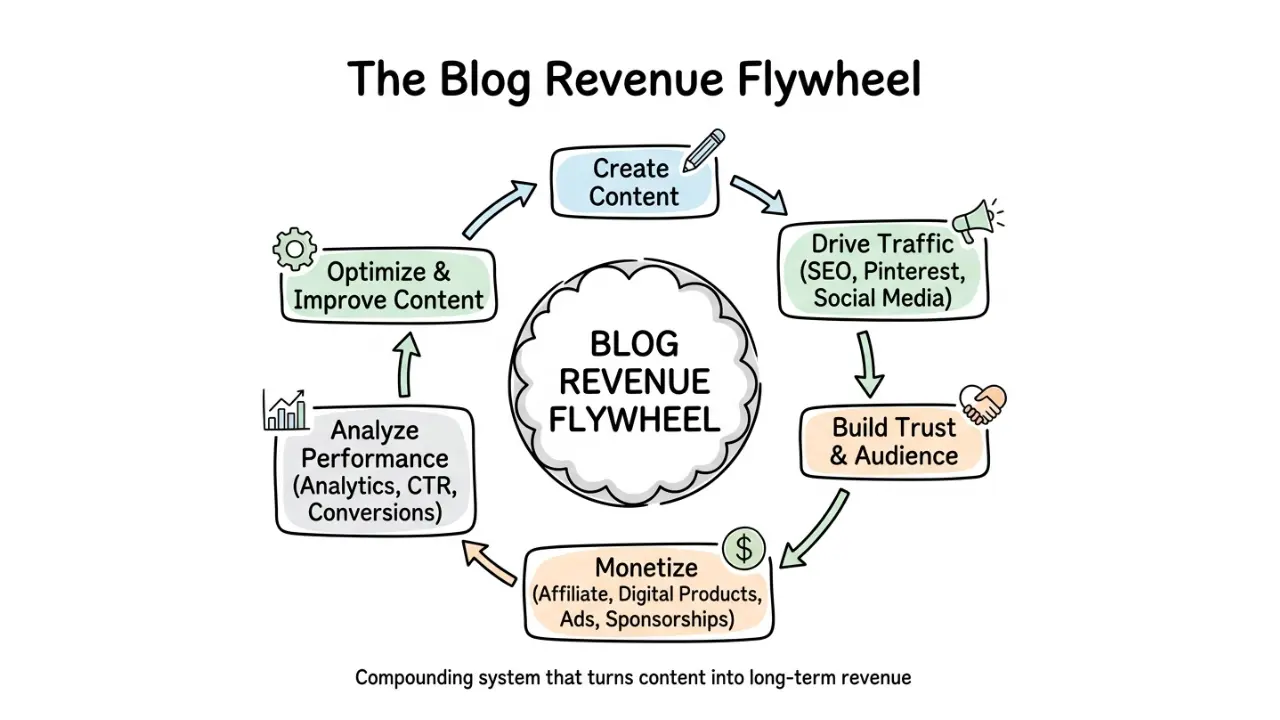
The most successful blogs are not built on traffic alone. They are built on systems.
Throughout this guide, we’ve explored how diversified high income blog monetization strategies can help transform a blog from a simple publishing platform into a scalable digital asset. The goal is not to depend on a single source of revenue, a single traffic channel, or a single monetization tactic. The goal is to build multiple income streams that work together to create long-term stability and growth.
That is why learning how to make money blogging with low traffic is such an important shift for modern creators. Instead of chasing pageviews alone, you focus on audience trust, user intent, and creating solutions that genuinely help your readers.
As your blog grows, opportunities expand. You can learn how to sell digital products on a blog, position your site for premium ad networks for bloggers, build strategic affiliate partnerships, and develop sponsorship opportunities that are aligned with your niche expertise. Combined with a lean blog monetization stack for beginners, these systems create a foundation that can grow alongside your content and audience.
The key takeaway is simple:
The key takeaway is simple :
Traffic creates opportunities. Trust creates revenue. Systems create scalability. Start by choosing one monetization pillar and implementing it well. Then gradually add complementary revenue streams as your authority grows. Over time, these assets compound, creating a blog that works as a business rather than a collection of articles.The creators who succeed long term are not necessarily the ones with the largest audiences. They are the ones who consistently build valuable content, solve meaningful problems, and create monetization systems that serve both their readers and their business goals.Focus on building the system. The results will follow.
Malaka Dharmarathne - MRD
Digital Marketing & Blogging growth specialist
” I help beginner bloggers build high-converting, no-code WordPress websites and master the fundamentals of SEO and content distribution. Through actionable blueprints on affiliate marketing and high-income monetization, I turn simple blogs into profitable digital businesses.“
Popular Blueprints
Table of Contents - High income blog monetization
Build & Scale a High-Converting Blog Platform
Join thousands of creators getting actionable breakdowns on affiliate monetization, clean UX design, and growth strategy delivered straight to your incbox.
- Step-by-Step Guides: Proven traffic & monetization tactics.
- Tech Stack Curations: The exact tools & plugins to build faster.
- Zero Spam: Unsubscribe in 1 click at any time.
🔒 We respect your privacy. No spam, ever.

” I’m MRD, a digital entrepreneur specializing in building lightweight, automated systems for solo creators. I founded Learn2Launch to share the exact AI orchestration protocols and framework setups I use every day—helping you launch a profitable one-person business completely free of technical overwhelm or backend bloat.“