
If you’re struggling to get likes, comments or even views, the problem is often not your content , it’s your hook. Learning how to write hooks for social media as a beginner helps your posts get noticed before people scroll past. Simply put, a hook is the first line people see. Understanding what is a hook in social media content can completely change how your audience reacts to posts.
Table of Contents on how to write hooks dor social media as a beginner ?

What is a hook in social media content?
A hook in social media content is the fist line or visual that grabs attention and makes someone stop scrolling .
Its only job is to earn the next second of attention.
For beginners, this is critical because social media users decide within seconds whether a post is worth reading. If the first line of a social media post doesn’t spark interest, even valuable content gets ignored.
Why the first line matters so much.
- People scroll fast and skim, not read
- Algorithms favor posts that get quick engagement
- A strong hook increases reads, saves, comments and shares
Without a hook, your content never gets the chance to perform.
Where hooks appear in social media posts
Hooks are not just for captions. They can appear in multiple places, such as,
- The first line of social media post (Caption opening)
- Headline style text in carousels
- Thumbnail text on videos or reels
- Opening sentence of story based post
Each of these elements works together to create scroll stopping content.
What a hook is not …….
- It is not clickbait
- It is not exaggeration or fake promises
- It is not manipulation
A good hook clearly signals value , relevance or curiosity , honestly.
When beginners understand hooks, social media stops feeling random. Instead of hoping people engage, you intentionally guide attention using clear, ethical hook writing.
Why hooks matter more than algorithms
Many beginners believe social media success depends on “ cracking the algorithm ”. In reality, algorithms don’t create reach , but people do. We live in an attention economy, where users scroll fast and decide in seconds whether a post is worth their time. If your content doesn’t grab attention immediately, the algorithm never gets a signal to push it further.
This is why high quality posts fail . Without attention grabbing posts , good information stays invisible.
Why good content fails without hooks
Even valuable content can struggle when,
- The opening line is vague or generic
- The post doesn’t clearly show why it matters
- The audience can’t immediately relate to the message
Hooks solve this by earning the first moment of attention. Once people stop scrolling, your content finally has a chance to perform.
How hooks influence reach and engagement
Strong hooks directly impact ,
- Social media engagement (Likes , comments , shares )
- Watch time and read time
- Saves and profile visits
These early signals tell platforms your post is useful. As a result, it gets shown to more people.
Why this matters for beginners
For beginners, hooks are one of the most effective social media growth tips for beginners because they,
- Work even with small audiences
- Don’t require paid ads
- Improve results without posting more
If you have ever wondered why your posts aren’t getting attention , this often explains why people do not engage with your content , the hook isn’t clear or compelling enough.
When you focus on hooks instead of algorithms, growth becomes simpler, more predictable and less frustrating.
Strong hooks are the starting point of any growth strategy. If your goal is long term results, hooks should connect to a bigger system. This is where understanding how to use social media to grow your online business becomes essential, because attention alone doesn’t build income. Growth comes from guiding people from curiosity to clear next steps.
What makes a good social media hooks?
A good hook doesn’t need to be clever or viral. It needs to be clear , relevant and easy to understand . When beginners ask what makes a good social media hook , the answer is simple . It immediately let the reader why they should stop scrolling .
Below are the four core elements behind attention grabbing social media posts that actually perform .
01 . Clarity over cleverness
Clarity always wins on social media. If people don’t understand your message in the first few seconds, they scroll away.
A clear hook ,
- Uses simple, direct language
- Avoids confusing words or inside jokes
- Gets to the point quickly
Many beginners attempt to sound intelligent or imaginative. Performance is frequently harmed by this. A hook’s purpose is to be understood, not to impress.
Readers are much more likely to continue reading when they ” get it ” right away.
Hooks aren’t just for social media, they matter in blogging too. The same principles apply when crafting headlines and introductions. If you’re also learning how to write your first blog post for beginners, mastering hooks will help you keep readers engaged from the first sentence instead of losing them after the headline.
02 . One clear benefit
Good hooks focus on a single advantage rather than several concepts at once. Confusion results from trying to say too much in the opening line.
One question is addressed by a benefit-focused hook:
- What will I gain from reading this ?
This could be ,
- A solution to problem
- A mistake to avoid
- A result to work toward
When the benefit is obvious, people feel rewarded for stopping. This is a key reason some posts outperform others, even with similar content.
03 . Curiosity without clickbait
Curiosity is powerful – but it must be honest
A good hook creates curiosity by ,
- hinting at a useful insight
- Teasing a lesson or outcome
- Opening a loop the post later closes
Clickbait misleads or exaggerates. Without making any false promises, ethical hooks just stimulate curiosity.
When your hook aligns with your content, trust increases. Better engagement and devoted readers result from this over time.
04 . Emotional or relatable trigger
People stop scrolling when they feel understood.
Hooks work best when they connect to,
- Frustration
- Confusion
- Desire for improvement
- Common beginner struggles
Readers are led to believe, “This is about me,” by relatable hooks. What transforms a fleeting glance into genuine attention is that emotional recognition.
Your hooks naturally get stronger when these four components come together, and your posts start attracting attention rather than chasing it.
This is the basis for creating hooks that consistently work, even for beginners.
Writing effective hooks becomes easier when you pair skill with the right tools. Many beginners struggle not because of ideas, but because of execution. Learning about best content creation tools and strategies can help you write clearer hooks faster, stay consistent and turn ideas into scroll stopping posts without overthinking every caption
Common hook writing mistakes beginners must avoid
Many beginners struggle with hooks not because they lack ideas, but because they repeat the same small mistakes. Understanding these beginner content writing mistakes will instantly improve your results without posting more.
Below are the most common hook writing errors and why they hurt performance.
Vague or generic openings
Hooks fail when the opening line doesn’t clearly say what the post is about.
Examples of vague openings include ,
- “Here is something interesting……….”
- “Let me share a quick tip ………”
- “This might help you ………..”
These lines give no reason to stop scrolling. One of the most important social media caption writing tips is to be specific from the first sentence.
Using overused hook phrases
Some phrases were effective once but are now ignored.
Common examples,
- “You won’t believe this………”
- “This will change your life……..”
- “Nobody talks about this……..”
Because people see these lines daily, they no longer feel trustworthy. Overused hooks reduce attention instead of grabbing it.
Trying too hard sound “viral”
Many beginners copy viral posts hoping for similar results. This often leads to,
- Exaggerated claims
- Forced drama
- Unnatural writing
Viral language without real value feels fake. Simple, honest hooks consistently perform better , especially for new creators.
Talking about yourself too early
Starting a post with ,
- “I did this ………”
- “My journey ………”
- “Here’s what happened to me…..…”
can quickly lose visitors if you don’t already have one. Beginners should start with the reader’s issue rather than their own story.
Why avoiding these mistakes matter
Reach and engagement can be significantly increased by resolving these hook problems. They fall according to the more general category of the 10 social media mistakes beginners must avoid and fixing them early on speeds up the development of trust.
The greatest improvements in results are frequently achieved with small modifications to your hooks.
Low engagement is rarely about bad content ,it’s usually about weak openings. If you’ve ever wondered why people do not engage with your content, hooks are often the missing piece. Without a strong first line, even valuable posts get ignored in a crowded feed.
A simple hook writing formula for beginners
One of the fastest ways to improve your social media content is by using a hook writing formula . Beginners often wonder how to write hooks for social media as a beginner without guessing or copying others. A simple, repeatable formula can save time, increase engagement, and build trust with your audience.
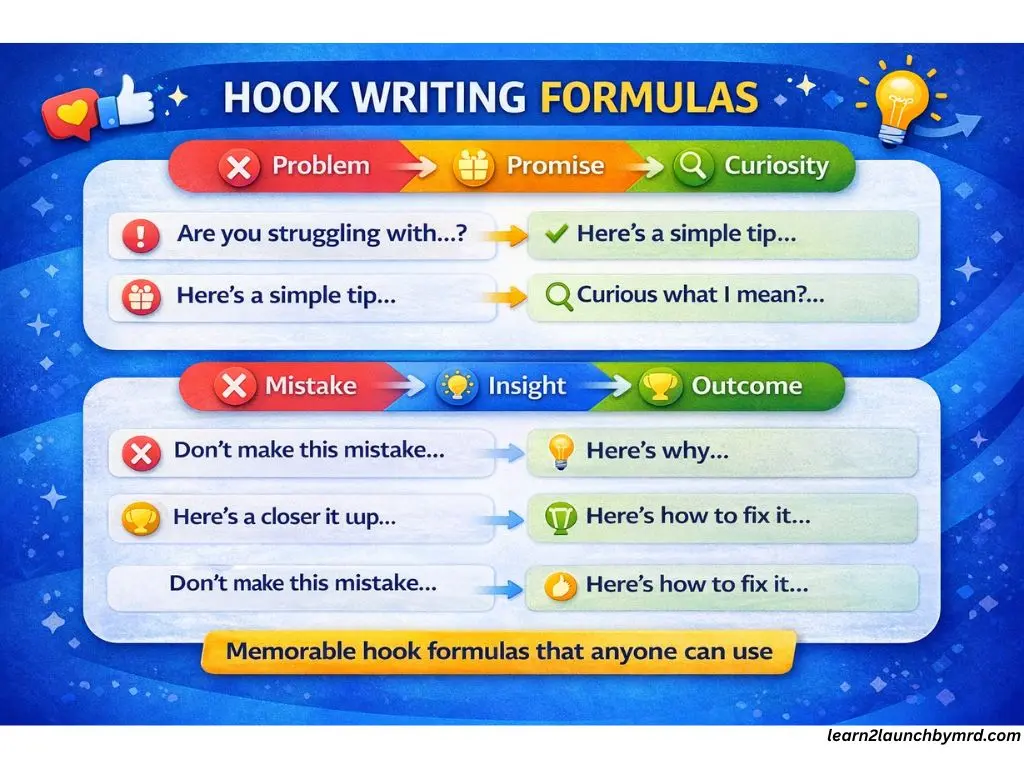
Formula 01 . Problem – promise – curiosity
This formula works because it immediately addresses a pain point, offers a solution, and sparks curiosity to keep reading
How it works ,
- Problem – Identify a common issue your audience faces.
- Promise – Show that your post will provide a solution or valuable insight.
- Curiosity – Give a reason to read the post or swipe for more.
Example –
“Struggling to get people to engage with your posts? Learn the 3-step trick that instantly grabs attention and keeps followers scrolling. ”
Why it works ,
- The problem is relatable
- The promise creates value
- Curiosity encourages engagement
Formula 02 . Mistake – insight – Outcome
This formula highlights a mistake people make, offers a quick insight and shows the benefit of reading further.
How it works ,
- Mistake – Point out a common error beginners make.
- Insight – Share a tip or a different perspective.
- Outcome – Show the positive result if they follow your advice.
Example –
“Most beginners start posting without a plan. Here’s why that fails and how a simple hook can double your engagement in one week.”
Why it works –
- Highlights a pain point
- Gives actionable advice
- Shows tangible results
Key takeaways
- Use these formulas consistently to write attention grabbing posts
- Adapt them to your niche, platform, and audience
- Start small: even a single hook improvement can dramatically improve reach
By using a structured approach like this, beginners can stop guessing and start creating hooks that consistently work, building trust and authority with every post.
If you struggle to write hooks consistently, AI can help , but only when used correctly. Learning how to use ChatGPT to write a blog post for beginners can also improve your hook-writing process, helping you generate angles, rewrite weak openings and refine clarity without losing your own voice or authenticity.
Beginner hook examples , Weak VS strong
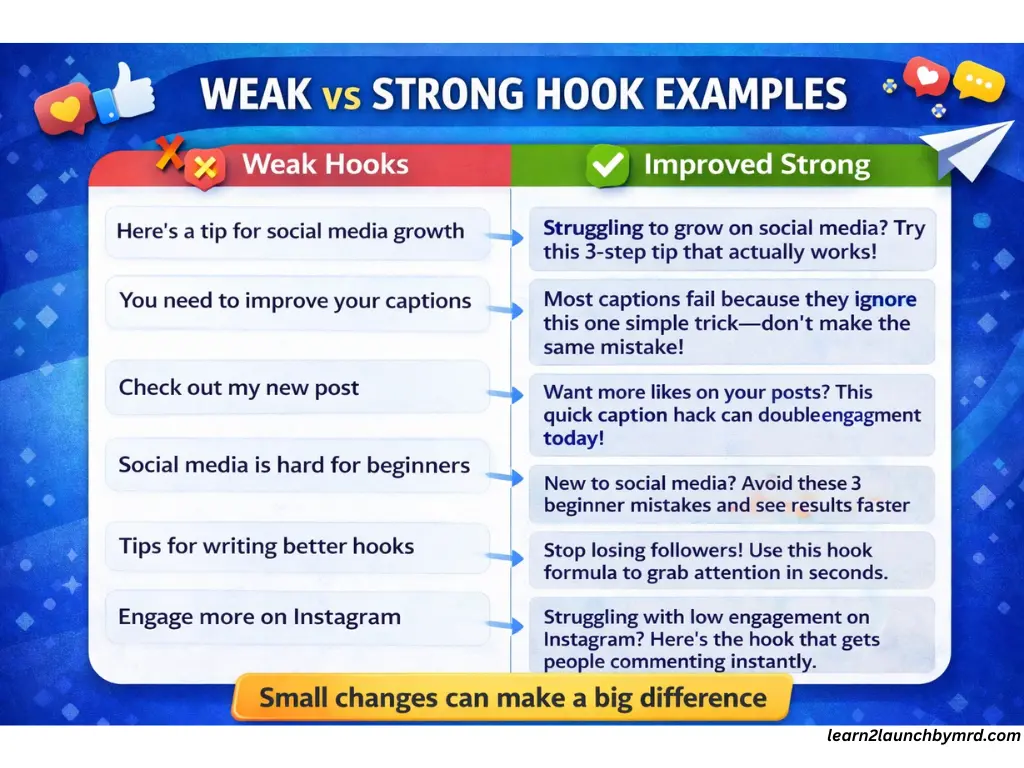
Understanding social media hook examples for beginners is easier when you can compare weak and strong versions side by side. Small changes in wording or structure can drastically increase engagement.
- 01 . Weak – “Here is a tip for social media growth”
Strong – “ Struggling to grow on social media ? Try this 3-step tip that actually works ”
Why it works – The improved hook addresses a specific problem and hints at a solution, encouraging readers to stop scrolling.
- 02 . Weak – “You need to improve your captions”
Strong – “Most captions fail because they ignore this one simple trick — don’t make the same mistake ”
Why it works – Adds curiosity and urgency while showing immediate value.
- 03 . Weak – “Check out my new post “
Strong – “ Want more likes on your posts? This quick caption hack can double engagement today ”
Why it works – Focuses on the audience’s desire, not the creator’s activity.
- 04 . Weak – “Social media is hard for beginners “
Strong – “New to social media? Avoid these 3 beginner mistakes and see results faster.”
Why it works – Clearly identifies the audience and offers actionable value.
- 05 . Weak – “Tips for writing better hooks”
Strong – “Stop losing followers! Use this hook formula to grab attention in seconds.”
Why it works – Introduces urgency, benefit and actionable insight – key for attention grabbing social media posts
- 06 . Weak – “Engage more on Instagram”
Strong – “Struggling with low engagement on Instagram? Here’s the hook that gets people commenting instantly.”
Why it works – Speaks directly to a pain point and promises measurable results.
- 07. Weak – “This is important for your posts “
Strong – “Most beginners ignore this one detail and it’s why their posts don’t perform.”
Why it works – Sparks curiosity and hints at a valuable insight.
Key takeaways
- Small adjustments can transform a weak hook into an engagement powerhouse
- Use these examples as templates for your posts (above mentioned)
- Focus on clarity , benefit , curiosity and emotional triggers
These comparisons not only improve readability but also give beginners practical strategies for writing social media captions that actually work
Hooks play a major role in early growth because beginners don’t yet have authority or reach. If you’re trying to learn how to get your first 1000 followers as a beginner for free, improving your hooks is one of the fastest ways to earn attention, engagement and profile visits without paid ads.
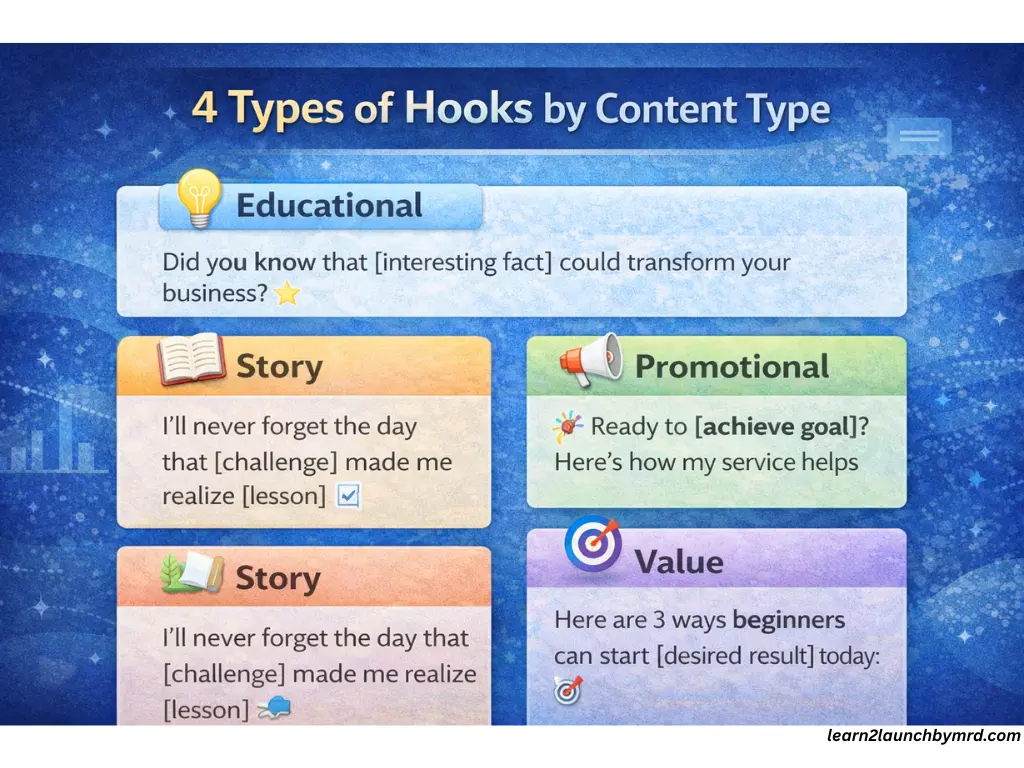
How to match hooks with different content types
Writing a great hook is only half the battle. To truly capture attention, your hook should fit the type of content you’re posting. For beginners, this is a crucial step in content creation for beginners because the same hook won’t work for every post.
Most posts fail because the hook doesn’t match the content. This simple guide shows you exactly how to pair the right hook with the right content type.
Educational posts
Story posts are personal or narrative driven.
Hook tips –
- Lead with a relatable moment
- Spark curiosity about the outcome
- Example: “ I almost gave up on social media…… Here’s what changed everything.”
Stories build trust and human connection, encouraging your audience to engage.
Promotional posts
Promotional posts highlight products, services or offers.
Hook tips –
- Focus on the audience’s problem, not your product
- Tease the benefit
- Example: “Tired of low engagement? This tool can save hours and boost your results.”
When done correctly, promotional posts can convert followers into customers without feeling pushy or forced. It’s about building trust first, then offering value at the right moment, something explained clearly in how to turn social media followers into customers through simple, practical steps.
Value posts
Value posts provide actionable insights, hacks, or inspiration.
Hook tips –
- Open with a bold claim or quick tip
- Make it clear why the reader should continue
- Example: “ Stop wasting time on posts that don’t work – use this simple strategy instead. ”
Value hooks establish authority and encourage sharing.
Key takeaways
- Always match your hook style to your content type
- Educational, story, promotional and value posts each require slightly different approaches
- Thoughtful hooks increase engagement and make your content creation for beginners more effective
When your hooks align with your content, you create posts that are more likely to engage, educate and convert your audience consistently.
A strong hook can be the bridge between social media and your website. When hooks spark curiosity, readers are more likely to click through. This plays a big role in how to get traffic to a new blog, especially when social platforms are your primary traffic source in the early stages.
Hooks matter visually too , especially on platforms like Pinterest where users scan quickly. Learning how to drive website traffic from Pinterest becomes easier when your pin titles and descriptions use hook principles that trigger curiosity while staying clear and relevant to the content behind the click.
How often should you change your hook style?
As a beginner, it’s easy to feel stuck trying to find the “ perfect ” hook. The truth is, there isn’t one fixed style that works for every post. Instead, you should focus on testing hooks and adjusting based on results.
Test your hook
- Experiment with different openings, tones and formats
- Track which hooks get the most engagement
- Learn from what works and repeat successful patterns
Testing helps you understand your audience while building confidence in your writing.
Avoid burnout
Switching hooks too often can feel overwhelming. Stick to a few formulas or styles that resonate with your audience. This keeps your content manageable and ensures you don’t burn out. For more tips on maintaining balance while posting regularly, see how to stay consistent on social media without burnout.
Consistency VS creativity
Consistency is key for growth, but creativity keeps your posts interesting. Find a balance by,
- Using a consistent hook framework
- Adding small variations for each post
- Observing what drives engagement
By testing, pacing yourself and balancing consistency with creativity, beginners can improve results without stress, making their social media efforts more sustainable and effective.
One well written hook can be reused across multiple platforms when done intentionally. This ties closely to what is content repurposing and how does it work, because hooks allow you to adapt the same idea into Facebook / LinkedIn posts, Instagram reels, Pinterest pins or emails without rewriting everything from scratch.
Frequently asked questions on how to write hooks for social media as a beginner
How long should a hook be on social media ?
A good hook should be short and easy to read, usually 1 – 2 sentences or 10 – 20 words. It needs to quickly convey value and grab attention. Remember, the first line of a post often determines if someone keeps scrolling. For beginners, focusing on clarity over cleverness is one of the most important social media growth tips for beginners .
Do hooks work for small accounts ?
Absolutely! Hooks are effective regardless of account size. Small accounts benefit even more because a strong hook helps posts gain early engagement, signaling to the platform that your content is worth showing to more people. Learning what is a hook in social media content early sets you up for faster growth .
Can I use the same hook for different platforms?
You can reuse the core idea, but it’s best to adapt the hook to each platform’s style. For example, Instagram captions may be longer, while TikTok or Reels need hooks in the first 2 – 3 seconds. Adapting hooks ensures they remain attention grabbing across formats.
Are hooks same as the clickbait?
No. Hooks are not clickbait. Clickbait exaggerates or misleads, often causing distrust. Hooks are designed to capture attention honestly by showing relevance, curiosity or value. Using hooks ethically builds trust and long term engagement.
How do I know if my hook is working?
Monitor engagement metrics such as likes, comments, shares, saves and watch time. If posts with certain hooks perform better, replicate that style. Testing different formats is a key part of social media growth tips for beginners and helps you refine your content strategy over time.
Mastering hooks to grow your social media influence
Learning how to write hooks for social media as a beginner is one of the most powerful steps you can take to improve your content’s visibility and engagement. Hooks are the gateway to capturing attention, and understanding what is hook in social media content ensures your posts are not only noticed but also valued by your audience.
The best hooks combine clarity, benefit, curiosity, and emotional connection. By avoiding common beginner mistakes, testing different formats and matching your hook to the type of content, you can consistently create attention grabbing social media posts that perform. Remember, even small improvements in your hooks can dramatically increase engagement, saves and shares.
For beginners, this isn’t just a strategy, it’s a shift in how you think about content. When you focus on real value, write ethical hooks, and pay attention to what truly resonates, growth becomes natural. Over time, trust builds, authority forms and long term social media success follows.
Thoughtful insight for beginners
Hook writing isn’t luck, it’s a skill you train. When you start tracking what works, learning from creators who get attention and refining your approach, everything changes. Your content improves, growth accelerates and you build an audience that doesn’t just watch , but trusts you.
Good hooks grab attention, but trust keeps people coming back. Over time, ethical hook writing supports how to build trust on social media as a beginner by setting honest expectations and delivering real value , rather than relying on exaggeration or clickbait tactics that damage credibility.
By mastering hooks , you are not just stopping the scroll , you are shaping attention , building authority and creating content that truly matters.